
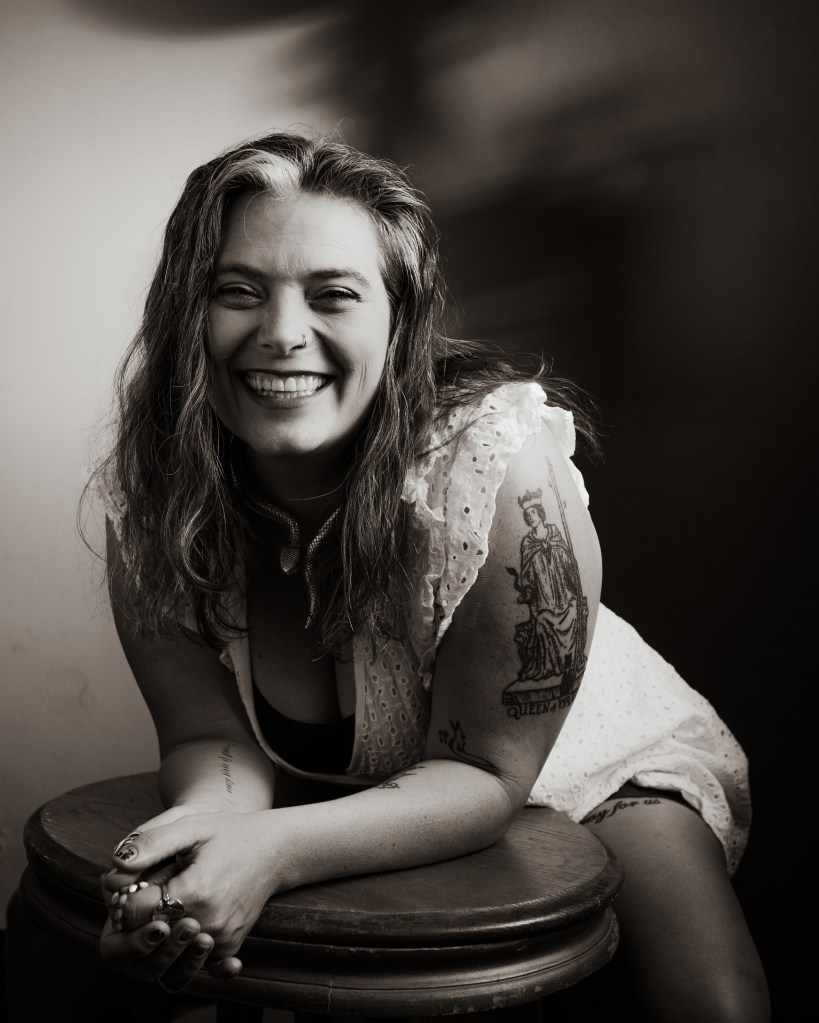
We slip into this interview with Kristen Nelson, on the meditative comfort of “Octavia Butler’s concept, ‘God is Change.’” Women’s writing in the past twenty years for Nelson has taught her to be ‘brave’. Explaining, “Female, transgender, non-binary, and BIPOC writers have come up against the towering white male wall of the cannon and rather than try to scale it, they’ve veered off in different directions.” Kristen Nelson dances across labels and genres, playfully considering herself to be a ‘genre-queer’ writer, or perhaps a ‘genre-slut’ expressing her deep commitment to “queerness, experimentation, magic, and play”.
In this second interview, we visit Kristen’s second full length poetry book, In the Away Time, out from Autofocus Books, ‘24. The collection, although raw and present, is written about an intimate breakup that took her the length of ten years to write; intimating first the experience of the wound, and then writing from the scar. The book embraces ‘the away time’ and answers how to “let go of the hope after a promise is broken”. It looks at the, “painful pulling back and reabsorption of the mangled or blossomed” parts of the relationship. But also, how queer communities ‘shift’, “through different containers of relationship”. In this way,” resisting ownership in relationships” and “heteronormative paradigms”. Ultimately illustrating how to “[stand] back up after you’ve been taken to your knees.”
Kristen E. Nelson is a queer writer, scholar, and performer. She is the author of two books In the Away Time (Autofocus Books, April 2024) and the length of this gap (Damaged Goods, August 2018); and two chapbooks sometimes I gets lost and is grateful for noises in the dark (Dancing Girl, 2017) and Write, Dad (Unthinkable Creatures, 2012). She has published creative and critical writing in Feminist Studies, Bombay Gin, Denver Quarterly, Drunken Boat, Tarpaulin Sky Journal, Trickhouse, and Everyday Genius, among others. Kristen founded Casa Libre en la Solana, a non-profit writing center in Tucson, Arizona, where she worked as the Executive Director for 14 years and co-founded Four Queens, a platform for divinatory poetics with Selah Saterstrom. Kristen is currently a Ph.D. candidate and instructor of creative writing at the University of California – Santa Cruz in the Literature Department’s creative/critical writing concentration. Her current research centers on Creative Writing, Divinatory Poetics, Feminist Autotheory, and Witchcraft Studies.
Websites:
Fleshing the Archive of Witches
- What were the first inspirations that made you desire to become a writer?
Same answer as I wrote to you in 2012! [gosh that’s a long time ago]
- Who have been mentor writers in your career?
There are so many folx who have mentored me in my writing career. I’m thinking about mentors in three categories. First, my peers, friends, and beloveds in my writing community; Second, teachers and guides who have supported me over the years; and third, writers who taught me to write with their writing. First, my writer friends are the folx who have read my work, remind me that I’m good at this when I falter, bolster me through rejections and celebrate my successes: Selah Saterstrom, TC Tolbert, Hannah Ensor, Jenna Korsmo, Kristi Maxwell, Teresa Carmody, CA Conrad, Julia Saterstrom, Maggie Zurawski and others. In the second category, I wouldn’t be the writer I am today without guidance from Andy Solomon, Rebecca Brown, Bhanu Kapil, Rachel Pollock, Anne Waldman, Susan Stryker, Micah Perks, Ronaldo Wilson, fahima ife, and Vilashini Cooppan. The third category is vast and deep and grows every year. It’s hard to name ALL of the writers whose work has influenced me, but in addition to everyone I have listed already, I would add Carole Maso, Sophie Calle, Saidiya Hartman, Audre Lorde, Lidia Yuknavitch, adrienne maree brown, and so so so many others.
- How has your own work changed over time and why?
The last time you asked me this question, in 2012, I ended my answer with this line: “My work has been more influenced by loss, grief, and the body as my life has become more concerned with these topics.” This is still true, plus 13 more years of leaning into these topics. And also, I’m producing a lot more critical writing than I used to, primarily feminist autotheorical essays.
- Have you been influenced by different genres, and if so how?
I’ve always been a cross-genre writer, finding excitement and inspiration in the liminal space between poetry and prose. But these days, I’m also working in the liminal space between creative and critical writing. I’m interested in what happens when you combine creative writing, research, and theory in different ways. I started my career writing mostly short stories. In my MFA program, I shifted to work that looks more like poetry. I’m still writing poetry and don’t think I will ever not write poems, and also I’m writing a book that looks more like prose now.
- What are your plans for the future?
I’m a fourth year PhD student at UCSC where my research focuses on Creative Writing (specifically poetry, creative non-fiction, and divinatory poetics), Feminist Autotheory, and Witchcraft Studies. I am very focused on writing my dissertation and finishing my degree in the next few years. My diss is a combination of essays about witchcraft and a creative non-fiction manuscript called The Witches of Benevento. It draws inspiration from my ancestral stories and the legends of witches that have surrounded my ancestral home of Benevento, Italy for centuries. Beyond finishing this degree and book, I’m not sure. I never believed that I would leave my 20-year beloved home in Tucson, until a pandemic happened and I left to pursue this degree. I’m not sure what the world is going to look like in a few years and what our country will look like in a few years. Will it still be safe(ish) for me as a queer woman to live in the United States? Will the humanities still exist in academia? Will there be a job for a queer creative writer? Will academic institutions still exist with all of the federal funding being cut by the current administration? I’ve been taking comfort in Octavia Butler’s concept, “God is Change.” So rather than make gods laugh by planning, I’m learning to embrace change and stay in the now until I have to move on to the next now.
- What are your views on writing by women as it has occurred in the past twenty years?
I think writing by women in the past twenty years has taught us all to be brave. Female, transgender, non-binary, and BIPOC writers have come up against the towering white male wall of the cannon and rather than try to scale it, they’ve veered off in different directions. With these new paths, they’ve stretched and manipulated genre, given credibility to writing about pain, language, and the body, and have continued to be brilliant, thoughtful theorists. There is no going back to a time when women’s voices, transgender voices, non-binary voices, and BIPOC voices were silenced. I include a variety of identities in my response here first because gender is fluid, and second because I believe it’s important to acknowledge all of us who have been comrades in this movement of expansion and bravery.
- Who are promising women writers to look at in the future?
The world is burgeoning with women writers to look out for. I find new voices to be excited about every day! I’ve gotten to know some incredible writers and their writing since moving to Santa Cruz and folx I’ve met during my recent book tour. Keep your eyes peeled for writing by Annika Berry, Melissa Mack, LuLing Osofsky, Maria Pachon, and all of the other creative writers at UCSC. I’ve been particularly excited about the first books of poetry by Hannah Kezema (This Conversation Is Being Recorded)and Emily Mundy (What Blooms in the Dark).
- If you were asked to create a flexible label of yourself as a writer, what would it be?
It’s taken me far too long to answer this question…I think at this point “writer” is the label that is the most flexible and most accurate. “Queer writer” describes me with more accuracy, and “poet” is a label I will always use to describe myself. I wish there was a term for writers that holds the same space as “queer” does in the LGBTQIA+ community. Something that signals, hey I’m a creative writer who writes in multiple genres, and across genres, and in-between genres and I’m interested in stretching the containers of genre while also deeply loving all of those genres. Also, I’m deeply invested in queerness, experimentation, magic, and play. How about Genre-Queer? Or what about Genre-Slut? Can I claim that without offending too many people? When you look into the etymology of the word slut, you find words like wanton, dirty, muddy, idle. I like those words. I’ll probably have a different answer tomorrow, but let’s go with Genre-Slut today.
- In the beginning of the novel we face a break up. We read, “Now: You are gone. Poof. / Keyser Söze. // I had forgotten: Love exists in pain or right beside it. Love remains despite the absence of the beloved. / Fuck.” (12) There are different ways in which we cope with loss; from a spiritual lens or a psychological one. Attachment theory or perhaps a nervous systemantum entanglement, the later of which requires the falling away of boundaries. How do you relate to each of these ideas in this sense of love and loss in your book and what are your personal views on the topic of love and attachment and our process of healing?
I love that you refer to this book as a novel. You’re not wrong—it is a book-length narrative. I have been thinking of it as a prose poetry collection, but I like the word novel, too. Your question made me think of Barthes, A Lover’s Discourse, “Language is a skin: I rub my language against the other. It is as if I had words instead of fingers, or fingers at the tip of my words. My language trembles with desire. The emotion derives from a double contact: on the one hand, a whole activity of discourse discreetly, indirectly focuses upon a single signified, which is ‘I desire you,’ …” I think that when two people fall in love there is a third entity that is created: the relationship. When that third entity dies, there is a painful pulling back and reabsorption of the mangled or blossomed or enlarged or shrunken or otherwise changed parts of you that made up the relationship. Sometimes you have to shore off a finger/word or a word/finger that is too changed to become a part of the whole again. It is a painful process of healing what can be healed and releasing what needs to be let go. When I was writing this book, my book companion was bell hooks’s All About Love, in which she writes, “The practice of love offers no place of safety. We risk loss, hurt, pain. We risk being acted upon by forces outside our control.” Boundaries get necessarily tangled in this act of risk, this act of dependency. If a relationship grows into a durational healthy relationship, it is because the two individuals chose to work on healthy boundaries and to avoid codependency. If it ends, to some extent, they did not. One of the things I love about being queer is the normalization in my communities of shifting through different containers of relationship until you find the right one for that individual connection. It’s not unusual to date a friend, who might become a partner or evolve back into friendship or even a family member. Resisting ownership in relationships is one of the ways we resist heteronormative paradigms. Some of my closest friends are partnered with beautiful humans that I dated, some of my “failed” romantic relationships evolved into close friendships. I think the most painful breakups for me are those relationships that simply end. There is nothing, in fact, simple about an ending when there could have been an evolution.
- The stages of loss are anything but linear. Wounds provoke us to face ourselves, beliefs; our shadows. And in this passage, we also must take action beyond just knowing, turn inward to address ourselves. We read, “I get drunk every night. I think of you—your physical. I cannot breathe. … it would be easier to die. Right now, I die.” (27) But also, the opening sentiment you lead with the book is, “I made a choice to ignore the one bleeding beside you, ‘She is going skinny-dipping. Wanna come?’.” Can you speak more to this notion of knowing and action and how this book took part in this process of healing.
I do not think that writing this book healed me, but I sure did hope that it would. It took me about ten years to write this book. I started writing it from the wound, then I healed me, and then I came back and finished this book from the scar. In the Away Time started as a daily journal I kept during the six months after an excruciating break up a long time ago. One of those breakups which ended a connection that I thought could have been evolving and life-long. I kept that journal in order to continue a discourse with my lover (which Barthes tells us is always a conversation with the self) that I was not ready to end. I would not have published the journal as is, because it was not art, it was not poetry, it was a break-up journal. Thinking with Sophie Calle’s project Exquisite Pain in the years afterward, I collected stories from friends, acquaintances, and strangers about their excruciating breakups. I took some bits of the journal, wove in bits of these stories and tried to tell the story of a universal pain. I do think it is healing to write, to read, to listen to the narratives that reflect our own exquisitely painful experiences. If nothing else they make us feel less alone in our pain.
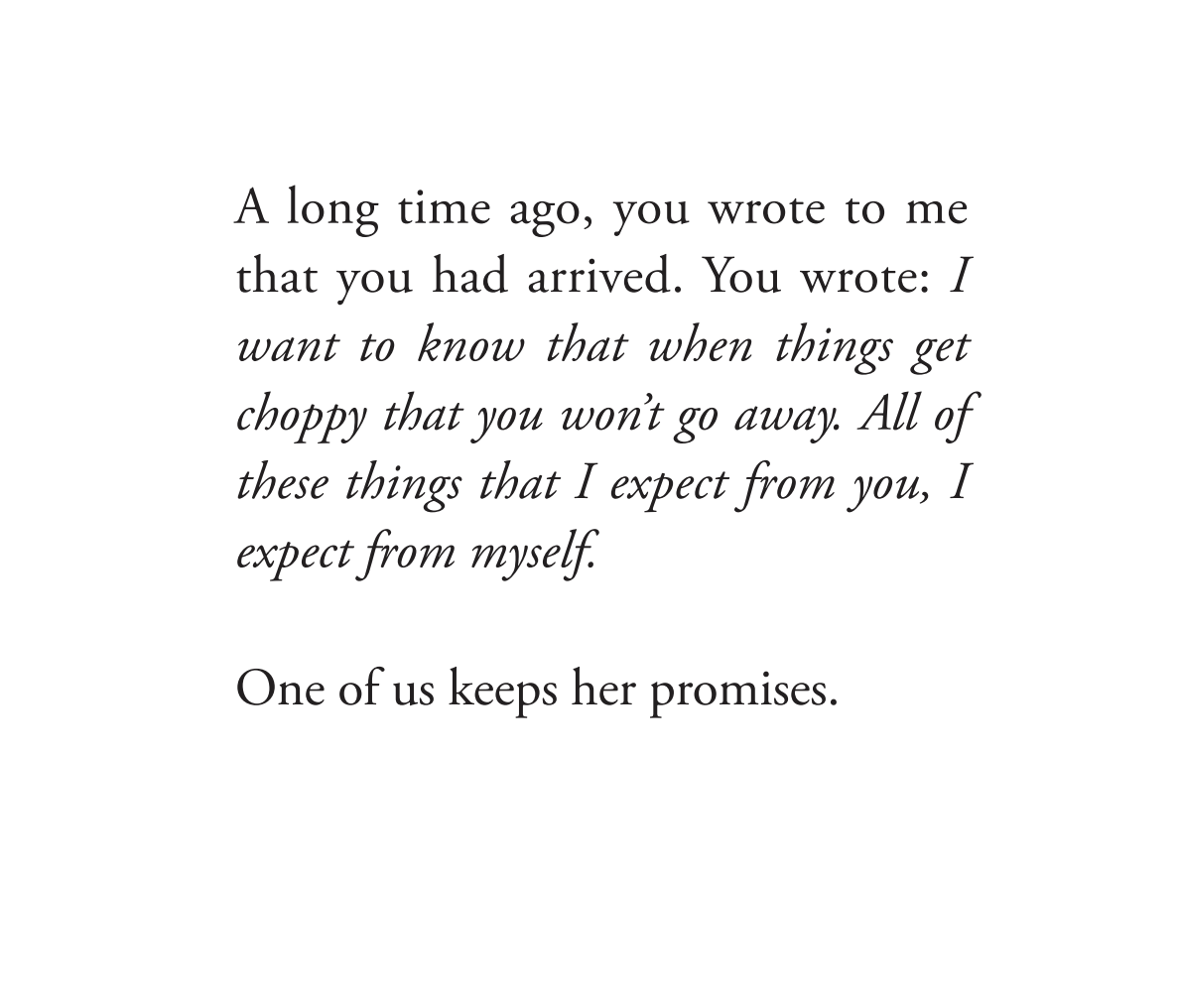
- Desire, obsession, and grief; the chaos of the loss break down the structure of the ideal. We slip into intimacy, “I took a bath last night or was it two nights ago? … I laid a Monk snake shed across my neck. // Let go / Let go / Let go / Let go / Let go / Let go / Let go.” (56) And then after a long silence, you cannot. But this obsession transforms into a powerful sentiment in a memory you have of a conversation where it is revealed that, “I want to know that when things get choppy that you won’t go away. All of these things that I expect from you, I expect from myself. / One of us keeps her promises.” (81) How do you hold these sentiments, that you were taken to your knees. And at once also, held this promise?
I think what you are describing here is a central impetus of writing this book. There are some universal truths when someone is left “in the away time.” What I mean to describe with my title is the liminal space when one beloved says to another that they need some time and space, but do not offer the clarity of an ending. How does one let go of the hope after a promise is broken? How does one trust that that promise was true, but is not true anymore? How does one move through the process of healing when the beloved is gone, just gone—no communication, no explanation, no opportunity for questions and answers. After years of love, promise, and hope, you now sit with the slow fading of those things and then with absence. How do you let go without knowing for sure that the other wants you to let go? At some point you have to make a decision to do what you need in order to claw your way out of “the away time” you have been left in. The book is my answer to your question, or at least it is a book-length description of how to sit with these based on my own experiences, the experiences of others who shared their stories with me, and queer models of loving. I hope people feel less alone in their grief when they read it. Of course, this book is not a comprehensive or direct reflection of my experience. In real life, I was intentionally celibate for a year after my relationship ended. In real life, I spent a lot of time in therapy processing this sudden absence in my life. In real life, I shifted deeply into avoidant attachment strategies and it took me years and years to trust another beloved. In real life, I spent years engaging in romantic relationships, only if they had clear expiration dates in order to keep myself safe. At least in these relationships, I could be sure of an ending. I gesture towards some of these things in the book, but I don’t directly address them, because this book is an experiment in autobiography—something crafted from, but not a direct reflection of, my real-life experience. I think it comes across in the book that this relationship fucked me up big time, but I hope it also offers some reflections on standing back up after you’ve been taken to your knees.
BNI
 womens quarterly conversation