profiles in poetics: Denise Duhamel

“How do we honor our mothers after they have passed? The person, the legacy, the body, after death? This interview is not meant to address the failings of motherhood, but rather, as Denise Duhamel states, “maybe Pink Lady is about my look at the female body—its capacity to do so much in a lifetime.” … (intro)

wqcs are now active on substack 🌷this journal is supported by its readers. subscribe & if you enjoy, give a 🩷 & please support.

upgrade for access to the full archive; writing lessons from the authors (that accompany their interview) and me, plus reading notes. 

🌻 straight to the interview 

thank you for being here 🙏

xxo, jillian

BNI

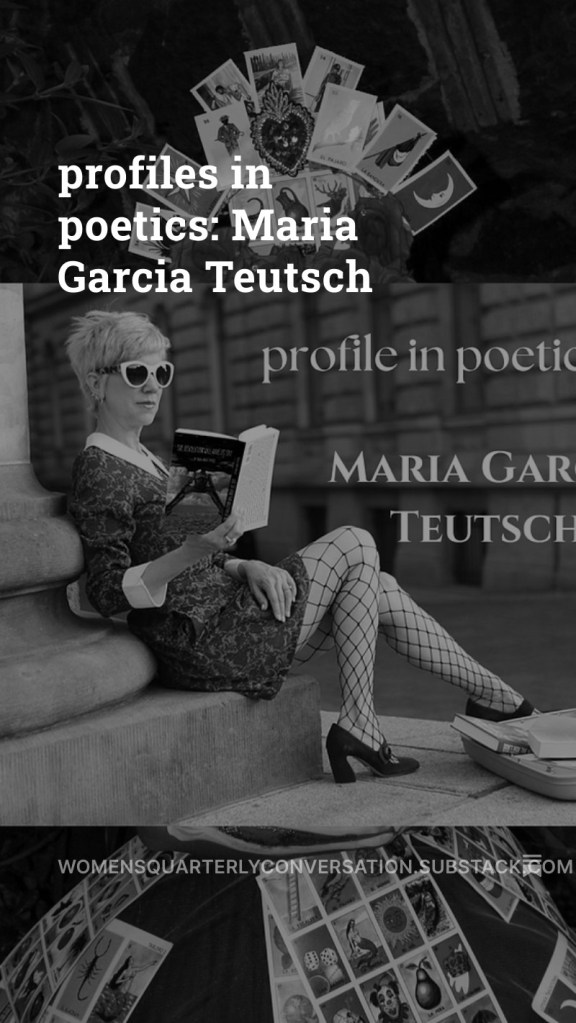
profiles in poetics: Maria Garcia Teutsch (II)

“… In What She Saw in the Lotería Cards, we discuss the Loteria’s close historical origin to Tarot, Maria’s process and ritual, and the roots of her Mexican and Southern Gothic Heritage. Here we can see how syncretism works with her Mexican Catholic and Protestant upbringing in a blend that reimagines La Loteria; lyrics of life, of warmth, family, and passion. And valuing, as she states, “its paradoxes of strength and oppression, silence and voice, nurturing and resistance.” … (intro)

wqcs are now active on substack 🌷this journal is supported by its readers. subscribe & if you enjoy, give a 🩷

upgrade for access to the full archive; writing prompts from both the authors (that accompany their interview) and me (the interviews I share from the archive). 

🌻 straight to the interview 

thank you for being here 🙏

xxo, jillian

BNI

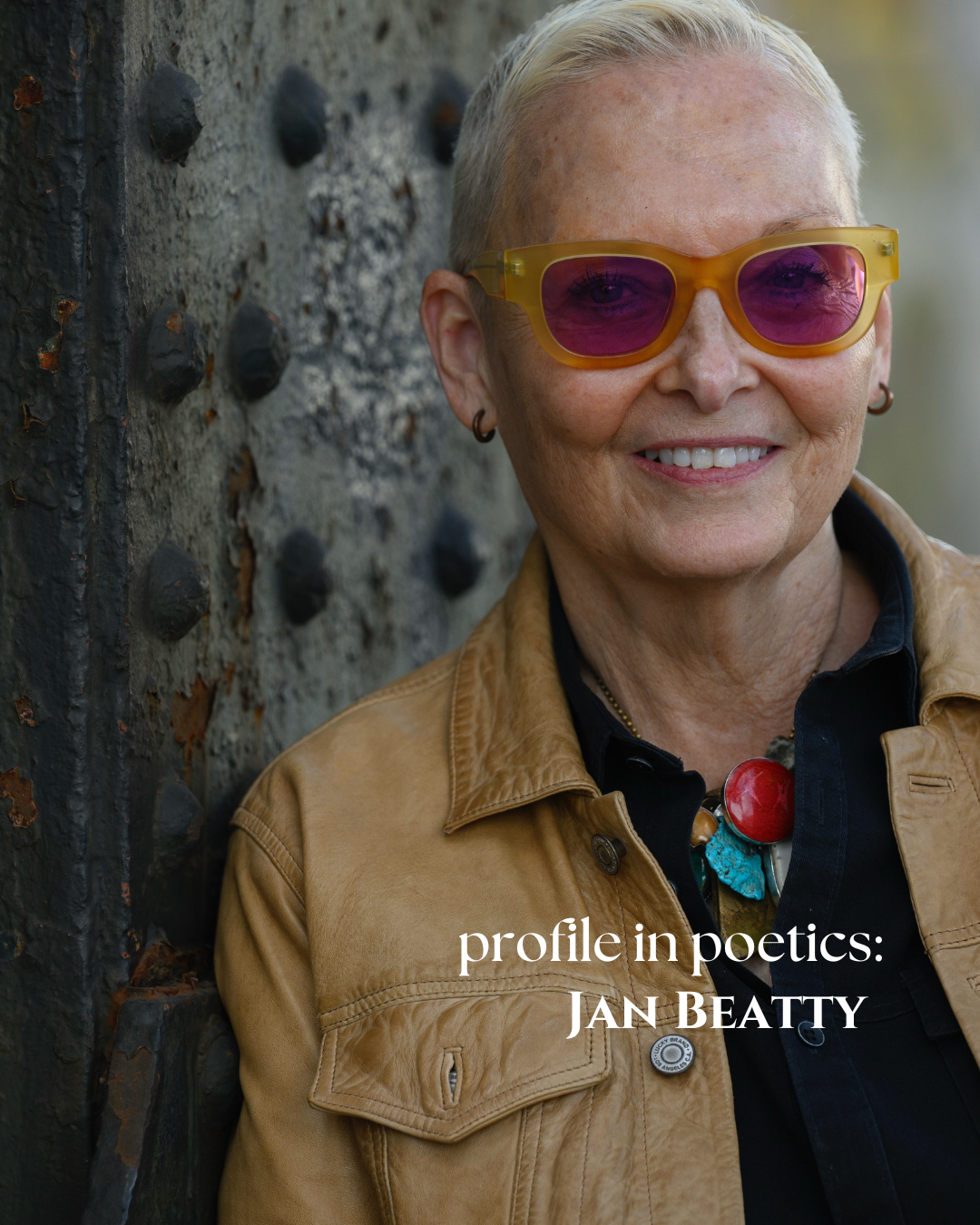
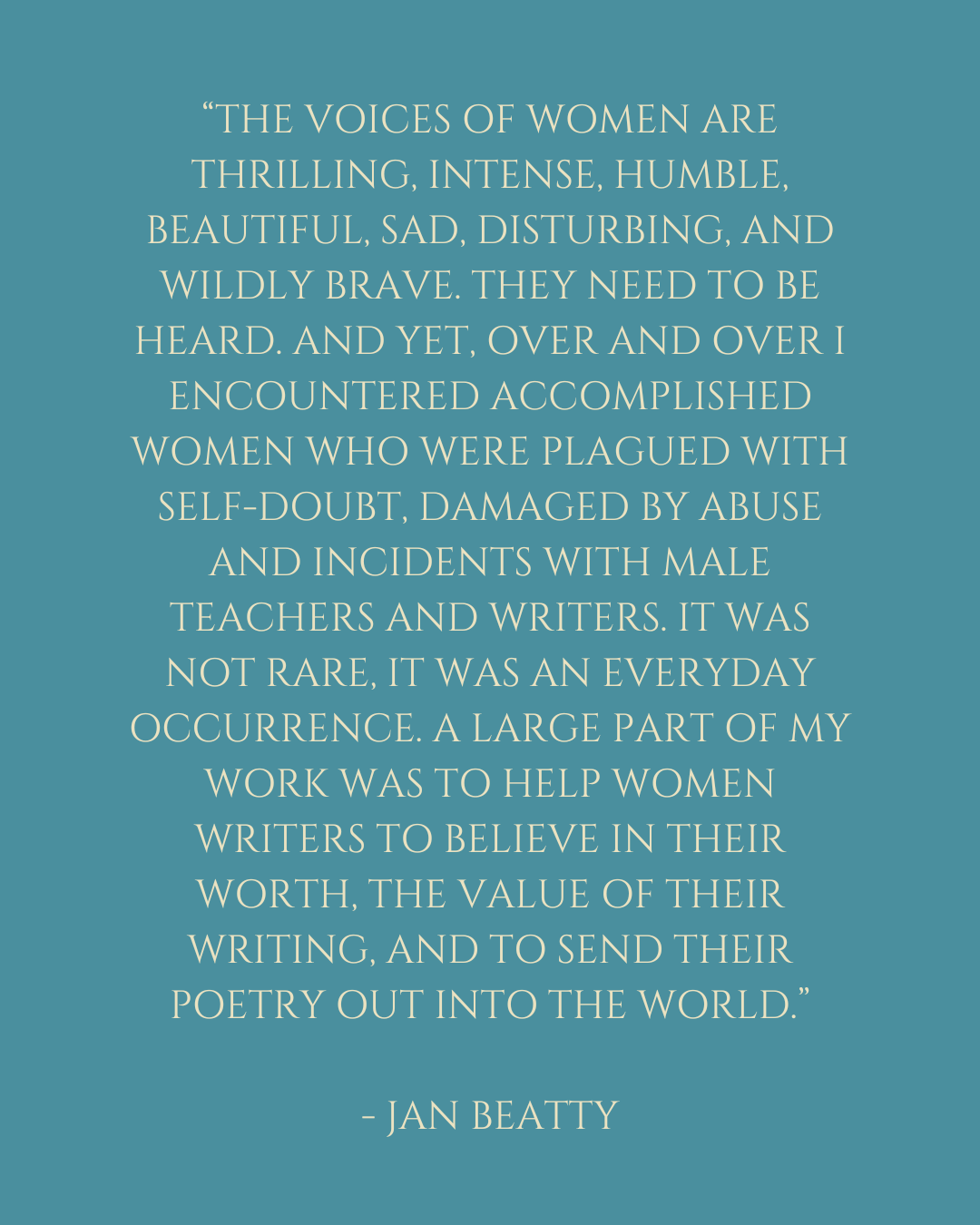
profiles in poetics: Jan Beatty

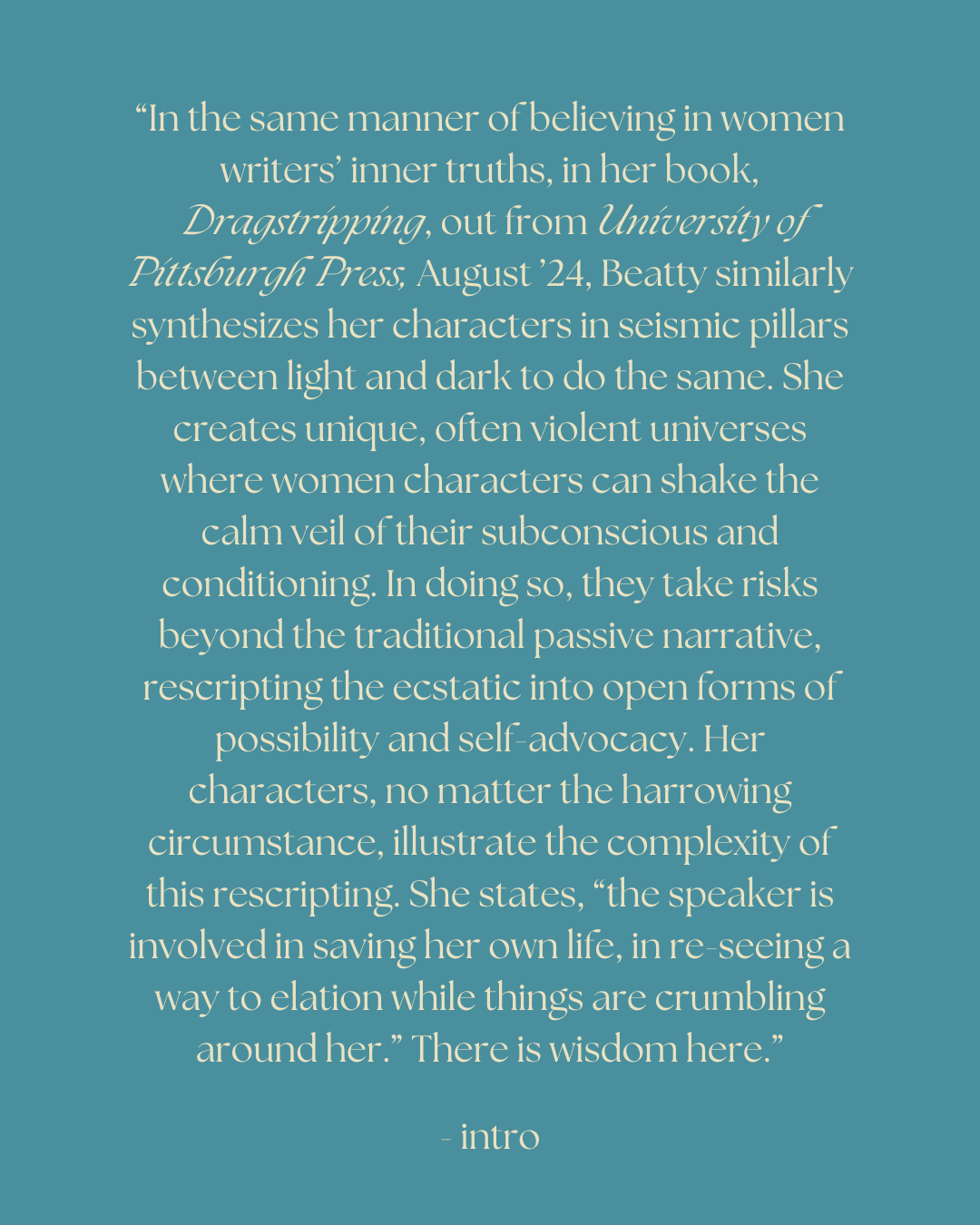
“… In the same manner of believing in women writers’ inner truths, in her book, Dragstripping, out from the University of Pittsburgh Press, August ’24, she similarly synthesizes her characters in seismic pillars between light and dark to do the same. She creates unique, often violent universes where women characters can shake the calm veil of their subconscious and conditioning. In doing so, they take risks beyond the traditional passive narrative, rescripting the ecstatic into open forms of possibility and self-advocacy. …” (intro)

wqcs are now active on substack 🌷this journal is supported by its readers. subscribe & if you enjoy, give a 🩷

upgrade & gain access to the full archive; writing prompts from both the authors (that accompany their interview) and me (the interviews I share from the archive).

🌻 straight to the interview

thank you for being here 🙏

xxo, jillian

BNI

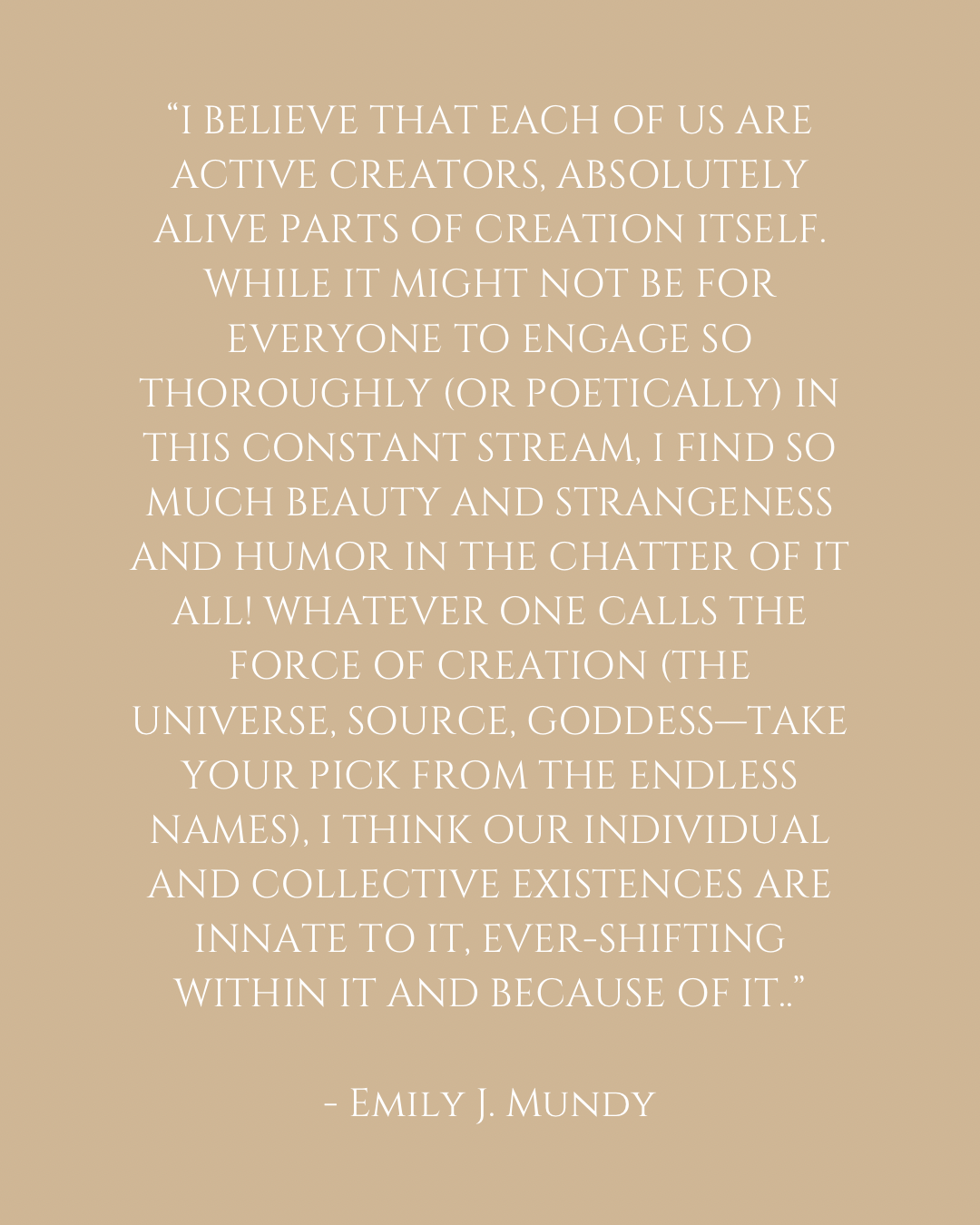
profiles in poetics: Emily J. Mundy

“The tiniest leaf is to be — words within a storm of, “perpetual growth, and release, and renewal.” It falls like small button candy into a sea, the reflection of an “externality of cycles and nature. … ” intro

womens quarterly conversations are now on substack 🌷this journal is supported by its readers. subscribe & if you enjoy, give a 🩷

upgrade & gain access to the full archive; writing prompts from both the authors (that accompany their interview) and me (the interviews I share from the archive).

use for your own pleasure, for teaching tools, learn and share with your friends. as a paid subscriber you also have access to direct feedback and coaching through a deep dive with me in each interview. more teaching and coaching opportunities are available via DM. not sure? try it 🙂 I added referral incentives.

🌻 straight to the interview

to the magnificent awareness in each of us 🙏

xxo, jillian

BNI

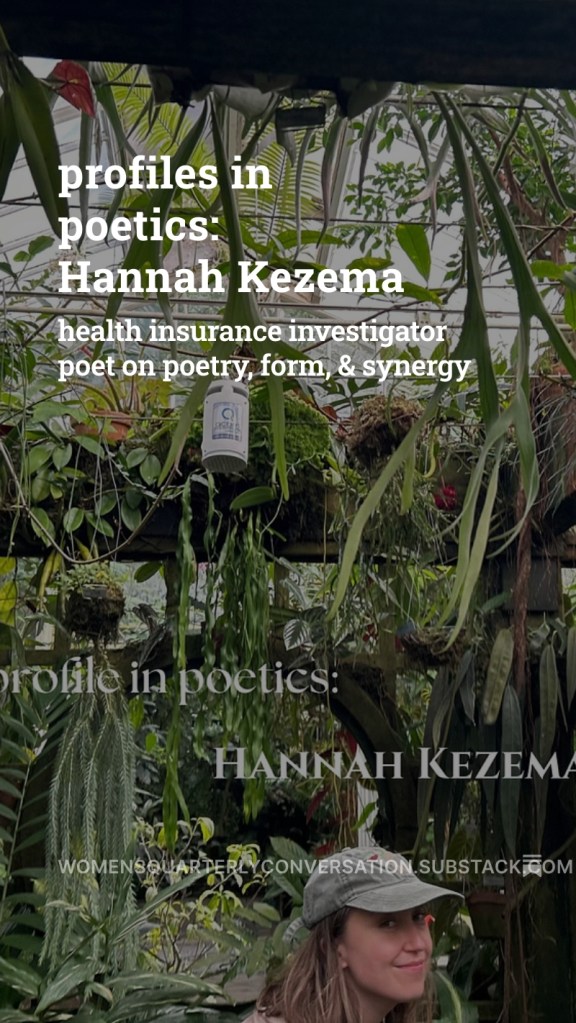
profiles in poetics: Hannah Kezema

womens quarterly conversations are now on substack 🌷

this publication is supported by its readers. I would encourage you to follow as a free or paid subscriber✨

free subscribers have access to the full archive, ad – free and notes 🙏 paid subscribers support the time & work put into this publication and have access to a personal writing prompt from the interviewee that accompanies each interview, as well as the full prompt archive. as a paid subscriber you also have access to a deep dive with me into the interview ✨

join us 🌷click on the picture or here 🌸 to direct you straight to the interview, and click here 🌼 to the writing prompts & dd.

thank you & joy 💖

jillian

BNI

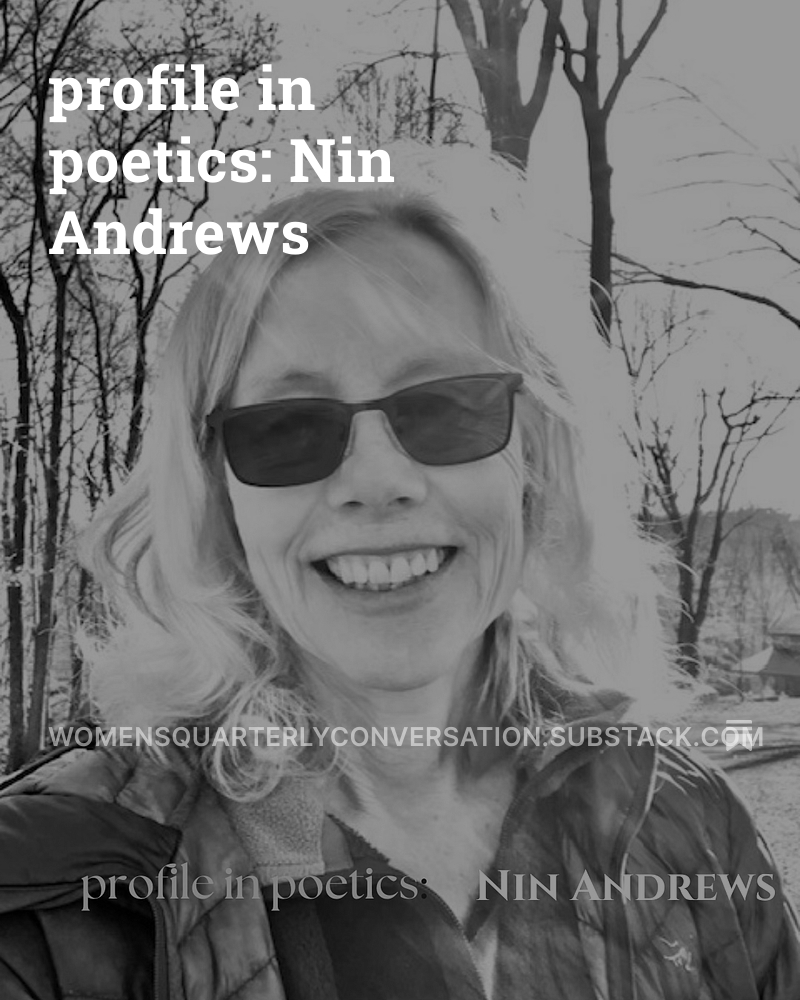
profiles in poetics: Nin Andrews

womens quarterly conversation interviews are now on substack 🌷

free subscribers have access to the full archive, ad – free 🙏 paid subscribers support this publication and have access to a personal writing prompt archive that accompanies each interview ✨

I merged some of you but not all 🌷click on the picture or here 🌸 to direct you straight to the interview, and click here 🌼 to the writing prompts.

thank you & joy 💖

jillian

BNI

profiles in poetics: Caryl Pagel

Pagel-PhotoCaryl Pagel

Websites:

h-ngm-n.com/twice-told/

www.rescuepress.co/

factoryhollowpress.com

From a tiny red notebook, Caryl Pagel watched “improvisational tales unfold in real time”. This act taught her to receive things that “stun her” in a thinking map delineated by structures of physical manipulation in which the brain tucks and pockets content. Twice Told,recently published by H_NGM_N Books, is a flexing flock of poems that gather “the vision and presence of another”.  She states, “To read or listen carefully is—at its best—to inhabit the vision … of another.” The present receiver is altered by the interaction; a multiplication of the self that bears memory, passion, and perspective simultaneously. This metamorphic narrative changes our tales, our recollection; the internal structure of our self-identity. Another associated circumstance with embracing other is empathy. These empathy exams can, if one is not careful, “eventually make a wreck of you,” although at the same time this act carves out parts of yourself for others to find comfort; essentially the same places that you yourself are seeking as well.

The concentrated loop of Twice Told has much to do with the life and death cycle. The repetitive notion of life in a concentric dream is each individual’s interpretative taste. So the reflection of our reception of these qualities shifts from each story, each evaluation; each interaction. As Pagel asks, “how much care is too much? And for what end, and to what purpose?” This “captivation” is savory, but also needs to be regarded with self-care so that the self is not swallowed up in the other. She asks, “Is care the clearest expression of love? How is it related to freedom? What is the right amount of care for someone who is sick, or in danger, or angry, or depressed? Does requited care matter? Can you harm yourself with care for others?” These questions are at the heart of Twice Told. The answers are by no means readily handed to you on your grandmother’s holiday china. They are ones of endless vision. Perhaps the central message is in the permutation of circles.

Caryl Pagel is the author of two books of poetry: Experiments I Should Like Tried At My Own Death (Factory Hollow Press, 2012), and Twice Told (H_NG M_N Books, 2014), as well as the chapbook Visions, Crisis Apparitions, and Other Exceptional Experiences (Factory Hollow Press, 2008). Caryl is a poetry editor at jubilat and the co-founder and editress-in-chief of Rescue Press. Her poetry and essays can be found in AGNI, The Iowa Review, Jacket2, The Mississippi Review, and The Volta. This fall she will join the faculty of the NEOMFA program in eastern Ohio and serve as the Director of the Cleveland State University Poetry Center.

.


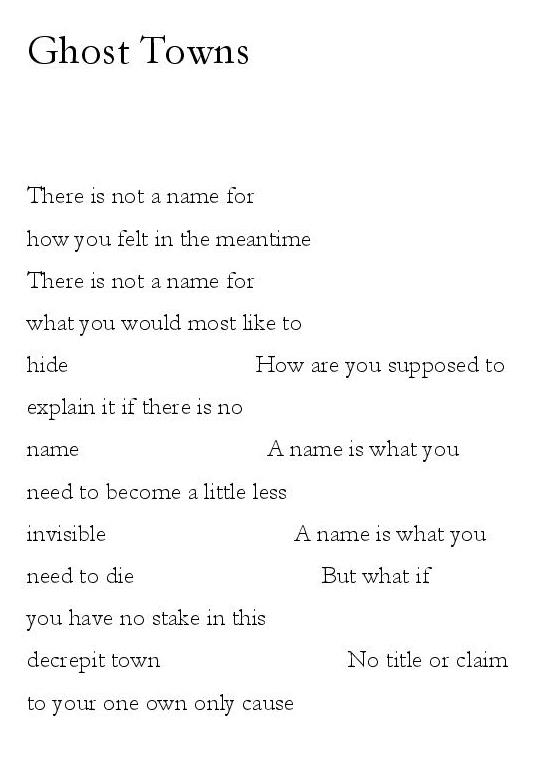
Ghost Towns-page-001


.

. What were the first inspirations that made you desire to become a writer? Who are your favorite writers and how did they change over time?

When I was little my dad had, or I remember he had, a tiny red notebook that he’d scribble stories in. This is how I learned to read: by watching improvisational tales unfold in real time. We’d practice sentences as he invented them, creating a secret (so I thought) tether between the two of us. I was extremely disappointed when in kindergarten all of the other children began chanting the alphabet and I realized that language was a public and communal tool, not a private puzzle between me and my Pops. Once I recovered from this minor trauma I knew that I wanted to write. A few of my all-time favorites are Inger Christensen, Emily Dickinson, Lorine Niedecker, and W.G. Sebald. They are compelling in part because as I have changed my relationship to their work has become increasingly bewildering and bizarre.

. Who have been the creative inspiration / mentor writers in your career?

The teacher who altered everything was Dan Beachy-Quick, who I was lucky enough to work with at the School of the Art Institute of Chicago about a decade ago. Others whose conversation, presence, and practice have transformed my approach to writing are Amy Margolis, Amber Dermont, Robyn Schiff, Emily Wilson, Elizabeth Robinson, and Madeline McDonnell.

. How has your own work changed over time and why?

My work shifts every time I read something that stuns me. I am frequently impacted by sentence structures or sound, by something that physically manipulates the way in which my brain receives content. Most recently an essay I was working on was affected by Renata Adler’s Speedboat.

. Have you been influenced by different genres, and if so how?

Absolutely. The poems in Twice Told engage the creepy gothic narratives that I (we all?) grew up re-reading and obsessing over: “A Death in the Woods,” Rebecca, Wuthering Heights, Ethan Frome, “The Tell-Tale Heart,” The Haunting of Hill House, etc. These days I probably read more fiction and nonfiction than I do poetry and most recently I’ve been writing essays. I should also say that one of the greatest gifts to my practice has been the opportunity to work alongside visual and performance artists at both the School of the Art Institute of Chicago (where I went to grad school) and the Milwaukee Institute of Art and Design (where I taught some of the most inventive students I’ve ever met). The way the makers at both of these schools dealt with perseverance, chaos, humor, form, and difficulty continues to affect the way I write and teach.

. What are your plans for the future?

I’ve been working on a collection of linked essays for a few years now. The most recent one includes rambling on Sir Thomas Browne, addiction narratives, deception, Fleetwood Mac, Kurt Schwitters’ Mertzbau, George’s Buffet, ice patches, and a particularly bleak year I spent in Iowa City. I’m also in the process of boxing up my books in order to move to Cleveland at the end of the summer where I’ll join the NEOMFA faculty and serve as the Director of the CSU Poetry Center. I can’t wait.

. What are your views on writing by women as it has occurred in the past twenty years?

Well, it’s hard to ignore the fact that so many of our contemporary game changers—the most compelling formal innovators, risk takers, experimenters, and thinkers—have been women. I think of the rangy, genre-bending, thoughtful and inventive work of Chris Kraus, Joan Didion, Maggie Nelson, Dara Wier, Renata Adler, Abigail Thomas, Lauren Slater, Claudia Rankine, Eula Biss, Lucy Lippard, Rebecca Solnit, Mary Robison, Sabrina Orah Mark, and Lia Purpura, to name a few. And, too, distinctive first books by wonders like Rachel Glaser, Andrea Rexilius, Suzanne Scanlon, and Hilary Plum. I’ll also say that while I (and every woman I’ve ever known?) have encountered the peculiar horrors of gender bias (such silly insult!) in writing and publishing (M v. W!) my spirits are buoyed by the brilliant lady editors who work so hard to shepherd strong writing into the world—people like Emily Pettit, Sandra Doller, Rusty Morrison, Janet Holmes, Kathleen Rooney, and Joyelle McSweeney, again to name only a few.

. Who are promising women writers to look at in the future?

Some of my recent favorite books are: Hannah Brooks-Motl’s The New Years, Amina Cain’s Creature, Anne Germanacos’ Tribute, Leslie Jamison’s The Empathy Exams, Kiki Petrosino’s Hymn for the Black Terrific, Sasha Steensen’s House of Deer, Bianca Stone’s Someone Else’s Wedding Vows, and Michelle Taransky’s Sorry Was In the Woods.

. If you were asked to create a flexible label of yourself as a writer, what would it be?


. The opening poem, “Old Wars,” in your manuscript TWICE TOLD, negotiates how memory, sense of self, and communication fracture in stifling societal climates. The rupture follows repressive measures. We read, “They were on a dusty / black road being marched to death / and you know this because the / narrator is delivering this information within / a story via another story—a / story told by the same old / woman who may or may not / have existed whom he may or / may not have met on a / train who may or may not / but most likely was a part / of the war             She was not / a hero […] There are no / heroes here.” Could you please allude to how the poem expresses multiplicity in identity, memory as story, and the puzzle as not one of “heroes,” but of “monster and master”?

To read or listen carefully is—at its best—to inhabit the vision and presence of another. Through this process one necessarily multiplies the self and bears many memories (or passions, or perspectives) at once. One can be, in fact, possessed by a story; their very body taken hold of, which is simultaneously a gift and curse. Empathy, although rightly associated with a certain kind of bravery and courage, can also eventually make a wreck of you. A many-selved monster. When writing “Old Wars” I was thinking about (or am at least now thinking about) the ways in which we are transformed by the narratives we read and recall, the ways in which stories become us, and us them, and how one might begin to remember (or suffer) others’ tales as if their own. I’ve long been enamored with writing that acknowledges this act of captivation.

. In “The Traveler,” the opening stanza reads, “The only fact to continue to / bear is suffering and the suffering / itself is what one requires to / exist—it is purely grief that / prevents one from vanishing completely.” Some of us our survivors, some of us are not. The traveler evaluates this wisdom from a stranger, but the intimate encounter surpasses the definition of someone we do not have physical personal history with. How is this poem addressing the personal / public sphere of intimacy and how does this relate to suffering?

I’m fascinated by the role of the traveler, often the first indication in gothic fiction of a framed narrative. In so many 19th century novels, for example, the reader receives the story through a stranger’s point of view. In Wuthering Heights we learn of Heathcliff and Catherine’s tumultuous romance through Mr. Lockwood, a stranger, who hears of it from Heathcliff’s housekeeper. In Ethan Frome, too, the narrative is conveyed by an outsider passing through town who hears it from, if I remember correctly, a shopkeeper. Story as rumor or hearsay; as something that necessarily includes both the personal and public spheres of intimacy.

. In the poem, “Four Dead Men,” we meet four individuals. One man, “He needs someone to circle his / sickness He needs you and only / you to circle his circles and / he needs you and only you / to attend to his sickness.” But the “you” in the poem does not. One man dies from a suicide and returns to help is friend. He has the hope that, “the third dead man— could inhabit again the tone and / humor and luminous brilliant beautiful significant / wonderful loving tortured sorrowful stagnant angry / awesome puzzled tragic hurtful magic difficult / mind of his dear friend during / the time in which he still / survived—when this man was not / yet ill but lived instead to / write about architecture and remarkable buildings.” The juxtaposition of these two life stages presents the desire to embrace the remarkably complex stifling and incredible beauty of our darkness and our light, love and madness, linear and dissonant multifarious experience of both life and death. I am interested in how you pair patriarchy to this conversation? How do you believe the fear and embodiment of death to also be the stimulus to “circle his circles,” not in the approach towards death, but as a vehicle later negotiated in death towards life?

The various circles—“the first of forms,” so says Emerson—that occur in “Four Dead Men” via repetition of subject matter and phrasing mimic an obsessive sense of looping that I found inescapable when writing this book. The cycle of life and death of course and also the circling that occurs in the at-times faulty and obsessive logic or repeated narratives of those who struggle with mental illness or addiction, and how easy it is to—purposefully or not—slide into someone else’s orbit of anxiety. Dependency shifts one’s experience of time, whether that dependency is on another person (many new mothers, so I’ve heard, experience an alternate sense—or speed?—of time after giving birth) or on a substance or idea. I was curious about this manipulation of time as well as the relationship between dependency and care, which is perhaps an idea related to your question about patriarchy. How do women—willingly or accidentally or reluctantly or forcefully—inhabit care-giving roles that threaten independence or creative autonomy? I have no answers, only more questions, some of which were the impetus for “Four Dead Men,” such as: how much care is too much? And for what end, and to what purpose? Is care the clearest expression of love? How is it related to freedom? What is the right amount of care for someone who is sick, or in danger, or angry, or depressed? Does requited care matter? Can you harm yourself with care for others? And on and on. You see the loop. I was also at this time steeped in the work of Thomas Bernard, who I find to be a fascinating writer, and whom I had just discovered was a hero of my hero, W.G. Sebald. In part this poem responds to fictional relationships in his novel Correction. I was interested in investigations of the disturbed, addicted, possessed, and pathological, and how those investigations might be expressed through relentless and oppressive sentences, creating—through endurance, doubling, recollection, endless revisions of thinking, second-guessing, and duplication of phrasing—ripples of paranoia and a sort of frenetic or frantic engine.

profiles in poetics: Renee Angle

DSC_0064Renee Angle

Websites:

The Volta

Renee Angle’s poetics ground immanence in a braid of corporeal plateaus that are connected to the fable and non-sequential congruence of the soul. Here we question what it means to witness. Can we possess witness or the voice of a child? And in the field of the poem how are interchangeable freedoms unable to “lose their souls”? These questions, Angle describes are at the center of her manuscript The Orphans.

The Orphans poems cohere because they don’t fit. This interview identifies the trauma that one can experience in language and how this merges fluidly into a Deluzian denial of transcendence. Here, “truth and absurdity (the absurdity of truth),” are distinctly malleable from the inside out. In this respect, “childhood is no longer of the future, each thought is or is not an orphan, ‘parents,’ if they exist, are interchangeable, temporary, fragmented, gutted of their middles, which is middle too.” There is admittedly “insufficiency” here and yet, the soul is retained. The witness is not a choice, yet it exists.

Renee Angle resides in Tucson, Arizona where she works for The University of Arizona Poetry Center. Her poems have been published in The Volta: Heir Apparent,DiagramPractice New Art + WritingSonora ReviewEOAGHI’ll Drown My Book: Conceptual Writing By Women, and in the chapbook Lucy Design in the Papal Flea (dancing girl press).

.

EXCERPT FROM-page-001

.

1.)    What were the first inspirations that made you desire to become a writer? Who are your favorite writers and how did they change over time?

I know it gets said a lot, but I didn’t desire to be a writer, I just sort of was.

2.)    Who have been the creative inspiration / mentor writers in your career?

Wallace Stevens, Stevie Smith, Frank O’Hara, William Carlos Williams, Sor Juana Inez de la Cruz, Laura (Riding) Jackson, Djuna Barnes, and many, many others.

3.)    How has your own work changed over time and why?

I hope that my work has become more focused, crystalized, and intentional. In terms of process, I now spend time devising contratints/methods to thwart ingrained habits whereas before I was cultivating habits. I spend time trying to forget what I’ve learned.

4.)    Have you been influenced by different genres, and if so how?

I try not to classify books by genre when I read and when I write I try to have the same mindset. I don’t think texts have genres—we give texts genres–and so in that way, while they can be helpful classifications, they are very artificial and more about marketing than anything else. I’ve thought about how both of the words genre and gender come from the same root. They both mean “kind.”

5.)    What are your plans for the future?

I’m working on a play about motherhood as an act of plagiarism, a YA novel about child labor and the Great Pacific Garbage Patch, and a novel based on a 7 hour movie based on a novel in Hungarian.

6.)    What are your views on writing by women as it has occurred in the past twenty years?

I’m very pleased and inspired that there is so much wonderful work being written and that I have so many good examples to draw from even before I sit down to write.  My general reaction is “more,” I want more.

7.)    Who are promising women writers to look at in the future?

Honestly, I read mostly dead poets. I also think most third and fourth graders have a lot of contemporary poets already beat.

8.)    If you were asked to create a flexible label of yourself as a writer, what would it be?

Writer. I sometimes like artist.

9.)    In the poem, “WITNESSED,” we pull the poem apart in the fashion of a fairy tale. For instance, “the way the blade can cut the length you like. and then there’s red. red can cut the same. crop circles with circumference built in, or the line established to help you do the math.” The poetic line manifests a feeling of linearity while it is also alluringly an invitation to untriangulate and play with the message. The poem ends, “climb in the bed made of the alternative comfort of the hearted. her circle skylight. able to wish water or sand. // exclusively ours!, exclusively ours!, exclusively ours!,”. To witness can always be “ours” if we choose this path of wander. Can you please discuss how the architecture is structured to rest the mind of a child and how the poem interacts with this both in the melopoeia and syntax?

I don’t know if “witnessing” can be “ours.” I’m thinking of the Celan poem “AshGlory” and the line “Nobody / bears witness for the / witness.” I also don’t think witnessing is something that is chosen. I align myself more with the fable and its important differences from the fairy tale. As G.K. Chesterton suggests, “fables repose upon[…]the idea[…]that everything is itself, and will in any case speak for itself[…]It is the limit and the loss of all such things that they cannot be anything but themselves: it is their tragedy that they could not lose their souls.” The concept articulated here by Chesterton is at the center of this manuscript. In terms of the syntax and the melopoeia, I write with my ear and I have an interest in sound poetry. A question I’ve been thinking about a lot is why children’s literature isn’t written by children. I find it inauthentic to present the voices of children as rendered by adults, though that is the task of any writer, in large part, to make voices, characters. My intention wasn’t to present the mind of the child in any of these poems, but to cultivate playfulness that can evoke childhood for some readers.

10.)    The form is comprised of wonder and terror. Take for example, “SCORPION, BIT PART,” that begins, “the hardest piece to make was / my boyfriend // who limp headed / and exit with / love and boldly draw / it was a piece i found on his / floor his exit his scalp hint Whitman / i started and stooped a dozen like / i was baking a leem long longer longest time / i had concern i would no hurry up or heat.” Boyfriend turns to heat turns to scalp turns to baking. Archetypal figures are submerged spirits in the dark. Why are these poems as the title seems to suggest, orphans?

The title of my manuscript is The Orphans because it speaks to the lack of formal similarity between the sections as well as its obsession with names and the unnamed in children’s literature. It is a group of poems that coheres because of what is absent and what doesn’t fit. The parents of these poems have been discarded because of their unsuitability. The learning and coming into language is traumatic and that experience correlated, somehow, with the narrative of the poem.

11.)     The poem, “RADIO DREAM: THE INDIAN CHILDREN ARE TOLD; CONCLUSION OF THE MYSERY,” utilizes the Deluzian plane of immanence. We read, “except the mermaids dry                        inside as dreams // a layered record of the Christian symbol                     all stories slipper the fish // the drying stream                        filling with silt and ash from fire // issued fear light                     to send the children through.” Can you describe how this poem in addition to the book unhinges ethical boundaries and aesthetics?  

I’ll talk about what you refer to as the Deluzian plane of immanence which dove tails nicely with what Chesterton is saying about fables (“It is the limit and the loss of all such things that they cannot be anything but themselves: it is their tragedy that they could not lose their souls.”) Deluze “denies transcendence as a real distinction” and I think the fable is basically an example of that. I greatly admire the idea that, “It is only when immanence is no longer immanence to anything other than itself that we can speak of a plane of immanence.” It is true, at the same time it feels completely absurd to me. Truth and absurdity (the absurdity of truth) are also qualities of fables. This particular poem you are quoting from is highly fragmented and is essentially the story of a group of women who serve as guardians of an ocean that is quickly becoming a desert. Gilles Deluze’s theory on the rhizome which states that there is no beginning and end, only a middle or plateau is another way to look at this poem. (And many contemporary poems for that matter). There is a narrative arc but it’s more like a series of plateaus. Any plateau can be related to any other plateau “its traits are not necessarily linked to traits of the same nature.” Deluze says “never send down roots.” I couldn’t agree more. To consider everything as coming from the middle has changed my concept of time and time as it is represented and happens in the poem. If everything is a series of middles, childhood is no longer of the future, each thought is or is not an orphan, “parents,” if they exist, are interchangeable, temporary, fragmented, gutted of their middles, which is middle too. Agamben claims, “one cannot write sufficiently in the name of an outside.” I try to grapple with that insufficiency in these poems.

profiles in poetics: Annie Guthrie

annie_guthrie_photo_savannah guthrie

Annie Guthrie

Website: annieguthrie.net

thevolta.org

Annie Guthrie poetically transfixtures emphatic and empathetic states of semiosis. Jewelry, she explains, is about “noise, rhythm, placement, shape and tools and I think about tension and action in terms of poetry.” A drawing produces intervals of “mark-making and how the gesture is made in language outside of chronology or narrative.” The elements of “poetry [happen] across investigation and encounter and it isn’t separate from life.” Rather, “It’s the score of a call and response of the interior.” This compelling play enunciates how we encounter life and self.

In this interview, we consider Guthrie’s book the good dark forthcoming from Tupelo Press in 2014. The tangled economical positions cue “gossip,” “ontological and existential suffering,” “visibility,” and the constitution of this space. The main character tumbles towards desire; intimations of saturated intimacy. “Threat” occurs when “visible” dissolves the speaker’s ability to merge with her beloved. Guthrie shares, “The identity of this beloved is often confused, for her, and for the reader. This is an enactment of spiritual grappling.” It is only when she is able to accept self-difference that conscious calculation is surrendered. This, as Guthrie inspires, “[makes] room for…a spirit-ditch.” Ultimately, “The speaker is seeking self/meaning/god in everything, which includes ‘a boy,’ ‘the visible,’ ‘the body,’ etc. In short, everything is considered. All approaches, conceptual, physical, perceptual, biological, intuitive, spiritual, are considered.”

Annie Guthrie is a writer and jeweler from Tucson. She is the Marketing Director at the University of Arizona Poetry Center, where she recently curated a national symposium, Poetry off the Page, featuring poets who work in hybrid, multi-media forms and in other art forms such as film, theater, book arts and dance.

Annie has a metalsmithing shop at the Splinter Brothers warehhouse in Tucson where she designs custom pieces in platinum, gold and silver. Her how-to jewelry book, Instant Gratification, was published with Chronicle Books. Her jewels can be seen at http://www.annieguthrie.net and on Etsy.

Annie received an MFA from Warren Wilson and has been teaching Oracular Writing at the Poetry Center since 2009. Annie has poems published in Tarpaulin Sky, Ploughshares, Fairy Tale Review, Many Mountains Moving, HNGMAN, The Destroyer, RealPoetik, Everyday Genius, Omniverse, The Volta, Spiral Orb, The Dictionary Project, 1913, A Journal of Forms, Drunken Boat, and more. Her book “the good dark” will be published with Tupelo Press in 2014.

.
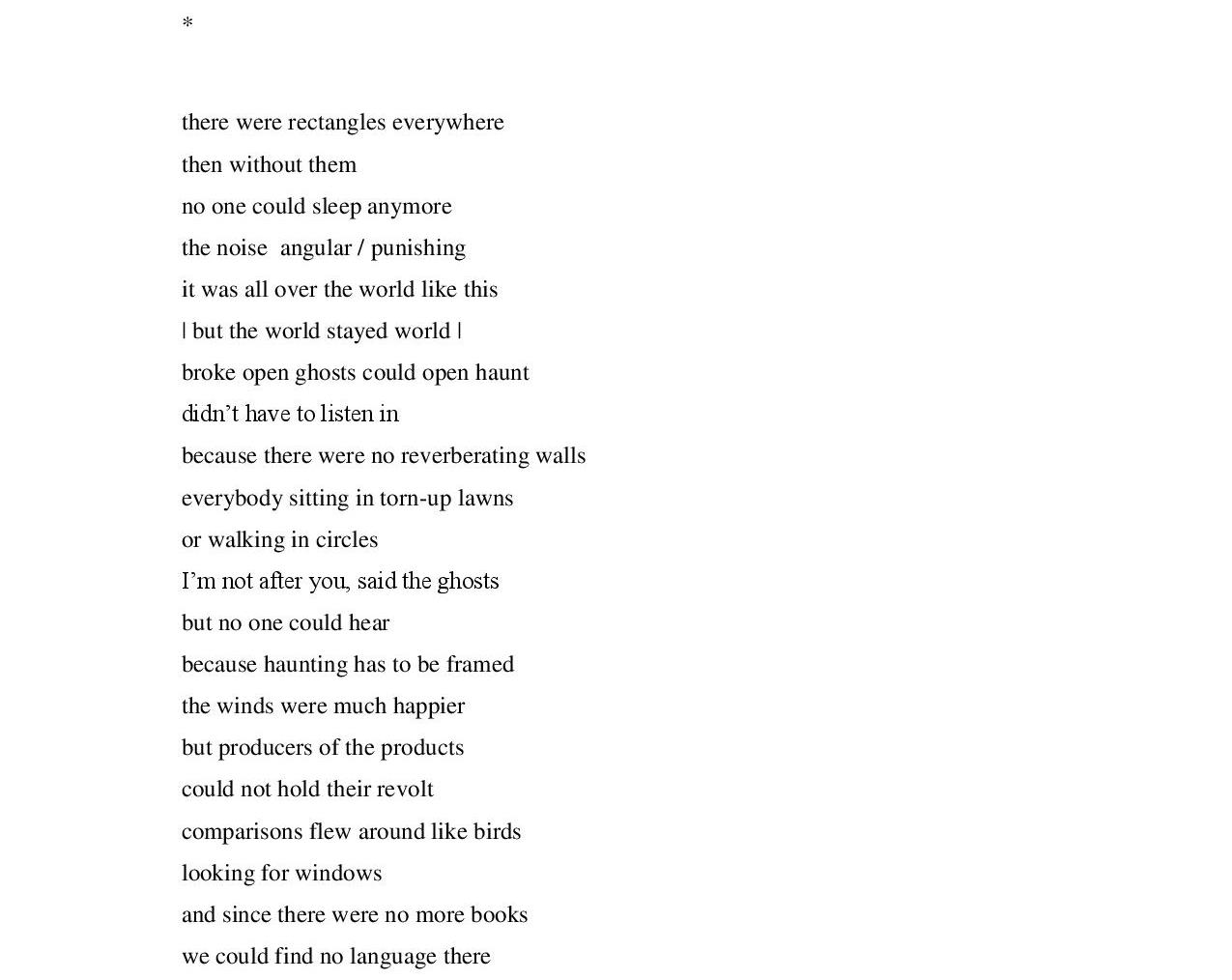
there were rectangles everywhere_jillian-page-001

.

1.) What were the first inspirations that made you desire to become a writer?

In fourth grade, I wrote a “collection” of my “creative writing stories.” The best one was called “fortunately, unfortunately.” It amuses me that my thought default mechanism was already in place. In sixth grade, I won a prize for reading the most books in the school. I think I wrote a hundred book reports. I was trained as a reader. My family was book-centered. In junior high I always hid in the library at lunch time to avoid the other kids. I think writing is just what young readers begin to do. There was never a decision. My Mom always made us keep diaries. I was really into journalism class in seventh grade. Writing was the way I worked out my being. It still is. I grew up identifying as a writer but I really wanted to be a painter.

2.) Who are your favorite writers and how did they change over time?

I like difficult writing. I think I always have. I like to be made to think harder or differently. When I was a kid I loved mystery novels. That has translated in adulthood to a love of mystic/shaman writer-thinkers like Helene Cixous, William Bronk, Bhanu Kapil, Gaston Bachelard, Sofie Calle, Michael Palmer, Virginia Woolf, Paul Celan, J.M. Coetzee, Jesse Ball, Fanny Howe, Fyoder Doestoyevsky, Hiromi Ito, W.G. Sebald, Fred Moten, Susan Howe. When I love a writer I read them for life. Additions are made, but my loves don’t change. I’m very loyal. I’m slinking around the thought-archives of Dalkey and Naropa and the Sorbonne.

3.) Who have been the creative inspiration / mentor writers in your career?

I worked with Claudia Rankine early on at Warren Wilson and she remains a powerful influence and friend. She’s got this ferociously lightning mind on top of this thick, established stratum of calm. An incredible human. Another great thinker that has shaped and re-shaped really my entire approach to writing, teaching, and to life is Kim Young, a painter, and a dream and IChing scholar. My husband Tommaso Cioni is my greatest teacher. He is a great manifester; he writes poetry with his lifestyle.

4.) How has your own work changed over time and why?

I don’t know. The subject of inquiry changes, so the writing changes. I like to think of the writing as what’s left behind of my inductions and transductions. It’s crafted evidence of thought. So whatever I am inspiriting gets its traces all over the pages.

5.) Have you been influenced by different genres, and if so how?

Absolutely everything has a chance to emphatically and empathically influence me. If I am making jewelry I think about noise, rhythm, placement, shape and tools and I think about tension and action in terms of poetry. If I am drawing I think about mark-making and how the gesture is made in language outside of chronology or narrative. I read a lot of fiction, because I am interested in building and accumulation. I often get a little lost in research when I explore other fields. I am teaching a class called “Oracular Mapping,” and so I am reading a lot of material related to urban planning. Right now I am reading “The Wayfinding Handbook,” “The Image of the City,” and “Visual Complexity: Mapping Patterns of Information,” for instance. The poetry happens across investigation and encounter and it isn’t separate from life.
It’s the score of a call and response of the interior.

6.) What are your plans for the future?

I’m going to continue teaching “Oracular Writing” at the Poetry Center in Tucson – it keeps me on my toes. Hopefully I can manage a tiny book tour when the book comes out. I have friends in big cities and I will probably just design it around where my loved ones live: Paris, New York, San Francisco, Los Angeles, Asheville…hmm I am forgetting somebody.

7.) If you were asked to create a flexible label of yourself as a writer, what would it be?

Artist.

8.) In the section: “chorus,” the voice of, “*the priest” orchestrates a scenario in which the “Lord performs a test”. The priest has set up “one mirror, in an empty room, the entrance to his home. / And the call to his guests: ‘Come, I’m in the back’.” The visitors are invited to walk through a “secret” opening admitting, “I don’t care for submission. As much as coincidence. / I’m not good at being very happy, / when not spoken to directly.” The request is one to look at themselves in a petri dish of sorts where the priest assumes an omniscient hierarchical presence. If this was a coincidental happening they may succumb in a discourse that places both respective intentions across from one another. However defining his position within his own home is alienating and their participation is black and white. They defensively acknowledge the test. The structure of the test dissolves the intimacy of the interaction. Does the test lack intimacy because of the structure of the environment, or does it lack intimacy because of the structure of the pathos? Which do you believe to be more hierarchical?

The priest is telling a story (an unlikely one for the priest to tell) about the Lord. It’s the Lord’s home, and the Lord’s test that the priest illustrates. However, the priest’s own sermon undoes his intentions, because his characters lose their identity in the syntax: the reader doesn’t know if it is the Lord whispering, or his guests. This is serving to abolish hierarchy. The syntactical arrangement itself is a gesture toward intimacy. Which is what the speaker is seeking throughout all her investigation.

How can the spiritual component of this piece be altered so that the priest is an open presence not lost in a looming controlling based spectrum that is based on fear? Well I wouldn’t want to do that, because it isn’t a tract, it isn’t redemptive. These poems are evidence left by a speaker, a seeker who leaves a trail of ontological and existential suffering.

Is this a critique of monotheism?
No, this is a poem- it contains our loneliness – god’s, and ours.

9.) The voice “*the gossip,” in the same section, is a tavern “damp, dark, filled with enough / to feel invisible.” We learn, “The Visible [is] a violent character here.” We read on, “She’s tethered to a game. The man will play the ground. / ‘What are you doing, protecting your rook?’ he’ll say, taking the queen. / ‘Trying to find a good place to hide,’ she’ll say, letting him down.” This societal reflection juxtoposes girl in her visibility as both victim and passivity. The “game” of social underpinnings is everywhere. “He” is the player. Here “She” lets him down. If she plays him does this admonish both visibility as violent and she as passive? Where in your mind do you see the flexible underpinnings of being both visible and non-violent, active, and cooperative? And why is this gossip?

The gossip tells of an encounter between a man and our main character (“she.”) The “visible” is a spiritual threat to her, she who is trying to mystically dissolve, or merge with her beloved. The identity of this beloved is often confused, for her, and for the reader. This is an enactment of spiritual grappling, but not a sociopolitical commentary. The gesture to want to hide inside of the inanimate and too-small rook reveals the crisis and confusion of the character, she missing entirely he man’s grounding gesture to keep her in the game (in the present.) Gossip is not real, it’s gossip. A poem is a kind of gossip, that is, it can only touch some part of the truth about this kind of crisis.

10.) The character/theme “*gossip” at one point in the “chorus,” shares, “In alongside intuition a certain new loneliness creeps / when she found out she might be the inventor of herself / the light the words her eyes spill.” This is juxtaposed to the transition in the last section is titled, “body,” in which an asterisk is unaccompanied, and “I” is used instead. We listen, “what if wish & love open at the same time? / I ask the glass with a kind of dare // (the difference between fantasy and prayer is innocence).” If the fantasy is towards self it is both love and open. This assumes a type of “innocence”. Does this ask us to reassess our patriarchal lens of competition?

It’s meant to reveal a move the character has made, into perhaps a place without reference. Her investigations are leading her into a reassessment of the lenses she has been using.

11.) The work ends as follows: “I counted truth for my life, recanted – / finding a sameness in things. // The body took the blame / for the deeds of the mind. // It was this kind of human.” “Human” becomes “body”. In sameness we depart from gossip, but how do you see this partaking in language? How does our difference assemble our visibility outside of fantasy and where does the body reunite with the mind?

When awareness achieves “lightspice,” fantasy and difference are momentarily dissolved (the robes fall; dark). This kind of character doesn’t end, and can’t, inside language, do anything but pick up difference again (to spell, to read, is to differentiate.) Perhaps the reunification will happen next: when difference itself is acknowledged, reunification as a goal, might be dropped. Which could make room for.. .

How do you see genders re-equating to each other outside of this pathos in visibility?

This book takes us through a spirit-ditch. I don’t see it as a gender-differentiated place.
The inequality suffered is not happening between genders here in this place. The speaker is seeking self/meaning/god in everything, which includes “a boy,” “the visible,” “the body,” etc. In short, everything is considered. All approaches, conceptual, physical, perceptual, biological, intuitive, spiritual, are considered.

profiles in poetics and linguistics: Kristen E. Nelson

websites:

http://www.kristenenelson.com

www.casalibre.org

http://unthinkablecreatures.tumblr.com/

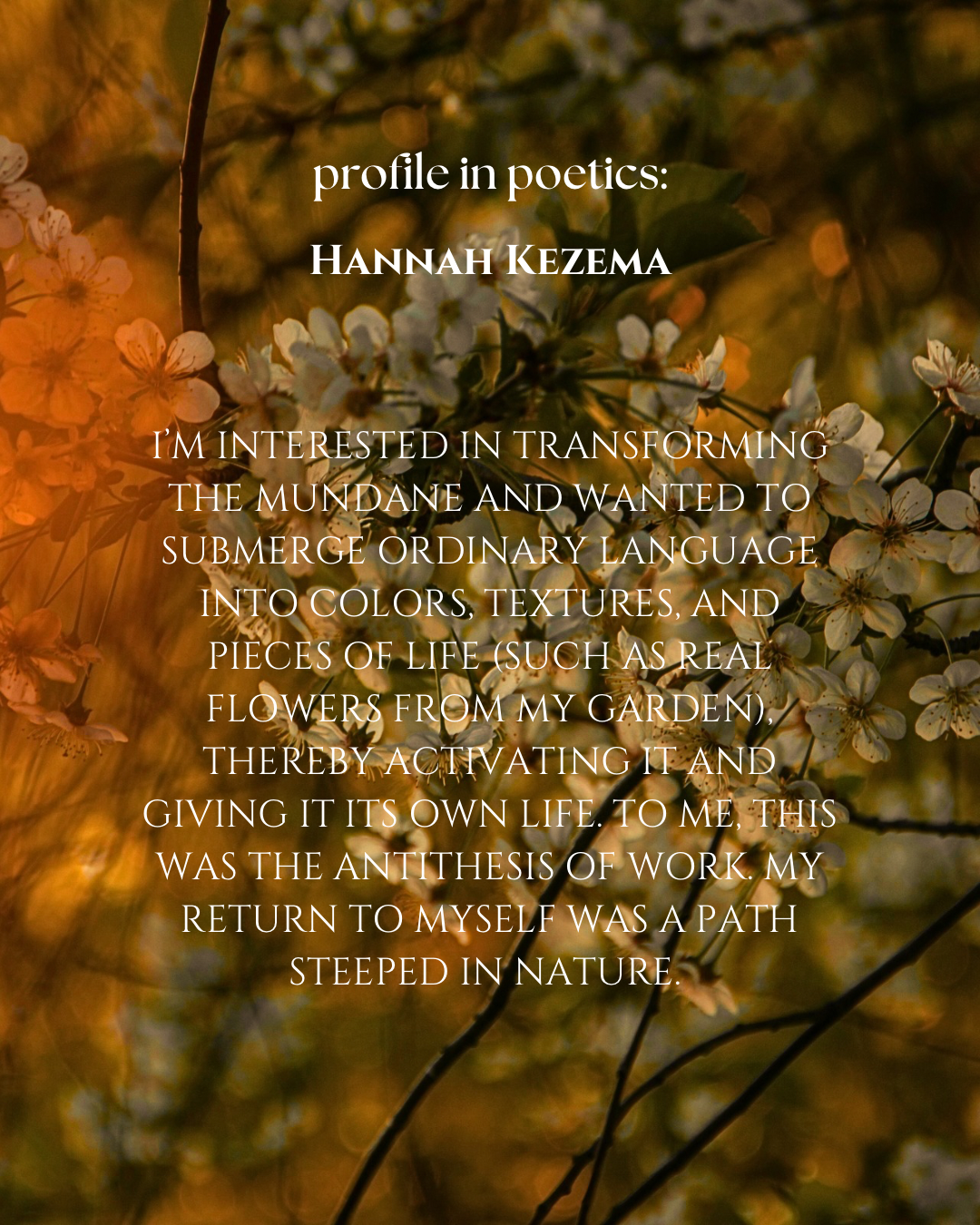
Kristen Nelson is a writer who bends, grinds, lavish in the poignancy of blown glass, language in camber and body. We saturate the ways in which form in the syntax of space is able to emote, to breathe, to entangle us, and create physical properties of the body she writes back onto the page. Investigating, “conversations about and awareness of how women are encouraged to modify their bodies in order to achieve ideals of beauty.” Sound, she names, “feral,” has properties written into bones, body, in times of closeness to another, and in times of solitude.

But it is not the body that is alone in the liminal space of self, of excavation, rather, it is how the self interacts in conversations with “other”. Intimacy in times of love, grief, and joy, invite collaboration that extends beyond creation, out of sharing the unknown. The conversation she says, is intimate, a “moment between one. The intent … to represent the ability of the speaker to love herself and maintain her independence.” Leading us to question the interiors of our attachments.

Nelson is a cross-genre writer who believes that “writing by women in the past twenty years has taught us all to be brave.” And, she says, “when I drink whiskey I think I’m a unicorn.”

Kristen was born and grew up in Mount Vernon, New York 20 minutes north of Manhattan. She earned a BA in English with minors in Marine Science and Biology from the University of Tampa in 2000. She worked for The Village Voice in New York City, The Weekly Planet in Tampa, and for two years as a full-time staff reporter for the Rivertowns Enterprise in Hastings, New York. She was a freelance reporter for various newspapers and magazines for four years until relocating to Tucson in April 2003. Kristen worked as an editor of the The Institute of the Environment at The University of Arizona from 2003–2009. In May 2009, she left her job at the university to run Casa Libre full-time and pursue her MFA.

1.)    What were the first inspirations that made you desire to become a writer? Who are your favorite writers and how did they change over time?

I do not remember my earliest inspiration to write. It was always there with me. I know my first journal dates back to when I was 10. Before that, when I was 7, I wrote my first short story. It was called “Linda and Her Unicorn” and my great-aunt Vera kept it framed in her house. The year before Aunt Vera died, she gave it back to me along with my great-grandmother’s dowry linens, and her wedding silver. It felt precious in its black frame with shifting glass next to these items. I remember typing the story on my mother’s typewriter and the frustration of my fingers pecking along at a jumbled up alphabet.

In college at the University of Tampa, after 2.5 years of a biology degree—vertebrate zoology, invertebrate zoology, genetics, organic chemistry, parasitology, etc.—I finally had the nerve to switch majors and pursue what I really loved. I had this mantra floating around in my head at the time: Every blade of grass tells a story. I still don’t know what it means. Not really. But that mantra and a college mentor encouraged me to follow my passion.

My favorite writers when I first began studying literature were JD Salinger, Hemingway, and Shakespeare. In the last 15 years, I’ve switched to reading more and more female writers. Carole Maso, Janette Winterston, Anne Carson, Rebecca Brown. Most recently I’ve been obsessed with Lydia Yuknavitch’s The Chronology of Water. I also read everything that Kate Greenstreet, Selah Saterstrom, and Kristi Maxwell publish. I love Roland Barthes and Jenny Boully. Mine is a muddled mixed-up group of inspiration.

2.)    Who have been the creative inspiration / mentor writers in your career?

My college mentor was Doctor Andy Solomon. I was also extremely frustrated and inspired to think by Don Morrill. For ten years, I found inspiration and mentorship from my peers including Julia Gordon, Julianna Spallholz, Kristi Maxwell, Elizabeth Frankie Rollins, and Selah Saterstrom. I took 10 years off of school to found a non-profit literary center, and finally found my way to grad school a few years ago. I was blessed to study with Bhanu Kapil and Rebecca Brown. Rebecca threw me in the dirt and taught me to ground. Bhanu taught me to float in the sky. Between the two, my work has found the tension it needed, tethered between dirt and sky. I also think that writers have the divine gift of being mentored by other people’s writing without having worked alongside or below a person. One of the most influential books I’ve ever read is Carol Maso’s collection of essays Break Every Rule. It was her conversations on the feminine and queer aesthetic that rocked my world—gave me permission to write outside the lines. I also fell deeply in love with Rumi about 5 years ago. He has been the only person to describe a concept of God to me that makes sense—a spirituality that I can get behind.

3.)    How has your own work changed over time and why?

I always thought I would be a prose writer when I grew up, but my sentences kept getting shorter and shorter. Then they became much more concerned with the lyric, sound quality, rhythm, and meter. I have become more interested in the liminal space between poetry and prose—combining tools from both genres. My work has also been more influenced by loss, grief, and the body as my life has become more concerned with these topics.

4.)    What are your plans for the future?

I am working on a multi-genre art project called Experiments on my Body. Experiments will promote conversations about and awareness of how women are encouraged to modify their bodies in order to achieve ideals of beauty as dictated by society and the media. The project begins with “care packages” sent to female artists. Each package contains a photograph of my body, a letter discussing my memories and engaging the individual artist with details of their own art projects, and objects relating to one or more of four categories: pain, hair, weight, and make-up. The intention of the categories is to define pervasive, accessible, and socially acceptable body modification—tattoos and weight loss versus scarification and breast augmentation. For example, a package may contain a close-up photograph of an un-waxed bikini line, a letter describing a first experience of getting a bikini wax, and objects such as fashion magazine clippings, wax strips, and a tarot card which relates to the theme discussed in the package. The packages are designed to prompt conversations between artists on how women are expected to modify their bodies in order to achieve “beautiful.” Each package also includes an artistic statement introducing the project and inviting a response. This project will culminate in performances in the home cities of participating artists and in a web archive of work generated during the correspondence—writing, fine art, photography, video, music, movement, etc. The website will be open to submissions to add to this original archive.

I am also working on a new poetic manuscript, but for the first time, I’m not sharing any of the work in it, until it is complete. Another experiment.

5.)    What are your views on writing by women as it has occurred in the past twenty years?

I think writing by women in the past twenty years has taught us all to be brave. These women have come up against the towering white male wall of the cannon and rather than try to scale it, they’ve gone off in a different direction. They’ve stretched and manipulated genre, given credibility to writing about pain, language, and the body, and have continued to be brilliant, thoughtful theorists.

6.)    Who are promising women writers to look at in the future?

I would recommend that everyone keep an eye out for Kristen Stone and Liz Latty. these two women are tearing it up and they have only just begun. Also, Tucson is a bursting with female literary talent—including Elizabeth Frankie Rollins, Julia Gordon, Kristi Maxwell, Lisa O’Neill, Annie Guthrie, Dot Devota, and so many others.

7.)    If you were asked to create a flexible label of yourself as a writer, what would it be?

I mostly identify as a cross-genre writer, but when I drink whiskey I think I’m a unicorn.

8.)    In your chapbook, Ghosty, published by Drunken Boat, I would like to focus on your use of form and image. The beginning sequences are similar in form. The speaker is italicized, followed by a prose style that informs the dialogue. But as we move further into the piece, the form assumes the style of a picture book. Fitting for the content, we meet “Ghosty,” [Dad] and learn about his death. The writing mimics memoir / short story form and we read about the further displacement of the original speaker. Can you describe your decision to introduce image into the piece further fictionalizing the memoir nature of the work and how you believe this affects the experience of the reader?

[“Ghosty” is not a chapbook. It is a series of text-image pieces that were originally published in Drunken Boat, and were then published in my chapbook Write, Dad (Unthinkable Creatures, 2012). ]

The writing and collaboration that happened between Noah Saterstrom (Ghosty’s illustrator) and I was organic not planned. “Ghosty” is autobiographical. I was sitting in a cheap motel room in Scranton, Pennsylvania drinking vodka out of a ceramic mug. My sister and I had just made the decision to turn off the machines that were keeping my father’s brain-dead body alive. I called Noah, my friend and at-the-time roommate. Noah sketched those drawings while I was manically telling him stories of my experience there. When I returned home to Tucson, he shared the drawings with me and they gave me immediate access to the writing of “Ghosty.” He sketched from my grief-laced stories. I wrote from those sketches. That was the process. “Ghosty” was birthed in the month after my father’s death from grief, friendship, and a need to understand what just happened. Then Deborah Poe accepted it for Drunken Boat and sent it off into the world. Christian Peet wrote a really beautiful review of “Ghosty” on the Tarpaulin Sky Blog. I think he understood the piece better than I did at the time. http://tsky-reviews.blogspot.com/2010/10/on-kristen-nelsons-and-noah-saterstroms.html

9.) “ix. Two Cups,” a poem of a larger sequence, The Length of this Gap, manifests a dialogue between the mind, the body, intimacy, and autonomy. The poem reads, “I have a body intellect much smarter than my brain, // My breasts know what temporary feels like,” proceeding, “If I had known that he was going, / I would have sacrificed too much to make him stay. // The men that go away that carried me in their wallets.” The speaker here acknowledges that the body encompasses an intelligence that seems to be in conflict with the mind. The rationality of the mind objectifies and alienates the self, surrendering an autonomy that is then consumed by the men in the relationship. “Othering” the body is a Western cultural staple. Can you discuss your intention using this specific lens to illuminate these frictions?

the length of this      gap in the entirety of the series, is attempting to measure grief—the distance between moments of joy. The gaping vastness that is mourning can feel unending. “Two Cups” is looking for some answers through body intellect. Our bodies have answers and truths stored. We can access these truths if we listen. If you read that line literally: “My breasts knows what temporary feels like” What I meant is that when my lover touches my breasts, I know if they intend to stick around or if this sexual experience will be fleeting. My body is better than my head or heart at interpreting the sincerity of other people. My head can be too clouded by hope, desire, and fear but my body knows.
10.) In the same sequence, the last poem, “xv. About this Big,” acts to describe love as a way to bring light and make visible the “existence” of something only seen by a lover. In this intimate, quiet, close encounter between two, “My love/ I dream                          you are writing me into / existence // Do not bring water / I wake to lilies                       their wild scent in big pink pushes spreading / shouting all of the heart wide open goofy dew // In this moment I am entirely alone.” We are alone. In the visibility of writing the self and lover in language we isolate ourselves in the process. Could you please address the logopoeia of this piece; writing, intimacy, autonomy, and the ways in which the body participates in this discussions?

This is an intimate moment between one. The intent of this piece is to represent the ability of the speaker to love herself and maintain her independence, confidence, and sense of joy, when the beloved is absent. I don’t think that love needs to be about losing yourself. When it works, love is a complement to an already full independent life. When I wrote this poem, I was in a relationship that taught me this truth.

Words are so much bigger than their letters and meanings. The aesthetic content of “lilies,” “pushes,” and “spreading,” for example, is filled with music—sounds that are stored in our bones and feral instinct. This poem is attempting to access the meanings of these words but also the interior attachment of the reader.