profiles in poetics: Denise Duhamel

“How do we honor our mothers after they have passed? The person, the legacy, the body, after death? This interview is not meant to address the failings of motherhood, but rather, as Denise Duhamel states, “maybe Pink Lady is about my look at the female body—its capacity to do so much in a lifetime.” … (intro)

wqcs are now active on substack 🌷this journal is supported by its readers. subscribe & if you enjoy, give a 🩷 & please support.

upgrade for access to the full archive; writing lessons from the authors (that accompany their interview) and me, plus reading notes. 

🌻 straight to the interview 

thank you for being here 🙏

xxo, jillian

BNI

profiles in poetics: Maria Garcia Teutsch (II)

“… In What She Saw in the Lotería Cards, we discuss the Loteria’s close historical origin to Tarot, Maria’s process and ritual, and the roots of her Mexican and Southern Gothic Heritage. Here we can see how syncretism works with her Mexican Catholic and Protestant upbringing in a blend that reimagines La Loteria; lyrics of life, of warmth, family, and passion. And valuing, as she states, “its paradoxes of strength and oppression, silence and voice, nurturing and resistance.” … (intro)

wqcs are now active on substack 🌷this journal is supported by its readers. subscribe & if you enjoy, give a 🩷

upgrade for access to the full archive; writing prompts from both the authors (that accompany their interview) and me (the interviews I share from the archive). 

🌻 straight to the interview 

thank you for being here 🙏

xxo, jillian

BNI

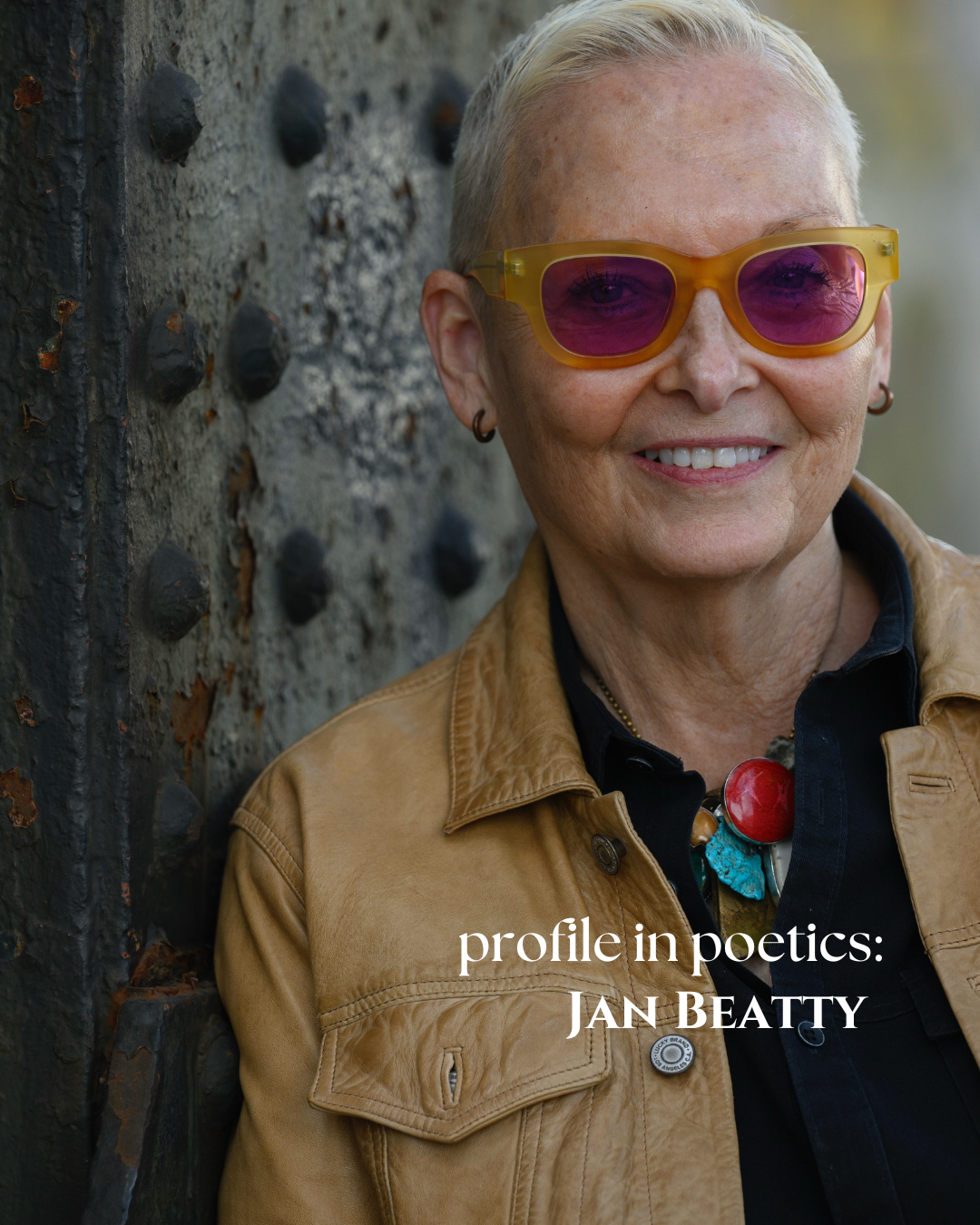
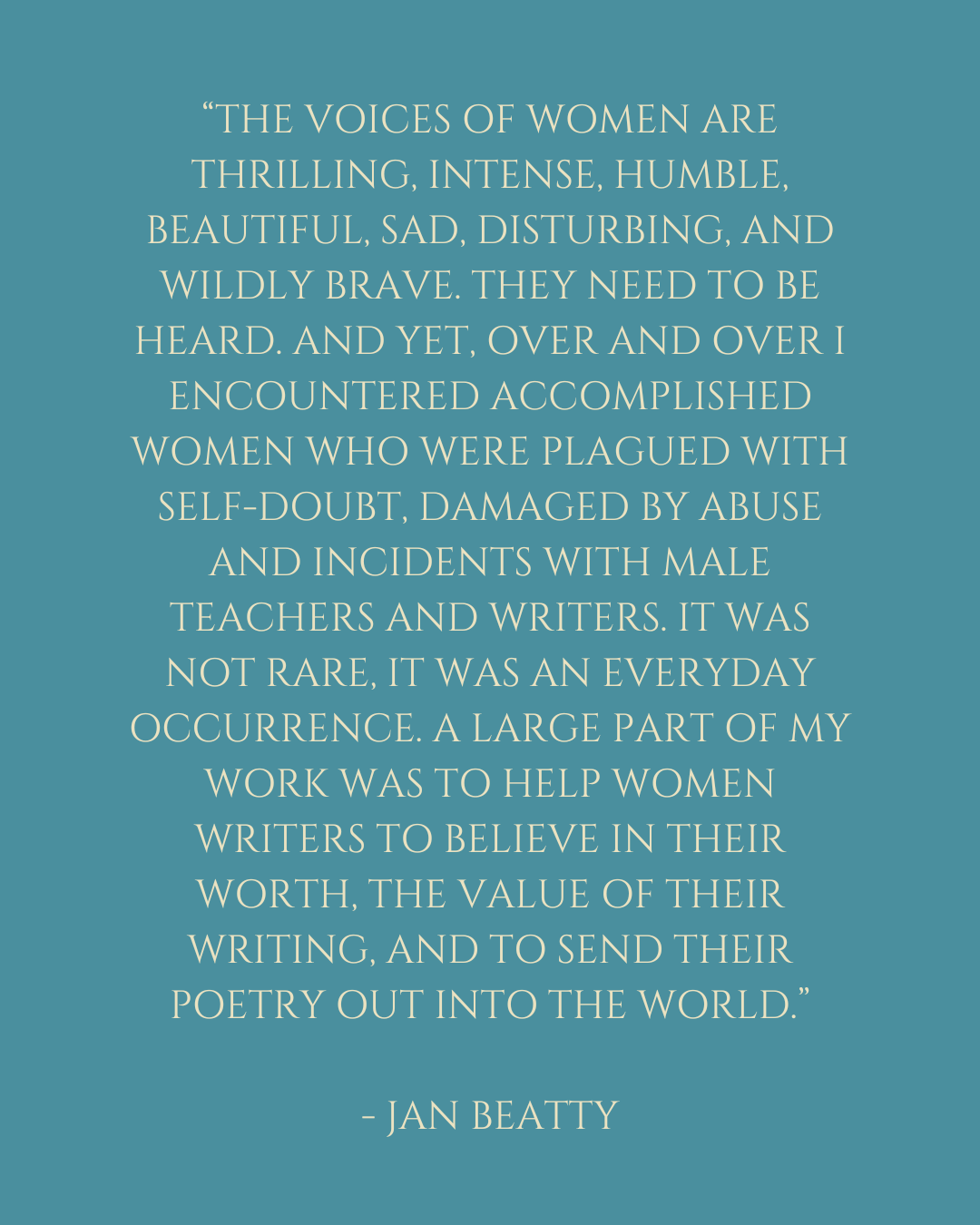
profiles in poetics: Jan Beatty

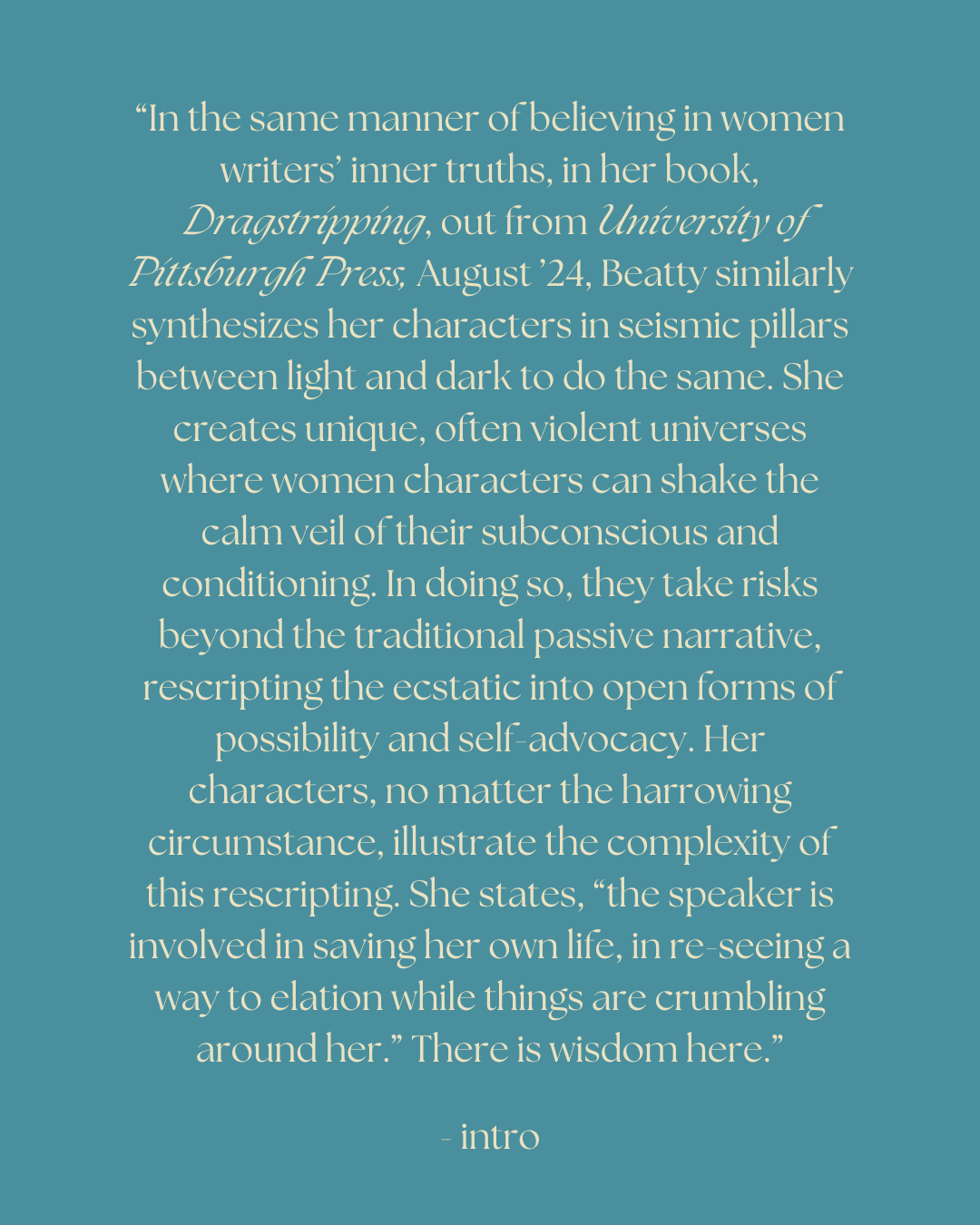
“… In the same manner of believing in women writers’ inner truths, in her book, Dragstripping, out from the University of Pittsburgh Press, August ’24, she similarly synthesizes her characters in seismic pillars between light and dark to do the same. She creates unique, often violent universes where women characters can shake the calm veil of their subconscious and conditioning. In doing so, they take risks beyond the traditional passive narrative, rescripting the ecstatic into open forms of possibility and self-advocacy. …” (intro)

wqcs are now active on substack 🌷this journal is supported by its readers. subscribe & if you enjoy, give a 🩷

upgrade & gain access to the full archive; writing prompts from both the authors (that accompany their interview) and me (the interviews I share from the archive).

🌻 straight to the interview

thank you for being here 🙏

xxo, jillian

BNI

profiles in poetics: Emily J. Mundy

“The tiniest leaf is to be — words within a storm of, “perpetual growth, and release, and renewal.” It falls like small button candy into a sea, the reflection of an “externality of cycles and nature. … ” intro

womens quarterly conversations are now on substack 🌷this journal is supported by its readers. subscribe & if you enjoy, give a 🩷

upgrade & gain access to the full archive; writing prompts from both the authors (that accompany their interview) and me (the interviews I share from the archive).

use for your own pleasure, for teaching tools, learn and share with your friends. as a paid subscriber you also have access to direct feedback and coaching through a deep dive with me in each interview. more teaching and coaching opportunities are available via DM. not sure? try it 🙂 I added referral incentives.

🌻 straight to the interview

to the magnificent awareness in each of us 🙏

xxo, jillian

BNI

profiles in poetics: Hannah Kezema

womens quarterly conversations are now on substack 🌷

this publication is supported by its readers. I would encourage you to follow as a free or paid subscriber✨

free subscribers have access to the full archive, ad – free and notes 🙏 paid subscribers support the time & work put into this publication and have access to a personal writing prompt from the interviewee that accompanies each interview, as well as the full prompt archive. as a paid subscriber you also have access to a deep dive with me into the interview ✨

join us 🌷click on the picture or here 🌸 to direct you straight to the interview, and click here 🌼 to the writing prompts & dd.

thank you & joy 💖

jillian

BNI

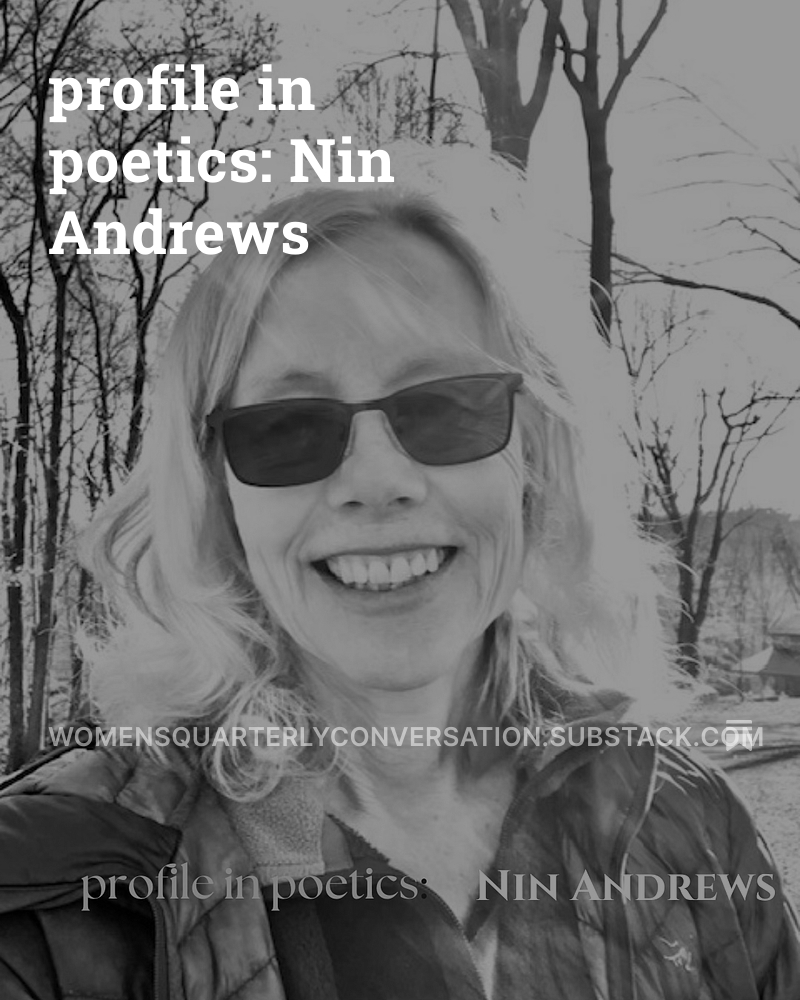
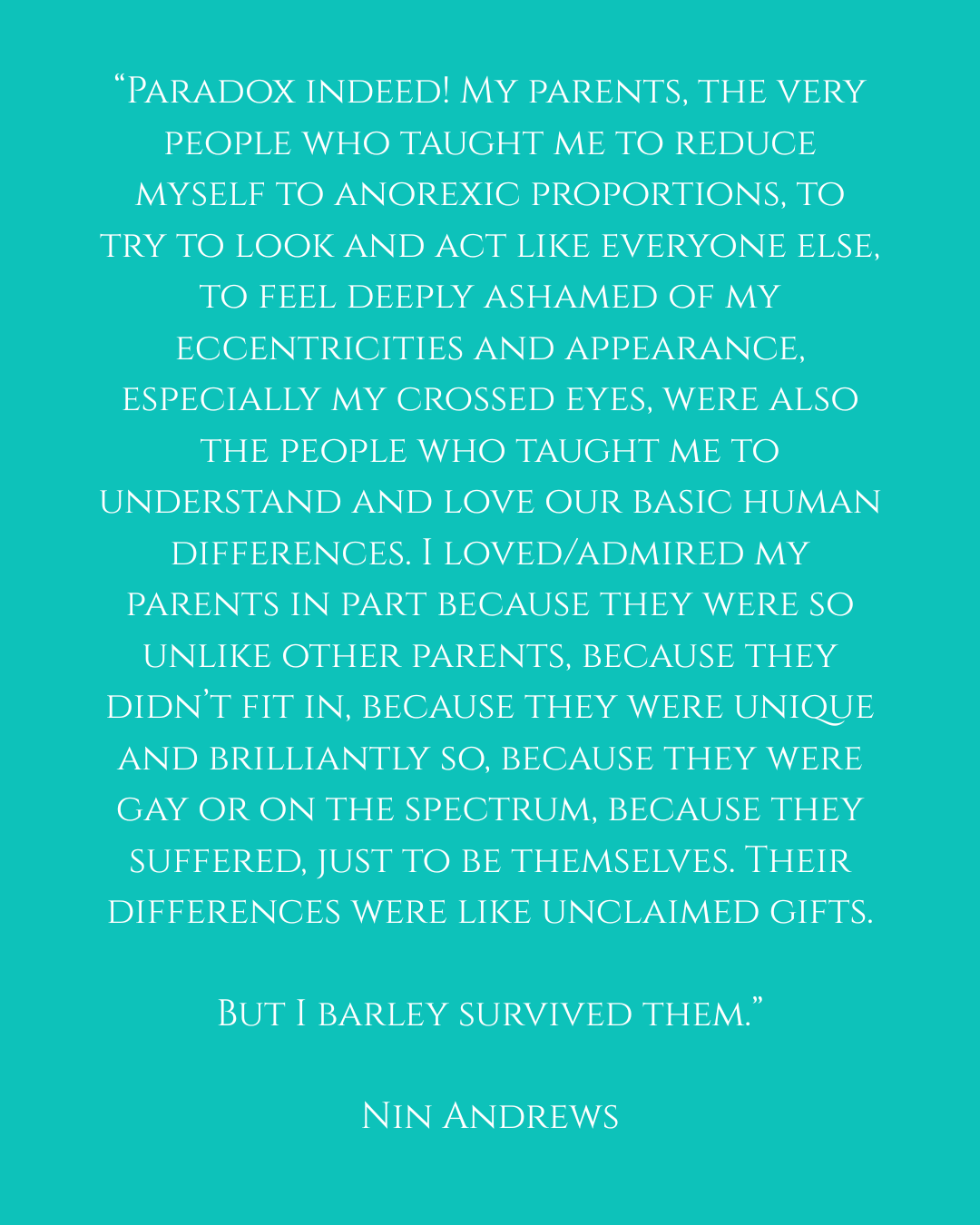
profiles in poetics: Nin Andrews

womens quarterly conversation interviews are now on substack 🌷

free subscribers have access to the full archive, ad – free 🙏 paid subscribers support this publication and have access to a personal writing prompt archive that accompanies each interview ✨

I merged some of you but not all 🌷click on the picture or here 🌸 to direct you straight to the interview, and click here 🌼 to the writing prompts.

thank you & joy 💖

jillian

BNI

profiles in poetics: Kristen E. Nelson (II)

We slip into this interview with Kristen Nelson, on the meditative comfort of “Octavia Butler’s concept, ‘God is Change.’” Women’s writing in the past twenty years for Nelson has taught her to be ‘brave’. Explaining, “Female, transgender, non-binary, and BIPOC writers have come up against the towering white male wall of the cannon and rather than try to scale it, they’ve veered off in different directions.” Kristen Nelson dances across labels and genres, playfully considering herself to be a ‘genre-queer’ writer, or perhaps a ‘genre-slut’ expressing her deep commitment to “queerness, experimentation, magic, and play”.

In this second interview, we visit Kristen’s second full length poetry book, In the Away Time, out from Autofocus Books, ‘24. The collection, although raw and present, is written about an intimate breakup that took her the length of ten years to write; intimating first the experience of the wound, and then writing from the scar. The book embraces ‘the away time’ and answers how to “let go of the hope after a promise is broken”. It looks at the, “painful pulling back and reabsorption of the mangled or blossomed” parts of the relationship. But also, how queer communities ‘shift’, “through different containers of relationship”. In this way,” resisting ownership in relationships” and “heteronormative paradigms”. Ultimately illustrating how to “[stand] back up after you’ve been taken to your knees.”

Kristen E. Nelson is a queer writer, scholar, and performer. She is the author of two books In the  Away Time (Autofocus Books, April 2024) and the length of this gap (Damaged Goods, August 2018); and two chapbooks sometimes I gets lost and is grateful for noises in the dark (Dancing Girl, 2017) and Write, Dad (Unthinkable Creatures, 2012). She has published creative and critical writing in Feminist Studies, Bombay Gin, Denver Quarterly, Drunken Boat, Tarpaulin Sky Journal, Trickhouse, and Everyday Genius, among others. Kristen founded Casa Libre en la Solana, a non-profit writing center in Tucson, Arizona, where she worked as the Executive Director for 14 years and co-founded Four Queens, a platform for divinatory poetics with Selah Saterstrom. Kristen is currently a Ph.D. candidate and instructor of creative writing at the University of California – Santa Cruz in the Literature Department’s creative/critical writing concentration. Her current research centers on Creative Writing, Divinatory Poetics, Feminist Autotheory, and Witchcraft Studies. 

Websites:

www.fourqueens.org

www.kristenenelson.org

Fleshing the Archive of Witches

AutoFocus Books,

  • What were the first inspirations that made you desire to become a writer? 

Same answer as I wrote to you in 2012! [gosh that’s a long time ago]

  • Who have been mentor writers in your career?

There are so many folx who have mentored me in my writing career. I’m thinking about mentors in three categories. First, my peers, friends, and beloveds in my writing community; Second, teachers and guides who have supported me over the years; and third, writers who taught me to write with their writing. First, my writer friends are the folx who have read my work, remind me that I’m good at this when I falter, bolster me through rejections and celebrate my successes: Selah Saterstrom, TC Tolbert, Hannah Ensor, Jenna Korsmo, Kristi Maxwell, Teresa Carmody, CA Conrad, Julia Saterstrom, Maggie Zurawski and others. In the second category, I wouldn’t be the writer I am today without guidance from Andy Solomon, Rebecca Brown, Bhanu Kapil, Rachel Pollock, Anne Waldman, Susan Stryker, Micah Perks, Ronaldo Wilson, fahima ife, and Vilashini Cooppan. The third category is vast and deep and grows every year. It’s hard to name ALL of the writers whose work has influenced me, but in addition to everyone I have listed already, I would add Carole Maso, Sophie Calle, Saidiya Hartman, Audre Lorde, Lidia Yuknavitch, adrienne maree brown, and so so so many others. 

  • How has your own work changed over time and why?

The last time you asked me this question, in 2012, I ended my answer with this line: “My work has been more influenced by loss, grief, and the body as my life has become more concerned with these topics.” This is still true, plus 13 more years of leaning into these topics. And also, I’m producing a lot more critical writing than I used to, primarily feminist autotheorical essays. 

  • Have you been influenced by different genres, and if so how? 

I’ve always been a cross-genre writer, finding excitement and inspiration in the liminal space between poetry and prose. But these days, I’m also working in the liminal space between creative and critical writing. I’m interested in what happens when you combine creative writing, research, and theory in different ways. I started my career writing mostly short stories. In my MFA program, I shifted to work that looks more like poetry. I’m still writing poetry and don’t think I will ever not write poems, and also I’m writing a book that looks more like prose now. 

  • What are your plans for the future?

I’m a fourth year PhD student at UCSC where my research focuses on Creative Writing (specifically poetry, creative non-fiction, and divinatory poetics), Feminist Autotheory, and Witchcraft Studies. I am very focused on writing my dissertation and finishing my degree in the next few years. My diss is a combination of essays about witchcraft and a creative non-fiction manuscript called The Witches of Benevento. It draws inspiration from my ancestral stories and the legends of witches that have surrounded my ancestral home of Benevento, Italy for centuries. Beyond finishing this degree and book, I’m not sure. I never believed that I would leave my 20-year beloved home in Tucson, until a pandemic happened and I left to pursue this degree. I’m not sure what the world is going to look like in a few years and what our country will look like in a few years. Will it still be safe(ish) for me as a queer woman to live in the United States? Will the humanities still exist in academia? Will there be a job for a queer creative writer? Will academic institutions still exist with all of the federal funding being cut by the current administration? I’ve been taking comfort in Octavia Butler’s concept, “God is Change.” So rather than make gods laugh by planning, I’m learning to embrace change and stay in the now until I have to move on to the next now.  

  • What are your views on writing by women as it has occurred in the past twenty years?

I think writing by women in the past twenty years has taught us all to be brave. Female, transgender, non-binary, and BIPOC writers have come up against the towering white male wall of the cannon and rather than try to scale it, they’ve veered off in different directions. With these new paths, they’ve stretched and manipulated genre, given credibility to writing about pain, language, and the body, and have continued to be brilliant, thoughtful theorists. There is no going back to a time when women’s voices, transgender voices, non-binary voices, and BIPOC voices were silenced. I include a variety of identities in my response here first because gender is fluid, and second because I believe it’s important to acknowledge all of us who have been comrades in this movement of expansion and bravery. 

  • Who are promising women writers to look at in the future? 

The world is burgeoning with women writers to look out for. I find new voices to be excited about every day! I’ve gotten to know some incredible writers and their writing since moving to Santa Cruz and folx I’ve met during my recent book tour. Keep your eyes peeled for writing by Annika Berry, Melissa Mack, LuLing Osofsky, Maria Pachon, and all of the other creative writers at UCSC. I’ve been particularly excited about the first books of poetry by Hannah Kezema (This Conversation Is Being Recorded)and Emily Mundy (What Blooms in the Dark)

  • If you were asked to create a flexible label of yourself as a writer, what would it be?

It’s taken me far too long to answer this question…I think at this point “writer” is the label that is the most flexible and most accurate. “Queer writer” describes me with more accuracy, and “poet” is a label I will always use to describe myself. I wish there was a term for writers that holds the same space as “queer” does in the LGBTQIA+ community. Something that signals, hey I’m a creative writer who writes in multiple genres, and across genres, and in-between genres and I’m interested in stretching the containers of genre while also deeply loving all of those genres. Also, I’m deeply invested in queerness, experimentation, magic, and play. How about Genre-Queer? Or what about Genre-Slut? Can I claim that without offending too many people? When you look into the etymology of the word slut, you find words like wanton, dirty, muddy, idle. I like those words. I’ll probably have a different answer tomorrow, but let’s go with Genre-Slut today.

  • In the beginning of the novel we face a break up. We read, “Now: You are gone. Poof. / Keyser Söze. // I had forgotten: Love exists in pain or right beside it. Love remains de­spite the absence of the beloved. / Fuck.” (12) There are different ways in which we cope with loss; from a spiritual lens or a psychological one. Attachment theory or perhaps a nervous systemantum entanglement, the later of which requires the falling away of boundaries. How do you relate to each of these ideas in this sense of love and loss in your book and what are your personal views on the topic of love and attachment and our process of healing?

I love that you refer to this book as a novel. You’re not wrong—it is a book-length narrative. I have been thinking of it as a prose poetry collection, but I like the word novel, too. Your question made me think of Barthes, A Lover’s Discourse, “Language is a skin: I rub my language against the other. It is as if I had words instead of fingers, or fingers at the tip of my words. My language trembles with desire. The emotion derives from a double contact: on the one hand, a whole activity of discourse discreetly, indirectly focuses upon a single signified, which is ‘I desire you,’ …” I think that when two people fall in love there is a third entity that is created: the relationship. When that third entity dies, there is a painful pulling back and reabsorption of the mangled or blossomed or enlarged or shrunken or otherwise changed parts of you that made up the relationship. Sometimes you have to shore off a finger/word or a word/finger that is too changed to become a part of the whole again. It is a painful process of healing what can be healed and releasing what needs to be let go. When I was writing this book, my book companion was bell hooks’s All About Love, in which she writes, “The practice of love offers no place of safety. We risk loss, hurt, pain. We risk being acted upon by forces outside our control.” Boundaries get necessarily tangled in this act of risk, this act of dependency. If a relationship grows into a durational healthy relationship, it is because the two individuals chose to work on healthy boundaries and to avoid codependency. If it ends, to some extent, they did not. One of the things I love about being queer is the normalization in my communities of shifting through different containers of relationship until you find the right one for that individual connection. It’s not unusual to date a friend, who might become a partner or evolve back into friendship or even a family member. Resisting ownership in relationships is one of the ways we resist heteronormative paradigms. Some of my closest friends are partnered with beautiful humans that I dated, some of my “failed” romantic relationships evolved into close friendships. I think the most painful breakups for me are those relationships that simply end. There is nothing, in fact, simple about an ending when there could have been an evolution.

  • The stages of loss are anything but linear. Wounds provoke us to face ourselves, beliefs; our shadows. And in this passage, we also must take action beyond just knowing, turn inward to address ourselves. We read, “I get drunk every night. I think of you—your physical. I cannot breathe. … it would be easier to die. Right now, I die.” (27) But also, the opening sentiment you lead with the book is, “I made a choice to ignore the one bleeding beside you, ‘She is going skinny-dipping. Wanna come?’.” Can you speak more to this notion of knowing and action and how this book took part in this process of healing. 

I do not think that writing this book healed me, but I sure did hope that it would. It took me about ten years to write this book. I started writing it from the wound, then I healed me, and then I came back and finished this book from the scar. In the Away Time started as a daily journal I kept during the six months after an excruciating break up a long time ago. One of those breakups which ended a connection that I thought could have been evolving and life-long. I kept that journal in order to continue a discourse with my lover (which Barthes tells us is always a conversation with the self) that I was not ready to end. I would not have published the journal as is, because it was not art, it was not poetry, it was a break-up journal. Thinking with Sophie Calle’s project Exquisite Pain in the years afterward, I collected stories from friends, acquaintances, and strangers about their excruciating breakups. I took some bits of the journal, wove in bits of these stories and tried to tell the story of a universal pain. I do think it is healing to write, to read, to listen to the narratives that reflect our own exquisitely painful experiences. If nothing else they make us feel less alone in our pain.

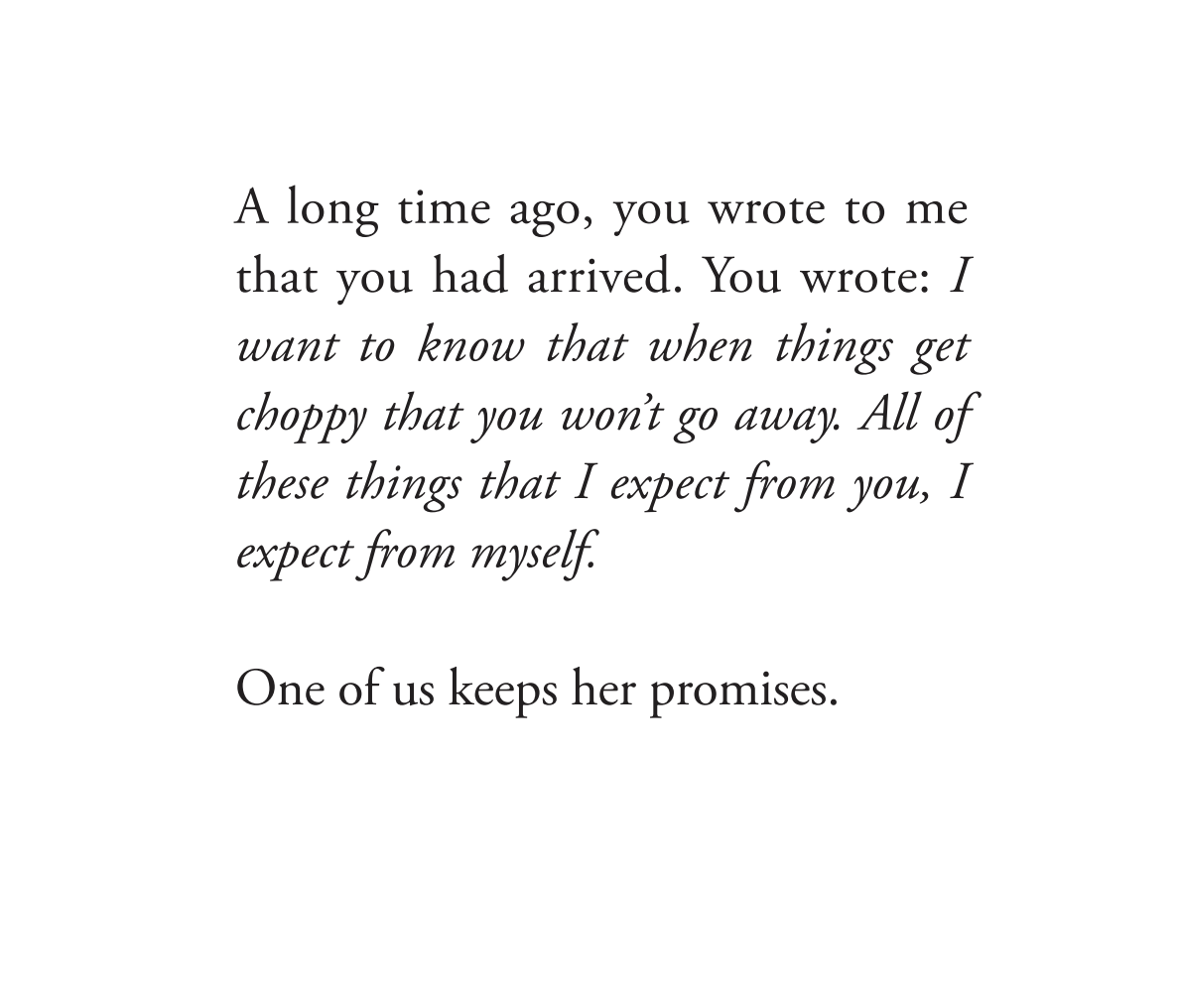
  • Desire, obsession, and grief; the chaos of the loss break down the structure of the ideal. We slip into intimacy, “I took a bath last night or was it two nights ago? … I laid a Monk snake shed ac­ross my neck. // Let go / Let go / Let go / Let go / Let go / Let go / Let go.” (56) And then after a long silence, you cannot. But this obsession transforms into a powerful sentiment in a memory you have of a conversation where it is revealed that, “I want to know that when things get choppy that you won’t go away. All of these things that I expect from you, I expect from myself. / One of us keeps her promises.” (81) How do you hold these sentiments, that you were taken to your knees. And at once also, held this promise?

I think what you are describing here is a central impetus of writing this book. There are some universal truths when someone is left “in the away time.” What I mean to describe with my title is the liminal space when one beloved says to another that they need some time and space, but do not offer the clarity of an ending. How does one let go of the hope after a promise is broken? How does one trust that that promise was true, but is not true anymore? How does one move through the process of healing when the beloved is gone, just gone—no communication, no explanation, no opportunity for questions and answers. After years of love, promise, and hope, you now sit with the slow fading of those things and then with absence. How do you let go without knowing for sure that the other wants you to let go? At some point you have to make a decision to do what you need in order to claw your way out of “the away time” you have been left in. The book is my answer to your question, or at least it is a book-length description of how to sit with these based on my own experiences, the experiences of others who shared their stories with me, and queer models of loving. I hope people feel less alone in their grief when they read it. Of course, this book is not a comprehensive or direct reflection of my experience. In real life, I was intentionally celibate for a year after my relationship ended. In real life, I spent a lot of time in therapy processing this sudden absence in my life. In real life, I shifted deeply into avoidant attachment strategies and it took me years and years to trust another beloved. In real life, I spent years engaging in romantic relationships, only if they had clear expiration dates in order to keep myself safe. At least in these relationships, I could be sure of an ending. I gesture towards some of these things in the book, but I don’t directly address them, because this book is an experiment in autobiography—something crafted from, but not a direct reflection of, my real-life experience. I think it comes across in the book that this relationship fucked me up big time, but I hope it also offers some reflections on standing back up after you’ve been taken to your knees.

BNI

profiles in poetics: Erika Lutzner (II)

How does grief transpose from the personal to the private? How do we process the grief of a nation and at the same envelop the deepest private sorrow of our intimate life? How is the political interwoven in this narrative? Does the public and private share glasses or merely hold hands with their eyes turned downwards. Are we perhaps so much more intimately connected than we care to realize, picking out our fresh vegetables, looking for dimples. How is our grief connected and separate and how do we negotiate and process these necessary steps? 

In this second interview, Erika Lutzner shares her book, While Everything Slipped Away, published by Calypso Editions, 2016. The book straddles the public private spheres of bereavement in the experience of losing her husband in the 911 rescue attempts. In Erika’s words, these poems which began out of the surrealist necessity of grief, love, and elegies, “told her what to do”. And furthermore, in this transformation, she says, “I let go of so much to write the poems and when they formed a book, I felt a huge release. They became part of the world.” 

These poems are filled with political insight, beauty and horror, mind body juxtaposition, and a deep yearning that is cut with honest gratitude and reflection. There is a music in all of her lines that leaves the carved space of a loved one. And at the same time this is a space filled with memories of saturated wholeness. An attempt to share the intimate love that although all at once lost, also became shared.

Erika Lutzner has written one book, While Everything Slipped Away From Me (Calypso Editions) and five chapbooks; four with dancing girl press and one with Kattywompus Press. Her work can also be found in journals such as Jet Fuel Review and Harpy Hybrid.  She is the publisher of Scapegoat Review, an online journal. She grew up in Garrett Park MD, next to Porcupine Woods and behind the train tracks. She is a former violinist and chef and loves cats.

https://www.scapegoatreview.org/

  • What were the first inspirations that made you desire to become a writer?

When my husband died, I started keeping a journal. I thought I was journaling, but my mother said that I was writing poems. I stopped, took a look and realized I could write poems. And it helped me so much with my grief to write about what was happening to me. I feel tongue tied much of the time and writing helps me to ‘speak’. I was told I was inarticulate as a child and writing made me coherent.  I could say the things I needed to say. 

  • Who have been mentor writers in your career?

Ilya Kaminsky, Paul Celan, Yusef Komunyakaa, Nin Andrews, Shel Silverstein, Carson McCullers, Anne Sexton, Maurice Sendak and so so many others. For me, whether I meet a writer or if he/she is alive doesn’t matter. I take so much from their writing. The exception being Ilya Kaminsky. I learned an immense amount from working with him. He taught me a different way of thinking about writing, thinking, and poetry.

  • How has your own work changed over time and why?

I have started writing centos and that is a whole new genre for me. I started writing them because I had so many lines of poems I loved saved up and I was having trouble being creative. It gave me a new outlet for creativity. I am a musical writer but over time, I have learned not to rhyme, although I throw them in from time to time. I am writing more surreal poetry and also writing about new subjects but always with a dark edge.

  • Have you been influenced by different genres, and if so how?

I would say that tragedy and horror have influenced me quite a bit. I like to write things that are full of horror at the same time as being haunting and have beauty in them. Music is a huge influence on me. When I wrote this book, I listened to jazz, especially Miles Davis while I wrote so that has also impacted my writing. I love humor but I can only get it into my writing infrequently. I wish I could more.  I’ve been asked to write love poems but except for the book on Jon, which I consider a love story, I have a lot of trouble writing them.

  • What are your plans for the future?

I would love to write more political poetry. And definitely more centos. I don’t know if I have another book in me, but definitely a few chapbooks.

  • What are your views on writing by women as it has occurred in the past twenty years?

Everyday women writers are becoming more prolific. Their voices are growing. There are so many strong women writers. So many more than in the past. Their voices are finally being heard.

  • Who are promising women writers to look at in the future?

Dianne Seuss and Diannely Antigua are two brilliant women writers.

  • If you were asked to create a flexible label of yourself as a writer, what would it be?

I write juxtaposing beauty and horror. I write about what I know; death and evocative imaging; bitter truth. 

  • In While Everything Slipped Away, we are faced with the destitute field and aftermath of 911 both literally and psychologically. Your husband was a computer programmer killed in the rescue attempts. For you then, 911 was both public and private. In this question I would like for you to focus on the private and how this was negotiated, one of which is detachment. We read, “Regret is the color of blood – the color of blood splattered.” (16) And “my left eye is / somewhere on Main Street or maybe it’s / still in the mulberry stained cup.” (29) Spiraling into, “They amputated your thighs from my hips.” (36) Was there a difference between writing it all down on the page and later constructing, editing, and crafting each poem? What was your writing process and did you experience any enlightenment through these acts of radical examination and self-discovery?

I was so raw when I wrote these poems that I didn’t think about public vs private. A lot of the poems are surreal. That was a form of detachment. I had to do it in order to keep sane. I don’t know that I really had a process other than spewing out all that was in my cluttered mind. I definitely had some form of enlightenment. Writing the worst things you possibly can, it brings truth forward. I was faced with my worst fears, and I survived. I discovered I was a lot stronger than I knew. I didn’t know any other way than to write what was in my mind. It was therapeutic.

In my process, I just wrote without thinking about the outcome. I couldn’t think about it considering the topic. I wrote about grief as a way to get it out of my system as a way to grieve. It ended up being very public but that wasn’t my intention. If I had thought about the very public aspect, I probably could not have written it at all. After he died, I kept to myself and only talked to a couple of people about his death. I was extremely private in my grief until I wasn’t.

  • It is impossible not to address the political as well as the personal in your book. As well as the micro and at the same time macro all-encompassing entrapment of this occasion. At one point we read, “This country is run by a man who sends men and women to war over oil // America needs more sugar in her diet. / my husband dies in 2001 // The President says: “The Middle East is responsible” (23). How were you able to address the political messaging? What was the function by including it in your work? Did you learn anything from these actions of resistance in the visibility and sharing of your experience? Has the self-reflection of these issues changed over time and how do you feel about poetry being political?

I wasn’t thinking about private vs public at the time. I was vomiting out thoughts. I was writing love letters to Jon. Later, it became more difficult when everyone ‘celebrated’ 9/11. I had and still do have a difficult time with that. Because it is such a private thing for me. But at the time when I was writing, I just kept writing everything that was in my mind. Some people really related to my poems which made the visibility worth it to me.

I don’t believe in war. I used to believe in capital punishment until Jon died. Then I stopped believing because it would never bring him back and would just be more murder. I wanted horrible things to happen to Bin Laden though. Didn’t make sense in my mind. I put a lot of blame on him. I didn’t believe in God when Jon died. Now I have become spiritual because I feel there must be something more, something else. There definitely was a bigger picture in terms of what happens to us when we die. I thought all politicians were horrible people. That the WTC could be bombed before and we did nothing to catch the criminals and then 3000 people died. It was overwhelming to me. As for Trump, like I said he didn’t have anything to do with it but I would say today he reminds me of Hitler and we are letting this happen with him. It astounds me and saddens me and creates a lot of fear in me.

  • In While Everything Slipped Away, intimacy and death hold an interchangeable exchange in the 911 movements of sorrow. Grocery Shopping, is “More intimate than sex / I do it with everyone / Harder to choose the perfect peach / Then to give a good blow job.” (48) This gives insight into how you were forced to face the public and private sphere of the towers and your love sacrificed in its destruction. All the while in an attempt to protect the public. You remind us that the emotional and innovative value we feel in our lives must be centered in physical reality. And, that intimacy and grief is indeed a public as much as private act. You write, “tell me how to capture sadness.” (51) How were you able to revolutionize your own will, without allowing it to dissolve your healing and spirit in such a public and private way? Can you speak more to this idea of your private grief and the public grief around you? Did your personal and public grief collide in any way? Were there different stages of writing and relating?

I actually felt better the more I wrote. I did not think of the private/public aspects very much when I was writing. I found writing to be cathartic. It allowed me to heal because I got out the horror of what was in my mind at the same time as writing about my love for Jon. I am actually a super private person but I don’t think I could have survived without writing this book. I just didn’t think about the public too much as I wrote. And in general, when I write, I tend not to think about the public. If I did, I would be stuck. I could not write. I had a really rough childhood, and I do write about it some. But because my parents are still alive, I do think about the effect it will have on them. It doesn’t stop me from writing, but it gives me cause. With this book, because I thought of it as a love letter, I didn’t have problems writing about Jon. I was so angry and sad and full of grief when I wrote it that I just said what was in my mind. And I wrote honestly because that is all I know how to do. When people ask me about poems at readings, I tend to get very tight lipped. I want the work to speak for itself. I don’t want to share my private self with the audience except through my writing. There, I will bare it all.

The editing was very intentional. It was very different than the writing of the poems. Some poems I wrote in forms while others were free verse. The poem told me what to do. I wanted to have well rounded poems. I started out writing poems of grief and Ilya Kaminsky told me I was writing a book. Then he said that the poems were actually one long poem so I worked with that and cut up the poems. It was all intentional. There was a lot of musicality involved in the writing and splitting up of the poems.

When Ilya told me I was writing a book, the work went from private to public. I realized all the poems were interconnected and could become something more. I wrote a book of grief, love and elegies. Once they were part of the book, I felt they could enter the public and I could still maintain my privacy. I didn’t have to share more of myself than I wanted to. I let go of so much to write the poems and when they formed a book, I felt a huge release. They became part of the world.

BNI

profiles in poetics: Laura Solomon

Laura Solomon800px-Laura_Solomon

Websites: https://en.wikipedia.org/wiki/Laura_Solomon

News

Bio: Laura Solomon (28 June 1974 – 18 February 2019) was a New Zealand / British novelist, playwright and poet. Best known as a novelist, her poetry and short stories have also been widely published and short listed for awards and prizes.

I wrote this tribute a year ago, but never published it. Today I felt was the correct time. I hope to start new interviews shortly. Interview is in original form edits are placed in ( ).

From last year Feb 26 2019:

…. There was a woman who inquired about an interview from me months ago. Her name was Laura Solomon. Laura had inquired about giving me an interview about five months ago. She emailed briefly I had reached out to her previously, but she had just undergone brain surgery. I was going through multiple surgeries with my hand and all other previous issues mentioned and so politely put her off to what seemed a little pushy. It was not until yesterday (Feb 25 2019) I realized her pushiness may have been because she was considering or in the midst of approaching her next step. She died on the 21st of February, 2019 from a brain tumor. I have not written an interview for three (now four) years. I agreed to the interview just asked her to give me some time. They are still (were) sitting in my inbox. She published another interview that I read yesterday that stated “winning”. The picture on the front pictured her with a yellow backdrop hot magenta lipstick and sunglasses. Obvious contradictions of her recent departure.

This was at the same time of the recent Nike commercial that is all about women empowerment in sports. I like the commercial, and the mind behind the activity is obviously intrinsic to any talent, but yet again western society was projecting women as of the body. This made me observe how trapped Laura may have felt observing her life limit just as I thought I may never get to play music again. Also the horror of surgery is really unbelievable and only talking through metaphysics or surreal landscapes that I think I could get to which I haven’t really approached yet and would be more of a surreal poem. Maybe something do with living in a war zone and plastics and empty air. But as I read her work things seemed to be very straight forward. I assume that is also her type of aesthetic. I also wondered if the reason she reached out to me and her death was a coincidence or acceptance.

In her poems she describes a love relationship where she hands her MRI scan along with a book on topography to a new lover. She also admits that if she was God she would judge her. Wanting needy self indignant. I noticed the whispers that were coming from these confessions were like songs of the oral traditions of poetry where poets would recite their messages out loud to one another as they were more easily hidden. In a way she was singing a song over her own ending. Is this same impeding knowledge of one’s death as near change a person’s perspective? Is this similar to the feeling of one at war? Domestic violence? (virus?) Yes.

What if you know that as she puts it “your brain is being eaten either way?”. And was her attempt to as she says “at living forever/ My long shot at immortality?”. She replies to her rhetorical inquisition with this: “if you take the time to listen. I still alive. In the selection that she picks from her novel.  _____________ we then travel to heaven with famous celebrities mocking their shocking demise. For example Kurt’s blown brains, Marilyns overdose. A common theme of suicide. The poem is called “The Party” and as readers we are informed that everyone has to be invited to the party. The last line of the poem which is the last that she sends to me is, “The black telephone rings./ I move to answer it,/Nobody is there. /I can hear the 22 century heavy breathing down the line.” To see the future as this black is representative of not only cancer in the brain, but cancer in humanity. Brave enough to look at her own truth, but also in a despairingly difficult way.

When I visited her Facebook page the family announced they were thankful that she did not take her life. The metaphysical progression of this interview and this meditation remind me that there is rediscovery and different realities and I am thankful to be participating here in it. Also that there is much work to be down while we are here so that Laura’s foreshadowing is not correct.  After all this I listened to this image and I could not help but falling in love with the partially heard correct line: paper boat. watermelon. Probably the kindest image I could imagine as a healthy brain.

ls four walls poem

*note : this passage has not been altered in any way from the original except for the ( ) given which is also why the dates may vary. laura & I we’re speaking up till a few weeks before she passed & I wrote this as her wish .. her space in this space is in honor of her & her work. please look up her webpages as you can still read most online. 🙏

profiles in poetics: Jamie O’Hara Laurens

FullSizeRender (1) (1)Jamie O’Hara Laurens

Websites: jamieoharalaurens.com

facebook.com/ppongfreepress/

How do you wear your otherness? Is it comfortable? Are you a visitor to this space or is it as if you are sitting on the corner of a small soi as the traffic warms your seat on the edge of a marble bench? Are you at a dunken donuts while the wind presses and stares cherry lined blossoms into the sidewalk? Are you climbing the slip of algae licking the rocks of an ocean running into street art tattoos caves music your sexuality your age your home? Does your otherness melt away or build your sense of self? Is this empowerment or shame?

In her book Medaeum, now out from Ping Pong Free Press,  poet Jamie O’Hara Laurens takes on the tricky character of Medea. “When you ask ‘Who was Medea?’ the immediate answer is that she committed the most unthinkable crime. My intention is to investigate with empathy her peculiarity and rage.” O’Hara Laurens confronts issues of feminism, otherness, domesticity, borderlessness, and language. The book is dedicated to  The witches who must,  which Laurens intimates, “allows for the uncomfortable notion that Medea is incarnate today in women who, caught between duty and true nature, are faced with impossible choices.”

Jamie O’Hara Laurens has collaborated with choreographers, sculptors, and translators. She completed her MFA in poetry and translation in 2014. A native to the West, she has an ongoing curiosity about the natural world. Recent work can be found in One, EnclaveThe FEM, Alexandria Quarterly, and HawkmothMedaeum was released in the fall of 2016 from the Press of the Henry Miller Library.  She became a feminist writer by necessity. She lives in Brooklyn.

.
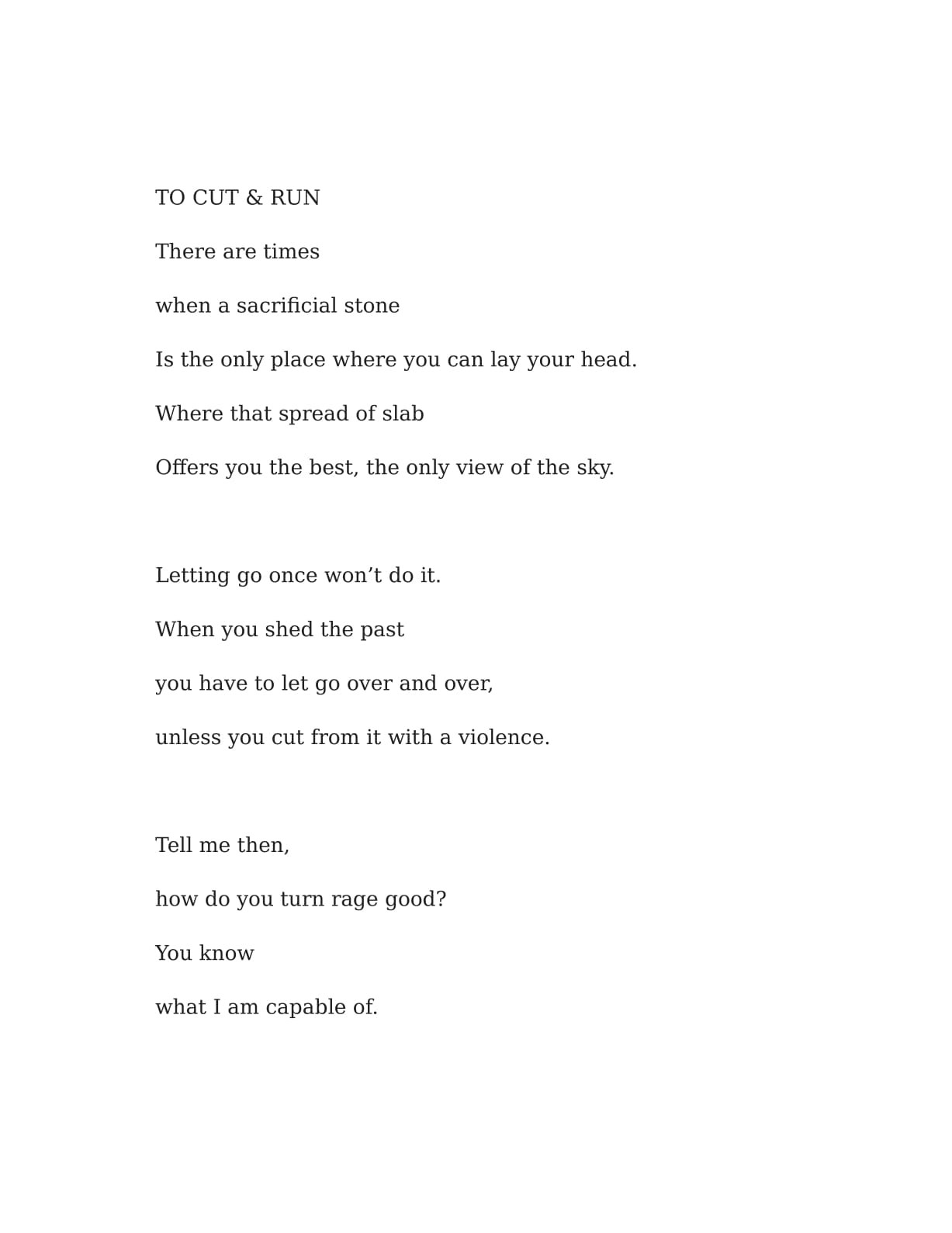
TO CUT-1

  1. If you were asked to create a flexible label of yourself as a writer, what would it be?

I might be a lyrical feminist who dabbles in time travel.

  1.  In the first poem, “MEDEA RAISES THE WHITE FLAG”, we begin with, “The Proper Guide to Household Life / has fallen open on the counter.” As we read further we learn, “Wait: the blood is still in the bodies / & her pinafore is still tied. / The setting sun red-orange & tremendous.” Medea has not yet murdered anyone. She is numb with rage. In the next poem however “SELF PORTRAIT IN HER FATHER’S ORCHARD” we jump to a flashback of her previous young self, “lost in the blossoms’ fragrance.”  It is here we are able to access issues of historical patriarchy and violence. Could you please introduce Medea,  and describe why you chose her as a persona to straddle these issues on a more personal intimate level?

When you ask anyone “who was Medea?” the immediate answer is that she committed the ultimate crime, which is against the very things we hold dear. If she is a victim, it is of hysteria; otherwise, she is just a monster, and this makes it impossible for us to see her any other way. But she was also an immigrant, a warrior, and the gatekeeper who helped Jason win his famed and celebrated conquest.  She inherited a talent for sorcery from her aunt, and was  one-quarter divine. Medea fell in love under a spell, and became Jason’s right-hand woman, helping him defeat an army, get past a dragon, kill a king, and escape her own family. She burned bridges and committed crimes against her own family in the name of his pursuits. When they arrived back in his homeland, they had two sons, and then he left her for the young local princess to improve his social status.
I wanted to ask two questions: First, what if her crimes were metaphorical? And second, if we put them aside, what do we see when we make a fair study of her rage? Her crimes were crimes of passion, and crimes of passion come not from calculation but from reactivity to provocation. What I found was a woman afflicted with landlessness, cut off from her family, a woman whose strengths were exploited, who fought her partner’s battles, used her skills, and then was discarded. If we reimagine the murders as a metaphor for vengeance, or interpret the removal of her children in a modern context, such as a more mild rejection of family roles, or as a controversial abortion, a different, suddenly a modern narrative emerges: one that looks a little more like The Real Housewives, and a little less like Sleep No More.  It was in my classroom that we came to the conclusion that if she has one single label, we are more at ease with her. But she doesn’t. She is ingénue, warrior, witch, herbalist, healer, battle axe, voyager, immigrant, wife, mother, and woman scorned before she is a murderess. We ignore her complexity and stick with the most comfortable name, so we can cast her aside and get her crimes away from us, like we do with anything we attribute monstrous qualities to.  It keeps us safe.

  1. Medaeum in this uprooted or perhaps contradictory visible social structure is able to step outside of her social contract. In the poem, “DIVINER I (FIELD)”, “There were innumerable cells / to begin from. / Forty thousand thumb- / prints on the body / where one could strike up / a symphony of trouble / & call it love.” Medauem then questions her humanity in “TILL AND TROUBLE” asking, “What separates our sleep / from the sleep of wolves? // What separates our work / from the work of vultures? // Why, love why, do you look cornered? // Wind, we are sick. We are sick and beautiful.” Medea in her transformative process becomes closer to the natural world. Could you intimate why you chose to bring her closer to the position of medium? How is this reflected in her remorse?

Medea spends the better part of the play tortured by what she perceives to be inescapable and inevitable consequences. We don’t often carry this part of the play in the collective consciousness – that she laments what she sees as the only way to save her children from shunning and exile and an eventual fate similar to other children who had to flee across the ocean. Medaeum spends the better part of the collection reflecting on how she got where she is, deciding not to have twin sons, and contemplating the murders she doesn’t actually commit, except of her own self-concept, which she escapes by distancing herself from the social construct and as a survival mechanism, aligning herself with her own animal nature and the natural elements in her foreign surroundings. At the turning point, where she is rejected and begins to retreat, she is more of a Mary Webster from Margaret Atwood’s “Half-Hanged Mary,” or a Hester Prynne—a woman who knows more than she should, who knows also that she has been shunned. She is already more in touch with the natural world as a sorceress, and turns to that aspect of herself in refuge, but for the strength to do what she foresees as inevitable—ending the potential future of her offspring (in this case, ending pregnancy).  Like the women in witch stories, being shunned, rejected, or convicted lead her to contemplate criminality.  

  1. The degradation of reality shifts to the disintegration of language structure. In “BOXING THE COMPASS” she struggles with, “testing / my new language, / holding the old one inside / my tongue’s folded flag, / a closed tattoo / in a fold of skin. // When I opened my mouth / Atlas & witchbody moths / flew the coop.” How do her issues of displacement give resonance to and invert her shame on the level of language?

Some believe that place and person are inextricably linked, that landlessness leads to a sort of unhinging, an inevitable loss of some part of the self. The experience of immigration is different for everyone, but for me there were many moments when I felt like I could wear my otherness like a skin, when I was considered to be an aberration, a shame. The spoken accent is something we can try to abolish, but when we do, we erase a part of ourselves. Medea gets in trouble for being different, and for speaking up against authority, for not being able to keep her barbarian outsider mouth shut. At this point in my re-imagining of the story she is going through the erasure of the self that comes with trying to fit in, failing, and trying again. She also experiences an inability to find an outlet, to put words to her experience. In a few texts about similar experiences, we could perhaps call them witch narratives, shame starts outside the self and mores inward, from the external world to the internal.

  1. Medæum slips further and further from her definition of self. The regression seems to suggest an ancestral mindset which displaces us into similar issues that occur regularly in present society every day. In “NOT QUITE A MURDER” she states, “My ancestors divined it: / I hate to be the bearer of bad news … I drive a knife into the earth / just far enough to scare up a shudder— // not quite a murder / of crows.” Can you iterate how closely this reflects contemporary issues in the news? Was this intentional?

Medeaum cannot fit in the confines of the domestic arrangement as it is imposed upon her. At this point in the narrative she senses the threat of breaking with it within herself. I see this drama playing itself out over and over again in contemporary culture, in narratives of possession, in the coding of social contracts, and in the stretching or acceptance of that coding. I see her moving away from traditional structure as she grapples with the conundrum of her true nature.  

The next—or rather, the very current and necessary— frontier of feminism, is deeply domestic. Couples in gender-normative roles will need to find the way to dismantle the expectations they set for themselves. Those who have embraced queerness and otherness by necessity perhaps will become role models for reconstructing them.

  1. We are offered a scenario consisting of a bird and a house. The bird is free outside of the house, but a nuisance inside of the house. Medea likewise is both inside and outside of the house simultaneously twisted in multiple spheres by her social contract. At the end of “DIVINER III (ANOINTING)”, we hear her say, “What whispers in my ear? // Dear Everyone, / Please, let me / let me disappoint you.” Considering this, could you please expand on the two lines in “& REQUESTS SEPARATION”: He says: you’re not a bit tamed. / She says: I’m untranslatable.”

Yes, the bird as a nuisance, or a prescient haunting in the house, was intended to show the discomfort of knowing what we don’t want to know before we know it, or before it has been confirmed. It was inspired by true events. It indeed does resonate with her dilemma and acts as a metaphor for her discomfort. A metaphor about freedom and entrapment could be found in the image of a bird in the house, but it is traditionally viewed as an omen, which was my intention. She has a failure of memory as she tries to remember the expression “a bird in the hand is worth two in the bush.” Is this because she has lost touch with her native language? Or because she is so unable to reconcile with her current situation that she can’t quite locate the folk logic on whether to go, to stay, to keep the pregnancy? I’m not sure. I’d rather let the reader decide.

At the end of “Diviner III” she grapples with the notion of the expectations placed on her as woman, wife mother, in opposition with what she describes to be her true nature—soldier, and the facet she takes refuge in— the sorceress. The only way out of the trap she is in may be failure to perform the role of indulgent wife and mother. She says in her famous address to the women of Corinth that she’d rather be on the battlefield than in childbirth.  

The lines from “& Requests Separation” suggest that the failure of the union is blamed on the woman being too wild, untamable, while Medaeum knows that Jason cannot grasp her complexity. We can see in Jason’s language for and about her that she is at fault for being an inconvenience to him—too strong, too wild, too different.

  1. I would like for you to touch on is Medea’s continual reference to a captainless ship. She relates these to failure and solitude. In the poem, “MEDEA COUNTS TO ELEVEN” she says, “I woke up one day on the wrong end of a country song. // Flung from loveless authority. // Holy Fuck, I thought: This is the captainless ship// This is the captainless ship //Screw the captain shit.” And at the end of the poem we are told that she grows fangs and states: “I empathize with vivid garçons. / I run my tongue.”

As the captain of the Argos, Jason left his boat of heroes to settle with Medea; and subsequently abandons the ship of their marriage and family. The captainless ship refers to the vessel of the Argos, and to the household without the presumed driver, who has abandoned his traditional role, leaving Medea with the two children to fend for themselves.  Medaeum is at once bewildered and enraged that there ever needed to be a captain, and that the captain who insisted on his role has left. What to do with the Argos when the captain has fled? Careful reading of Jason’s personal life such as it is possible, given that it is mythology reveals Jason to be more ringleader than hero. The animal grows in her beyond Medeaum’s will. Euripides painted Medea as a victim of passion: “passion is a curse.” She was in trouble with Jason prior to his departure to move in with Glauce (Medea’s Becky) because she spoke frankly about the political leaders of her time. So when she “runs her tongue,” it is both colloquial and literal—she runs her tongue with the need to speak too freely or too often, and runs her tongue over the fangs of her anger, her newfound animal nature.

  1. Lastly, in “CONSIDER THE GHOSTED LIVING” she is neither living nor dead. She states: “Do not ask me, ever, / who I do and do not forgive— / least of all, myself.” Could you comment on her struggle to find faith in any structure as she finally intimates in the last stanza of the book: “Is that what I was? A misbehavior? / See, I have outgrown the signifier, / have outgrown being the signified. / O! To have faith in something new.” And how does this relate to the very dedication in the forward, “For the witches who must”?

Medeaum’s only faith resides in the reinvention of structure outside the norms.  This modern interpretation of the character has chosen to end a pregnancy,  to divest them of their swords before they have them, and must leave as a marginalized Other; a process she is reluctant to undergo even if it suits her better. A woman who has carried a pregnancy carries the DNA of that being in her blood until her death, and so it can be a very difficult process to reconcile with. Medea may be considered sociopathic. I wanted to present a version of her who wasn’t. Medeaum hasn’t and cannot and won’t absolve herself entirely, but she will forgive herself enough to be able to survive. So she abandons being the “sight,” being the “signified,” being a woman possessed in a traditional role, and leaves in pursuit of ‘something new;’ a future time, or a future self, where there will be room for her.

Medea’s departure at the end of the play is considered widely to be a miscarriage of justice— an unmerited deus ex machina. Why would a monster get to ascend to the sky and escape? I tried to make her modern counterpart face an unchartered territory in which she would have to reassemble her relationship with the world.

It does mimic somewhat my own journey through process I both needed and feared. Nobody died, but my own image of what I and family were supposed to be had to be “cut from with a violence.”  

I am weary of the endless feminine apology. It goes without saying that I protect my child’s life with my own; that this is what they need and deserve.  Where I find an affection of a sort for a monster like Medea is that when you look beyond the unthinkable and try to really see her, you see the trappings of feminine power that have threatened over the centuries in a single character: the cauldron and the sword, the seducer and the banshee, the power to take away life as well as to make it. We can’t handle her. But on a metaphorical level beyond any crimes, I believe that may be a good thing.

  1. What were the first inspirations that made you desire to become a writer? Who are your favorite writers and how did they change over time?

I love harmony, language has the power of casting a spell, and voices that seems to reach through time. I’ve had an obsession with borderlessness. Among the first “aha” moments I remember were reading and rereading Hurston, hearing TS Eliot’s voice, and watching Brecht performed live, seeing Robert Wilson’s plays, reading about Rothko, watching PJ Harvey and Bjork; reading Marquez, Blake, Chekhov, Kundera, Neruda.  My favorite writers are the ones who acknowledge, see through, and play with music, time and space– like Keats’s living hand that reaches toward the reader.

The desire to become a writer is troublesome. Like many things, we mistake the verb for a noun. I come from a family with a musical ear, but hear words instead of music, and I just have always wanted to write. In my dreamscape, I hear things, and especially in the place on the edge of sleep .


  1. Who have been the creative inspiration / mentor writers in your career?

There are the writers I turn to for technique (Hopkins, Berryman, Ashbury, Hirschfield, Niedecker, Levis, Graham, Carol Frost, Brigit Pegeen Kelly) others I turn to for inspiration, solidarity and companionship, like  Caroline Bergvall, Alice Notley, and Ann Carson. I enjoy the poetry that is in conversation with other genres, like the fertile modernist period.. I definitely feel the importance of a feminine aesthetic lineage. Carol Frost taught me to put my heart back again and again to the work, and Malena Morling taught me to trust it, and to keep out of its way.  Jorie Graham and Helen Vendler have influenced transformed my view of many things.

  1. How has your own work changed over time and why?

I’ve learned to completely separate generation and craft. They are two distinct practices. Generative work is like divination, and craft can be like automotive mechanics. I try to write what I’m told; as HD said, ‘follow my daemon,’ and then let it marinate for weeks before I return to it with the Allen wrenches.

  1. Have you been influenced by different genres, and if so how?

Yes! When it’s going well, writing is like quilting. Starting points sparks can come from random places; sometimes philosophy, sometimes a dog bark,  line, to find a place to start, like striking a tuning fork. For Medaeum the play made the voice click into place.  I’m afraid of being a poet who writes only for poets.

The most inspiring work I’ve read recently has been challenging, transgressing, and hybridizing genres. Ann Carson has been doing this her whole career, but more recently Ben Lerner, and Maggie Nelson, Sjøn, and Ta-Nehisi Coates are redefining the novel, the historical novel, and memoir in a way I find exciting—making story inhabit the body in a way it hasn’t before. We process information differently than we ever have. I’m curious to see what’s next.

  1. What are your plans for the future?

Right now I’m continuing to develop on Medea’s story in its larger context. I’m also developing a collection of urban-set eco-poetry inspired by the Symbolists. I want very much to make activism that matters without renouncing the privacy needed for creativity.

  1. What are your views on writing by women as it has occurred in the past twenty years?

I see a redefinition of boundaries in publishing which has led to a remarkable expansion in the number of homes available for a growing number of voices.  It was not long ago that anyone who wasn’t male needed a man’s permission to be published. Now you can now find the words hegemony and patriarchy on advertisements in the subway. We’ve reached a sort of critical mass. The pursuit of agency has gone from being a radical choice,  to a necessity, to a norm. We can work to join together excellence and truth.  In the new cacophony of user-generated content, writing can feel like a competition to be heard, but we mustn’t fall into this notion.  I believe we must turn to each other in solidarity and gratitude; in inspiration rather than in competition,  because in fact the work may never be over.  Right now, in the public sector, we are lucky to see a genuine shift, but the private life of many remains very coded. Alice Notley reinvented the epic with The Descent of Alette. Caroline Bergvall has been taking on language and the history of art and religion through conceptual poetry.  Ann Carson has rewritten our relationship with classic voices from Sophocles to the Brontë sisters to philosopher Simone Weil. And now feminist writers like Claudia Rankine,  Marwa Helal and Salwar Sharif are holding new mirrors up to nature and really rearranging the gaze. I think it is an incredible time to be a woman writer. We have taken the surface apart. Now we need to continue to go deeper, to find the next layers.