profiles in poetics: Elizabeth Myhr

Elizabeth Myhr

the vanishings and other poems cover

Website: http://www.calypsoeditions.org/

http://elizabethmyhr.wordpress.com/

Elizabeth Myhr, poet and editor of Calypso Editions, spent fifteen years in her first career as a jazz pianist. She tells us, she “came at poetry through music”. Importance of music’s connection to living and our silence in this space encapsulates life in alternative spheres. Time then becomes a concern of light.

In her forthcoming book, the vanishings & other poems, which will debut September 2011, Myhr addresses the perceived linearity of time and confronts the surreptitious unraveling of light. The exposed skeleton is one of great fragility and makes us question our experience of being in addition to the tools we use to describe this experience; language. In the process of this deconstruction we are able to embrace music in both its noise and silence. The negation of noise being possessed first before language.

She leaves us with this: “I mean, imagine if every car on the road had a silent electrical engine but was tuned to a particular note such that freeway travel would result in an amazing, flexible harmonic experience?”

1.)    What were the first inspirations that made you desire to become a writer? Who are your favorite writers and how did they change over time?

Inspiration for writing came in a different way for me than I suspect it does for most people.  I didn’t start writing until I was about 22 or 23 years old, and for the 15 years before I became a writer I was a jazz pianist. Writing was and is a second creative career.  Because of the music, I initially approached writing almost purely as sound, aware of rhythm and cadence and tone – those words we so often use for music – as well as composition, phrasing, meter – so I came at poetry through music. This happened one day inBerkeley. The urge to write came quite suddenly one afternoon and I started writing like mad, but I knew I couldn’t be both a writer and a musician at the same time.  Music is just too demanding.  So I made a choice and chose to be a poet.

My favorite poets in those days were Rilke, Sandburg, Bly, Snyder, and Plath, and they were great for someone starting out because, on the surface anyway, they write accessible poems. But my true early influence was T. S. Eliot. Before I had become a poet and been warned against the “dangers” of influence, I wrote my undergraduate thesis on Eliot.  So I had, and have, no defense against him, and he still walks the streets of my poetry and he probably always will.  Now I am influenced by Polish and Russian poets, Herbert and Mandelstam in particular, but I also love Stevens,Ireland’s Yeats andHeaney,England’s Keats and Shelley, the Italian poetMontale,Germany’sCelan,Canada’s Anne Carson, and Latin’s Virgil and Horace.  I hold the very strong opinion that no poet should (or can) go without reading Latin and Greek poetry. It’s the foundation of everything and most of it is fabulous.

2.)    Who have been the creative inspiration / mentor writers in your career?

Luck has been at my side with my teachers.  Diane DiPrima, Jody Alieson, John Haines, Reginald Gibbons, Ilya Kaminsky, Jeanne Murray-Walker, Jeanine Hathaway, B.F. Fairchild, Robert Cording, and those are the writers who also teach. I have to include my high school science teachers in that mix, and I have to include my parents who are both amateur naturalists.  Also, musicians are on that list, Randy Halberstadt, Gaylord Young, Clarence Acox and Jerry Grey. Those men stood in front of me or sat beside me for countless hours and taught me how to listen to the creative voice that flows through a person when they are improvising, and how to capture that voice in my head and translate it to my hands and to the keyboard without losing focus or concentration.  Jerry in particular used to blindfold me and make me wait until I heard the next note before I played it. It’s the best training a poet could possibly hope for. Because the bad music will try and sneak in, the music (or phrases) that you think instead of feel.  They taught me to feel my way in.  I wouldn’t be the writer I am without them.

3.)    How has your own work changed over time and why?

Punctuation and capitalization have gone out the window for me because it’s just more challenging to try and write clearly without them.

4.)    Have you been influenced by different genres, and if so how?

I’m deeply influenced by scientific writing, field biology in particular. I read a lot of essays and non-fiction books about adventure, natural history including anthropology, and lately, archeology and physics. So I guess I like facts along with my fantasies. For fantasies, I watch a lot of films and look at a lot of paintings, particularly the high modernists. If you’ve never seen Cy Twombly’s paintings of Greek epic battles you haven’t seen one of the most extraordinary intuitive renditions of violence and passion on the planet.  They’re remarkable and they remind one of what fine art can do with literature.

5.)    What are you plans for the future?

Just to keep reading and writing as much as I can before I die, and to publish what good work comes of it.

6.)    What are your views on writing by women as it has occurred in the past twenty years?

Honestly, gender doesn’t matter much to me. Political situations in which poets find themselves and out of which they write is another matter. That’s critical, and it’s critically important for poets to tell it like they see it.  But woman or man, a writer is a writer and if your work is amazing, it will get published eventually. All one needs is one passionate friend who cares to make one’s work available to the public and knows how to do that.

7.)    Who are promising women writers to look at in the future?

I trust there are hundreds, if not thousands, of astonishing and gifted women all over the world writing in this moment. I don’t know of any woman writer in theUnited Statesthat everyone who cares to listen hasn’t already heard of. We’re pretty good at locating remarkable talent in this country.  But as a publisher, one always hopes to find unknown talented women writing in other countries who need their work translated.

8.)    If you were asked to create a flexible label of yourself as a writer, what would it be?

I am a poet.  I don’t really write anything else but the occasional book review or essay.

9.)    How has your editorial career affected how you approach your personal work?

Editorial work makes a person humble, because as an editor it’s one’s job to spot the weaknesses in writing and to correct them, so one becomes hard on oneself.

10.) In the conclusion of your essay “A Haunted Silence: Examining Poetry’s Relationship with Silence in the Wake of the Shoah through the Work of Johannes Bobrowski and Paul Celan,” published in Web Del Sol Review of Books, you state that the “cultural obsession with media is having a deep effect on poetry. Silence of any kind is no longer the place to begin. There is barely even a blank page.” And later, “[t]he result is contemporary poetry that feels recycled, tired, self-referential.” This is in reference, as you argue, to a move away from the divine silence inherent to poetry before World War II. I am interested in whether or not you believe this movement “inside noise,” you later state, is positive or negative, and what effect this has had in your own work.

Working “inside noise” is pretty exhausting, for me anyway. Those of us who live in huge cities forget how loud the world has become. Electricity makes everything hum, even at night in the country it’s hard to get away from noise, and now there are all these conduits for the internet under the earth – it’s pretty wild, our wired world. We forget that it hasn’t always been like this – only for a few hundred years. So I seek out silence where I can find it – in the woods, in meditation, in the places where there are no machines. It’s hard to find those places but it’s valuable to do so. Interesting things happen to perception when silence comes into one’s head and body, when speech is interrupted for an extended period of time. You see, there was a time when human beings did not speak, but that we have forgotten what that time was like. So I go look for that. What happened as a result of the Shoah was the opposite of the silence I seek. The silence created by the Shoah was the silence of a mass grave. That is a horrendous silence. I hear that silence too. It is also a silence, a terrible silence of the earth.

11.) In your forthcoming book the vanishings & other poems, there are weighted pockets of meditation and breath crafted through your use of sound idea and image. The effect leaves the readers with an elegant grasp of recycled space in a quiet ambiguity. Can you elaborate on this sensitivity and how this relates to your previous negotiation of noise?

the vanishings is a book less about noise and silence than about light and its corollary in abstract terms, which we call time. So I think the sense of “recycled space” and “quiet ambiguity” have to do more with my explorations of non-linear temporality and its disorientations than silence per se. I also talk about the limitations of language though – limitations such as the forces of history, of love, of war, of desire, of music.

12.) In the vanishings & other poems, a fragmenting theme expresses the limitations of language. There is fragmentation in our experience of the world similar to the fragmentation of the letters of a word. If language and more specifically speech permits us to share our humanity, how does this limitation in your opinion affect our ability to articulate humanity in and outside of poetry?

Language does some things well, like advertising what’s being sold in a store or creating a gift for a loved one that we call a letter, but it is a poor tool for explaining, for example, religious experience, true love, profound loss, and other difficult human emotions. Music is in some ways a much better vehicle for emotion than language. The world’s response to September 11th is a good example – the Requiem was a far better explanation for our feelings of that event at the time than any language would permit. Language always comes second, after music. I think we probably learn music first anyway, and language second.  We may have even sung and played music to each other before we ever spoke. Think of that world. We could create a world like that today if we wanted to. I mean, imagine if every car on the road had a silent electrical engine but was tuned to a particular note such that freeway travel would result in an amazing, flexible harmonic  experience?

profiles in linguistics: Katherine Towler

Katherine Towler

Website: http://www.katherinetowler.com/

Who are we? Are we elements of our environment; the subways we ride on, the grit of bare earth, the chairs slipped under our office desks? Is our identity interconnected to the perceived bones of time? Maybe memory? How do my relationships affect who I consider to be elements of what I deem “me”? Am I multiples in transition? These are questions that prose writer Katherine Towler pursues in her work.

Towler actively disassembles the intricately woven experience of our everyday lives. She is here to remind us of these moments. Perhaps it is her experience as a photographer that makes us focus on the complicated yet so varyingly simple nature of the minutia of our lives. These types of life intimacies mold our motion through that which we experience in life. Towler, states, “I’m looking for something that goes beneath the surface to the more subtle challenges, confusions, ambivalences, and longings we all experience on a daily basis.” Settings and characters mutate and grow as Towler is able to gravitate us through a Trilogy of novels, Snow Island, Evening Ferry, and her most recent, Island Light in which we face aspects of time, identity, and human relationship. Her newest projects include a piece of young adult fiction and a non-fiction book.

1.) What were the first inspirations that made you desire to become a writer? Who are your favorite writers and how did they change over time?

When I was a girl, my sister, who is two years younger, used to complain that I never wanted to do anything but sit on the couch and read.  My strongest memories are those times when I could escape into other worlds, into silence, into my imagination.  I suppose in many ways this is still true.  The times of going off by myself – whether in my mind or in actuality – are the times that feed me most.  The desire to find stillness in the midst of noise and people was one of the first things that led me to writing.  Growing up in New York City made me perhaps more attuned to this need.  In the summers we spent a month on the Rhode Island shore.  There I reveled in my love for the ocean and sky and air, for changing weather, for being outdoors, for the rhythms of nature.  I continue to draw a lot of sustenance from hiking and bird watching, and snowshoeing in winter.  I live in New England now, where I’m lucky to spend time in beautiful and sometimes remote places.  These places are a source for my writing.

The books I read and loved as a child made me imagine myself as a writer.  There are so many books I adored when I was young – everything by A.A. Milne (I especially loved the poems) and the Nancy Drew books.  I read all of Madeleine L’Engle’s books and sent her a fan letter.  She wrote back, addressing my concern that I was a poor speller and that this might prevent me from becoming a writer.  The Diary of Anne Frank made an enduring impression and remains one of my favorite books.  Jane Eyre is another book I first read when I was 11 or 12 that continues to be a favorite.  As a teenager, I loved e.e. cummings and Robert Frost.  I read their poems over and over.

As we age, the books we love don’t always age well with us.  It can be crushing to go back to a book that made me swoon when I was a teenager or college student, and find that it doesn’t resonate anymore.  This is an occupational hazard of being a writer, though.  The more experienced you become as a writer, the more critically you read; the more critically you read, the greater chance there is that books you once cherished will fall by the wayside.  Cummings is one of those who has fallen by the wayside.  Frost is not.

2.) Who have been the creative inspiration / mentor writers in your career?

This is a significant question for women writers because, for women of my generation at least, it was not always that easy to find mentors, and certainly not female ones.  I was fortunate to attend a private girls’ school for high school in New York City.  I had a wonderful English teacher who encouraged me to write and suggested, when I was a junior, that I might like Virginia Woolf.  I had never heard of Woolf.  I read To the Lighthouse and then read every other novel of Woolf’s I could find.  I took a course in women writers of the 19th and 20th century with that teacher and remember, in particular, reading Emily Dickinson.  I took creative writing as an elective as many times as they would let me sign up for it.

In college, I spent more time on photography than writing.  My photography teacher was very supportive and encouraging.  I worked with him mostly as an independent study student.  He was one of the teachers who helped me believe I could do it on my own, that I just had to carve out the time.  I had a couple of other writing teachers in college who were the first to suggest I seriously think about pursuing writing.

I wandered around after college and worked a variety of odd jobs.  I was a clerk in a jewelry store in Burlington, VT, where I worked in the bridal registry helping brides-to-be choose their china and crystal.  The year I lived in Burlington, a friend who was a writer and editor gave me the application to the MFA program at Johns Hopkins.  “I’m not going to get around to filling this out,” he said.  “Why don’t you?”  I was accepted.  I always felt that I was living out his dream, in a way, though it was my dream, too.  But going to graduate school felt like an accident of sorts, as much of my life did then.  Once I had borrowed all that money to pay for the degree, however, I was determined that I better make good on the investment and get published.  This took a while . . .  I worked with John Barth at Johns Hopkins and Stephen Dixon.  At the Bread Loaf School of English, where I got an MA in English literature, I worked with Robert Houston.  All of these teachers gave me encouragement and made me determined in different ways.

My most lasting mentors are probably found not in writers I’ve met personally, but in those I have met on the page – Willa Cather, Edna O’Brien, Eudora Welty, Marguerite Duras, Carson McCullers, Edith Wharton, Antonia White (to name just a few).

3.)    How has your own work changed over time and why?

I like to think – hope anyway – that my writing has improved.  I never stop trying to get better.  It’s the one thing that keeps me going, in fact – the passionate hope and desire that I will write something better than what I have just written, because finishing a book inevitably means confronting its shortcomings.  While you’re writing it, you’re immersed in that book’s world and mostly blissfully unaware of where it falls short.  But once it’s done, you have to see the thing as a whole, and to see what didn’t happen this time around.

I spent most of two decades working on a trilogy of novels.  Creating this series of interlocking stories (the books take place over a 50-year span) with their interlocking characters was a far greater challenge than I understood when I set out to do it.  Now that I have surfaced from this long project, I am working on a book of non-fiction and a young adult novel.  My process with these new projects feels freer to me.  It may be simply working in different voices and forms, or it may be not working within the confines of three connected books.  In any case, I’m enjoying composing in a looser way, simply writing down anything that comes to me in no set order, with no “plot.”  I’m interested to see where this new approach will take me and whether I can duplicate it in writing an adult novel.

4.) Can you describe how you have been influenced by different genres? I am specifically interested in your movement from poetry to fiction.

I began by writing poems when I was ten years old.  I wrote poetry all through high school and declared I would be a poet when I grew up.  When I returned to writing in earnest after graduating from college, I began writing prose, mostly short stories.  I went through a poetry writing binge about eight years ago, as a break of sorts between novels, but since then I haven’t been engaged with poetry, and I’ve written a number of essays.  But the time I have spent on poetry has, I think, made me attentive to language and rhythm.  There are rhythms in prose just as there are in poetry. Writing poetry has made me a slower prose writer (by which I mean it has made me a patient writer who doesn’t mind taking her time in a scene or a book).  I have worked on a fledgling collection of short stories for years.  I find the short story a very demanding, unforgiving form.  Short stories, like poems, are about the moment and require finding the heart of the moment, the revealing turn.  Writing in different forms has given me an appreciation for what they all have in common.  Good writing in any form depends on a fully realized voice, and entering the moment you are writing about, and paying attention to cadence and language, and digging beneath the surface.

5.) What are you plans for the future?

As I said above, I’m currently working on a non-fiction book.  Once I finish that and the young adult novel, I have a couple of adult novels in mind.  I’d also like to complete a collection of linked short stories.  I may go back to poetry one of these days.  I have many drafts of poems sitting in a drawer waiting to be rescued.

6.) What are your views on writing by women as it has occurred in the past twenty years?

I was fortunate to come of age when I did, at the height of the women’s movement in the late sixties and early seventies.  We felt we could do anything.  In the years since then, there’s been an explosion of women writing in America – though I suppose there’s been an explosion of writing by men and women both.  There’s still a bias against women.  Women are less likely to get the major prizes, like the Pulitzer and the National Book Award.  Their work is more likely to be seen as dealing with “domestic” concerns and, hence, to be inherently deemed less risky/interesting/muscular/intellectual.  But women writers have done very well in recent decades in terms of finding a wide readership and, in some cases (God love them), making money.

7.) Who are promising women writers to look at in the future?

I have by no means made a survey of women publishing today and admit I find it difficult to keep up with more than a fraction of the new work coming out.  But here’s a random list of writers whose work I have enjoyed.  Alison Bechdel, author of the graphic memoir Fun House, is brilliant, and I’m ready to read whatever she publishes next.  Alexandra Fuller’s Don’t Let’s Go to the Dogs Tonight was unforgettable.  I eagerly await the next collection of stories from Alice Munro.  Leslie Marmon Silko is another very interesting writer, whose Ceremony is a book that has stayed with me.  Gretel Ehrlich’s non-fiction is wonderful and full of surprises.

8.) If you were asked to create a flexible label of yourself as a writer, what would it be?

I consider myself primarily a prose writer.  I write about place and memory.  I’m interested in stories that are revealing of character, that are more about ordinary lives than extraordinary ones, that deal with people first and ideas second.  Identity is a theme that comes up in my work.  I’m especially interested in the middle ground of identity, when we experience ourselves to be neither clearly one thing or another.  I hate labels of all kinds.

9.) In a review of Snow Island, Donald M. Murray, columnist for The Boston Globe and author of My Twice-Lived Life states that “Towler’s characters are as complex and contradictory as those with whom we live our lives… A master of pacing, [she] accomplishes the higher art of bringing us to see the drama in the commonplace.” Do you believe that there is something to say about the complexity of the human persona and its relationship to time and pacing?

I was honored to have the late Donald Murray review my book.  He was a mentor to so many writers in New England and was so generous.  I’m not sure what to say about the relationship between humans and time, though I am certainly interested in exploring how people change over time – or don’t.  The first volume of my trilogy takes place in 1941-’43, the second in 1966-’65, and the third in 1990-’91.  A couple of the characters appear in all three books.  Though I don’t give a continuous narrative of 50 years in these characters’ lives, by reading all three books, you get the arc of their lives over this period.  I believe that change is possible, that people do evolve.  Time is a mystery.  We largely take the time we are given for granted, until we are forced to confront our own mortality.  My sense of time has changed in significant ways since I turned 50.  I see it as much more precious and try to value each day.  This is territory I attempted to explore in the trilogy through the story of Alice, who goes from being a 16-year-old in the first book to a grandmother in her early sixties in the third volume.

10.) The Providence Journal, in reference to your novel Evening Ferry, argues, “[Towler] imagines characters and an island life that feel remarkably real. Inner quandaries over love, sex, memories, dreams and codes of duty are rendered with a light but vivid elegance… by intertwining each era’s history and cultural shifts with the stories of individual islanders, Towler is creating a memorable regional trilogy.” Do you believe that the interpersonal intimacy that you capture in this work is universal? In other words, do aspects such as “love, sex, memories, dreams and codes of duty,” change with cultural shifts? Or do you believe these are universal themes outside of our linear concept of time?

Different cultures have different orientations to some of the things cited in this quote.  Dreams, for instance.  Some cultures today, and in the past, have been far more attuned to dreams than we are in 21st century America.  But I would say that the basic experiences of dreaming, and loving, and remembering are common to human beings across time and cultures.  Years ago I taught a Dickens novel to ninth graders.  They complained that they couldn’t relate to the book because it was “old-fashioned,” and the people and lives in it were so different from theirs.  I argued that they were only looking at the surface.  Has the experience of falling in love changed since 1850?  Or since Sappho wrote about it in the fragments of her poems that have come down to us?  When I want to be reminded of what it means to feel that passion and wonder, I still take Sappho off the shelf.

11.) You write in your personal blog, “Drama for the sake of drama alone is meaningless.  It’s only when an exploration of the tough situations we all face is linked to a larger canvas – the basic stuff of human life – that it resonates.  If you look carefully in that monochrome, you’ll see a hint of color.” How do you capture these reductive concepts and connect them to larger, more universal issues of humanity? Do you believe this technique to embrace more readers, alienate them, or both?

In this quote, the monochromes I’m referring to are photographs.  I’m making a connection between my love for monochromatic images and my writing style.  Monochromes in photography offer a different experience, allowing the viewer to see more detail than a vibrant color image full of high contrast and drama.  I like these photographs because I feel they allow me to see to the heart of the image.  The drama is still present, but it’s quieter, more muted.  Monochromes ask the viewer to enter the frame, to be more reflective.

Though I have made a connection between these sorts of images and my writing style, I wouldn’t describe my writing as monochromatic, and I don’t think the concept I’m describing here is reductive.  On the contrary, I’m making an argument for writing that opens up to larger questions and themes, that is not tied to drama or plot alone.  Many contemporary novels grab the reader by the throat in the opening pages through an account of some extreme loss or trauma.  The story rests on plot and drama more than it does on carefully crafted characters and an exploration of what we all face in our daily lives.  While loss and trauma really do happen to people, and writing about such events is certainly legitimate, I am saying that these sorts of stories are of less interest to me as a reader and writer.  I can get such stories from the newspaper.  I’m looking for something that goes beneath the surface to the more subtle challenges, confusions, ambivalences, and longings we all experience on a daily basis.  Certainly plot and drama occur in my books, and my characters experience plenty of loss.  I attempt, nonetheless, to locate my stories first in setting and character, rather than plot, and to allow the broad canvas of these elements to lead the story.

profiles in poetics: Jeannine Hall Gailey

Jeannine Hall Gailey

Website: www.webbish6.com

http://www.steeltoebooks.com/books/44-becoming-the-villainess.html

http://www.kitsunebooks.com/Gailey.html

Jeannine Hall Gailey is an eco friendly feminist poet that utilizes wit, pop culture, and myth to illuminate the likeness of present messages towards women “hemmed in by cultural expectations, by violence, and by exploitation,” to those of fairy tales and other mythological archetypes. Here in the juxtaposition, she continues, is the ability to “illustrate how limited the scope of most women’s lives remains.”

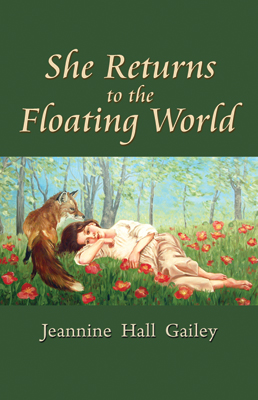
Author of Becoming the Villainess, and her newest book She Returns to the Floating World, that will come out in July, 2011, Gailey celebrates the “idea of woman as monster/changeling, as a way to communicate concepts of female alienation and/or men’s fear of women’s ‘other-ness’.” At the same time, enticing the reader with humor filled succulent bites. Comedy, she describes is “tremendously powerful because it comes in a non-threatening box.” For Gailey, writing “is the product of our imaginations, our upbringings, and the things – intellectual and otherwise – we fill our brains with every day.” A message that reminds us to acknowledge the power of both word and image and the ways in which we choose to live.

1.)    What were the first inspirations that made you desire to become a writer? Who are your favorite writers and how did they change over time?

The first poems I learned by heart (for a fifth-and-sixth-grade school poetry recitation contest) were “Anyone Lives in a Pretty How Town” by e.e. cummings and “My Father in the Night Commanding No” by Louis Simpson. My mom talked me out of trying “The Love Song of J. Alfred Prufrock” as she said the tone was off for a ten or eleven-year-old girl  (and as always, she was probably right.) My mom introduced me to poetry as she was studying it herself in college, and one of my most treasured books is her 1969 textbook, Introduction to Poetry, with her notes in the margins.

In college – well, while I was getting my MA, as my BS was in Biology – I learned that – gasp – there were women poets besides Edna St. Vincent Millay and Emily Dickinson – I got to read Louise Gluck, Rita Dove, Margaret Atwood, Dorianne Laux, Denise Duhamel, and HD – all of whom had some influence on how I write today.

2.)    Who have been the creative inspiration / mentor writers in your career?

I have been lucky, in the past ten years, to meet quite a few of the writing heroines of my youth. – and feel special appreciation for all the professors I worked with in my MFA, Dorianne Laux, Pattiann Rogers, Sandra Alcosser, Joe Millar and Marvin Bell in particular. They all went above and beyond in terms of encouragement and support.

I also had the opportunity to work with writers at conferences like the Port Townsend Writers Conference, which is a great nurturing environment for writers of all stripes – I loved working there with writers like Erin Belieu (who was the first person I heard talk about the importance of women poets volunteering to write book reviews) and Kim Addonizio.

I also credit the writers in my writing group of nine years for helping me keep sane and giving me feedback on poem after poem over the years.

The first writers that I remember wanting to write “like” were Louise Gluck and Margaret Atwood. They both have a sort of hardness to their poetic voices that I was really attracted to (an early attraction to the villainess voice, I suppose) as well as their tendency to mythologize contemporary women’s voices.

Sometimes I think that every woman writer I run into leaves something in my brain – Debra Earling’s vivid storytelling, Dana Levin’s intellectual lyricism, Matthea Harvey’s playful attitude towards language, Denise Duhamel’s irreverent humor. They have all given me permission to do something in my own writing that later I found very valuable. This is why I think it’s nonsense when some writers talk about not reading other writers for fear it will somehow harm or contaminate their own writing.  Every writer you encounter is an opportunity to learn and grow and change, and allow yourself to walk through another gate. Why limit your own vocabulary, your box of tools, so to speak, that way?

3.)    How has your own work changed over time and why?

I notice each book has its own mood, tones, and obsessions – my first book, Becoming the Villainess, is concerned with violence and power, images of heroines and villainesses. The comic book and my old copy of Grimms’ and the Andrew Lang Fairy Books were the main inspirations for the book. The book contains a lot of humor as well as a certain…sharpness in critiquing the role of women in contemporary pop culture.

The second book, She Returns to the Floating World, is more melancholy, and was inspired by my study of Japanese archetypes in folk tales and my lifelong love of Hayao Miyazaki’s films. The forms and the tone differ from Villainess in that I explore forms like haibun and haiku, as the voices tend towards the expression of that feeling “awaré” – a term that means “softly despairing sorrow.” This book was mostly written while I was struggling with illness and the fact that I was not going to be able to have children, and I think those things make their way into the book, though not directly.

My newest manuscripts, Unexplained Fevers and The Robot Scientist’s Daughter, are different from the previous published manuscripts as well. Unexplained Fevers is more language-oriented and focused on issues of the woman’s body and passivity in certain fairy tales (Snow White, Rapunzel, and Sleeping Beauty in particular) and The Robot Scientist’s Daughter is probably my most autobiographical work to date – it explores growing up in Oak Ridge, the fallout of living downwind of Oak Ridge National Labs, and the fraught relationships between fathers and daughters.

4.)    Have you been influenced by different genres, and if so how?

I’m a pretty voracious reader – not just of my own genre, but of fiction, especially short story collections, from Margaret Atwood to Osamu Dazai and Haruki Murakami to Kelly Link. I definitely enjoy literature that falls into the “speculative” category, and love prize-winning books like The Brief and Wondrous Life of Oscar Wao and The Amazing Adventures of Kavalier and Clay that sort of brought to the mainstream or glamorized geek and comic-book culture. The comic book genre influenced not only the poems in Becoming the Villainess but also the structure of the book, which mimics the necessary narrative element (origin stories, the “dark phoenix” gambit of turning a good character evil, etc.) of the comic book. She Returns to the Floating World draws very much on the world of anime and manga, which I have been a fan of since I was a kid, even more so that traditional American comics. I’m a lover of film and television, and I’m not ashamed of it. Hayao Miyazaki’s movies are just as important, just as visually stunning, to me as any art work I’ve seen in a museum. And I love hanging out in museums, galleries, constantly acquiring a new visual library – images are really important to me when I’m writing.

I think our writing is the product of our imaginations, our upbringings, and the things – intellectual and otherwise – we fill our brains with every day.  If you grew up in a cityscape, cities are bound to reappear throughout your writing; if your day job involves amphibians, frogs will probably appear in your poems. So, everything we read, every piece of visual art we encounter, every song we listen to and show we watch – eventually filters through into our creative writing. I was listening to Rae Armantrout read from her new book, Money Shot, and realized from listening how much television she had been watching – I clocked references to True Blood, Buffy, CNN, and porn all in one poem.

5.)    What are you plans for the future?

Well, I have my second book, She Returns to the Floating World, debuting in July, so there will be a lot of readings starting in September, in Seattle, Portland, Cincinnati, and probably some other cities as well. I’m also polishing my third and fourth manuscripts, and

I’m hoping to do some more community-based teaching in the near future. I’ve been teaching online poetry classes for three years and I miss the face-to-face part of teaching.  I’d like to start my own small press someday.

6.)    What are your views on writing by women as it has occurred in the past twenty years?

I think proliferation is important. Not too long ago, most critics compared women poets to a stingy handful (Plath, Sexton, maybe Elizabeth Bishop) – and now, if a critic doesn’t have a bigger pool to draw from when making a comparison, then it’s a sign he is poorly read. There are too many excellent female poets to count on one hand, and I applaud seeing more young women with more ambition that I dared to have when I was twenty, for instance. I am all for young women becoming editors, critics, publishers. I think that’s the most important change that has yet to happen – more women in positions of real power in the writing and publishing industry.

7.)    Who are promising women writers to look at in the future?

My favorite women writers working currently – well there’s a huge list: Dorianne Laux, Matthea Harvey, Dana Levin, Beth Ann Fennelly, Rachel Zucker, Kristy Bowen, Rebecca Loudon, Suzanne Frischkorn, Aimee Nezhukumatathil, Mary Biddinger, Brigit Pegeen Kelly, Denise Duhamel…I could keep going! I like what Tracy K. Smith is doing. Really, I discover new favorite writers every day – I just reviewed a book called “I Have to Go Back to 1994 and Kill a Girl” that was so amazing, I made all my friends read it, by Karyna McGlynn. I haven’t met her, and I’d never heard of her before reviewing that book, but now I’m going to read everything she writes!

As far as fiction, I’m a fan of Kelly Link and Felicity Shoulders and will buy whatever they publish as well. There are a lot of writers, like Helen Phillips and Lizzie Acker, who are exploring a kind of book –  hyrid-form apocalypse-oriented short-short linked collections – that I enjoy a lot.

I am also a devoted fan of the poet s in my writing group – Kelli Agodon, Annette Spaudling-Convy, Lana Ayers, Janet Knox, Natasha Moni, Ronda Broatch, Holly Hughes, and Jenifer Lawrence. They are all amazing writers and I am proud to have worked with them for almost nine years now!

8.)    If you were asked to create a flexible label of yourself as a writer, what would it be?

I’m pretty leery of labels in general, but I’d say it’s safe to say that as a writer I’m ecologically-minded, I’m feminist, I’m interested in pop culture, humor, and mythology, in the language of archetypes and the hidden messages found hidden in our stories, our ads, and our art.

When I look for labels for the kind of visual art that appeals to me, I find things like “pop surrealism” or “underground gothic folk-art.” Whatever words describe artists like Yumiko Kayukawa or Rene Lynch – these words would probably also apply to me.

9.)    There are a number of women writers writing within the realm of fairy tales and mythology. How and why do you use these genres as a platform for feminist discussion?

I think I mentioned I was inspired first by writers like Margaret Atwood and Louise Gluck who often use tart-tongued, updated versions of mythological characters to make cultural critiques; later, reading writers like Alicia Ostriker who did similar work in the space of the Old Testament stories was also inspiring.

I also liked the idea of giving silenced characters in these old stories back their own voices, their own versions of the story – that poor stepmother, the Snow Queen, Melusine and witches and saints, etc.

To me, these old stories, “Little Red Cap,” “the Cinder Girl,” “A Thousand Furs” – they are all encoded messages passed on through generations. Men like Perrault and the Grimm brothers may have had their own agendas in their collected retellings, but the power of the original stories remains at the core. What is the hidden agenda in “Little Red Cap?” Even after they added the woodsman (in the original story, Little Red Cap herself takes an axe to the wolf) the story is essentially one of self-protection. So I think of these stories as the original female empowerment tales. After all, it’s Gretel, not Hansel, who murders the witch.

10.) Your poem “The Changeling,” reads, “It is as you fear; / beneath the push-up bra, / the false set of eyelashes, / I am fundamentally ‘other.’” Do you see this perception of ‘other’ changing from the fundamental to a flexible equality in difference? If so how?

I love the idea of woman as monster/changeling, as a way to communicate concepts of female alienation and/or men’s fear of women’s “other-ness.” I’m not sure if the perception is changing. I hope so!

11.) You have been commended in various reviews for your utilization of wit. Do you believe that wit / humor permits access to the reader that would be otherwise alienating?

I’m a fan of humor in poetry, from Kenneth Fearing to Denise Duhamel, and I like the way that humor can be used as both a welcoming entryway for a new reader and as a devastating weapon in the right hands. Duhamel’s book, Kinky, is a great example of that – a hilarious but  awfully cutting critique of the norms of beauty that little girls are introduced to with Barbie.

I also think of the work that Jon Stewart or Stephen Colbert do with their shows – the idea of displaying the news machine as ridiculous, of producing a cultural critique that’s tremendously powerful because it comes in a non-threatening box. “Oh, it’s only comedy.” So, they can get away with saying a lot more than a typical journalist might.

12.) In Fickle Muse, a review by Sari Krosinsky states, ““Becoming the Villainess” gives a different twist to the old tale of the reclaimed mythic woman. What makes its heroines empowering is not that they overcome their obstacles—they often don’t—but that as much as they lose, they don’t lose themselves.” I am interested in your research process for these archetypes and how you remaneuver these traditional roles into an empowering embrace of the feminine.

Terri Windling’s The Armless Maiden was on the essential list of reading for the writing of Becoming the Villainess, along with a bunch of fairy tale criticism: From the Beast to the Blonde: On Fairy Tales and Their Tellers by Marina Warner is a great one, Jack Zipes, Maria Tartar…The old Endicott Studios online archives have a great bunch of links to essays as well. Margaret Atwood and A.S. Byatt both have really intelligent things to say on these topics in their fiction and their criticism. I love reading Jungian criticism in particular and that is actually how I fell into writing my second book, She Returns to the Floating World, by falling in love with the work of Japanese Jungian scholar Hayao Kawai. (His fairy tale criticism is some of the best I have every read.)

(Sub-note: this web page’s archived conversation contains a great bunch of resources for those involved in researching fairy tale lit crit: http://userpages.umbc.edu/~korenman/wmst/fairytale_feminist.html)

All of this reading influenced how I made my own particular statements about the artchetypes women are expected to embrace, how to transcend them.

13.) Maya Jewell Zeller, in LitList, writes in a review that “Gailey normalizes the fantastic, contemporizes the Gothic, and leads Persephone into Seattle in such a casual way you wonder why it didn’t make your evening news.” Can you elaborate on your use of pop culture and how the juxtaposition to classical myth gives you the space to negotiate the feminine?

I’m afraid to say that when I juxtapose modern contemporary pop culture heroines with mythological or folk narrative heroines, I find that not much has changed for our heroines. They are still struggling with the same issues – the silenced voice, the violence of men against women, the balance of caring for family and caring about work in the realm outside the home. Our comic book heroines are almost as un-empowered as Ovid’s heroines. The juxtapositions mostly illustrate how limited the scope of most women’s lives remains, the way women are hemmed in by cultural expectations, by violence, and by exploitation.

14.) The tales that encrypt the narrow dimensions of traditional archetypes are saturated with violence. How do you traverse this space in a way that invites the reader to listen?

Becoming the Villainess focuses on power and violence in many of the poems, with characters from ancient mythology to contemporary comics. Yes, I always say Ovid was the Jerry Bruckheimer of his time—his stuff is full of sensationalized sex and violence. I thought it might be nice to take a look at some of his characters in Becoming the Villainess and give them a bit more of a POV and a chance to expand on their circumstances. Although fairy tales are often encoded warnings to young women on how to survive, they end up depowered in a depressing number of tales (“Snow Queen” and “Jorinde and Joringel” being exceptions). Women end up playing the victim role far too often even in the comic books of today—a phenomenon addressed by comic book writer Gail Simone on her web site “Women in Refrigerators,” which I reference in one of my poems.

So, how to address these issues without alienating the reader, without becoming didactic? I think I use humor to diffuse some of the issues, and (I hope) that a tone of directness about the issues of violence that confront women today in some of the poems doesn’t cause anyone to set down the book—though that’s probably unrealistic. Using persona poetry—and women’s characters from past and present—to address these issues adds some distance that may make these stories easier to read, and hopefully, easier for a reader to identify with.

profiles in poetics: Patricia Fargnoli

Patricia Fargnoli

Website:  http://www.patriciafargnoli.com/

Patricia Fargnoli is a poet who invites the reader into a world of precise vision as if we are viewing the world for the first time through a microscope. Fargnoli was Poet Laureate of New Hampshire from 2006 – 2009 and the author of several books including her most recent, Then, Something, Tupelo Press, 2009  Tupelo Press — Recent Releases. Here, we encounter spirit, the raptured beauty of the natural world, life and death, in an all encompassing melody spoken with fresh tones of youth.

When asked about women’s writing as it has changed in the past twenty years, Fargnoli admits, “I grew up in the 50’s and was, for many years, a housewife and mother in a time when women’s voices were seldom heard and women’s concerns were not seen as important material for poetry. I used to feel bored and alone in my desire to be heard. No more.” Fargnoli shares her voice in a complicated sense of space and direction, metaphysical meditations that surround our experience of this life, this gift in-between.

1.)    What were the first inspirations that made you desire to become a writer? Who are your favorite writers and how did they change over time?

The earliest poem I remember writing was when I was 7, the year after my mother died from leukemia. It was Mother’s Day and I had the impossible hope that somehow I would be able to reach her and let her know how important she was to me and how much I loved her. I don’t now remember the words I wrote but only remember that I showed the poem to my Aunt Nell (who was taking care of my brother and I) and that she was appreciative, and gentle as she explained to me that no mailman could take it to my mother.

I have loved poetry as long as I can remember.  Our houses always had many books and I was always read to.  When I was very young, my mother read me nursery rhymes. And I had a favorite book of poems, Peter Patter and His Owl , that I asked to have read again and again even long after her death.

After she died, Aunt Nell (a kindergarten teacher who had retired early to care for us) read to us every night from all the children’s classics (The Jungle Books, Black Beauty, Little Women, etc.) as well as from the poetry books One Hundred Favorite Poems, Silver Pennies,

and  More Silver Pennies.   I still own  One Hundred Favorite Poems and go back often to reread the poems I loved then:  “Little Boy Blue,” “The Raven,” “The Highwayman,” and so many more.

I attended Chaffee (now Loomis-Chaffee) prep school was I became the Assistant Editor of the school newspaper.  I wrote poems all through high school (very bad ones) and we published them in the paper.  The recognition I received from pupils and teachers for those poems no doubt motivated me to write more of them.  Besides those poems were an outlet for my adolescent loneliness.  Here’s part of one of them:

“Alone, alone and afraid stand I

Apart from the world and its battle cry”

I married a year after high school, became the step-parent of a six and twelve year old and soon the parent of a baby boy.  On my 21st birthday I had my second child, a girl and three years later another boy.  So by the time I was 25 I was caring for five children and there was no time or thought for writing poems

Although I studied poetry superficially in a couple of adult classes, it wasn’t until I was in my late 30’s that I somehow happened by great good luck into a graduate poetry class taught by Brendan Galvin at Central Connecticut State University. There, for the first time, I learned about the craft of poetry and began to learn about other poets and the poetry world. Along with several other women who became close friends, I took the class over and over…maybe five times, and began, at last to write a few poems that had value.

When, in the 3rd year, Brendan submitted a sestina I’d written to the then excellent journal, Tendril, and it was accepted for their fifth anniversary issue, I was exalted ….and hooked.

Shortly after, another poem was taken by Poet Lore.  I began to read poetry extensively

and attended some poetry conferences (Bennington Summer Seminar, Wesleyan Poetry Conference, The Frost Place (several times).   And I continued to meet regularly with the group of women I’d met in Brendan’s class.  In fact, we still meet….over 30 years later. They have made a significant contribution to my work.

When I first entered Brendan’s class, I knew of only two contemporary poets: Sylvia Plath and Robert Lowell, and these were my early influences.  Over the years, I’ve admired Mary Oliver, Mark Doty, Richard Wilbur, Maxine Kumin, Charles Wright, Louise Gluck, Linda Gregg and more others than I can name.  More recent favorites are: Alicia Ostriker, Ann Fisher-Wirth, Ilya Kaminsky, Michael Dickman, and Sean Thomas Dougherty to name a few. (and I have a dread that I am leaving out some that have been very important to me).

2.)    Who have been the creative inspiration / mentor writers in your career?

I have never been an academic writer and, thus, have had little contact with poets I consider “real life” mentors.  However, Mary Oliver, since she chose my first book, Necessary Light as the May Swenson Award Winner, has been very supportive of my work.  I consider her a mentor and my poetic touchstone. And I am enormously grateful for her kindness and generosity.  Brendan Galvin taught me to write and what it is to be a poet over thirty years ago and I have considered him a mentor since that time.  And, over the years, my workshop poets have motivated me, given me extremely helpful feedback and sustained me in my life as a poet.

But mentors, too, are the poets I most often reread in order to learn from them: W.S. Merwin, Charles Wright, Robert Hass, Linda Gregg, Louise Glück to name just a few.

3.)    How has your own work changed over time and why?

I think one’s work changes as one ages simply because one’s concerns change over the life-span, but also because the world/culture changes, and also a poet is continually influenced by the poetry of others around him/her.  I began by writing mostly narrative poems about my childhood, about the birth of my children, about the events of my current-day life: marriage, travel, learning to be single and independent.  Over time, I’ve continued to sometimes write about my life, especially about aging, but the poems have become, first more meditative and then more lyrical and, for the most part, I’ve shifted away from narrative. Also there has been a shift in subject to exploring places at the boundaries of things…and to questions of spirituality and our relationship to the natural world.

4.)    Have you been influenced by different genres, and if so how?

I’ve not been influenced much by other literary genres though I read both fiction and non-fiction often.  I am, though, influenced by art and am interested in poetry/art collaborations (I’ve been a part of 3 of these) and ekphrastic poetry (which I’ve written a good deal of).  I also have been influenced by music, most specifically by Goldberg’s Bach Variations which was a trigger for my long poem “Pemaquid Variations” which appears in my book, Then, Something.  Movies also have influenced me, especially the techniques of movies, (e.g. close-up, long-shot, panning in, slowing down or speeding up the action).  These are good techniques for poems also.

5.)    What are you plans for the future?

Thinking about the future can be scary when one is seventy-three.  I am still writing almost daily but am finding it harder to access strong words and ideas and thoughts of mortality can easily take over my work.  But I’m hoping to have a new small book of poems published in 2013 by my wonderful publisher, Tupelo Press.  This isn’t a “done deal” yet and I’m currently still working on the manuscript. I also plan to do readings, to teach my private poetry class and to do occasional manuscript and/or poem-group critiques. Poetry is the center of my life and I can’t see ever giving it up.

6.)    What are your views on writing by women as it has occurred in the past twenty years?

I grew up in the 50’s and was, for many years, a housewife and mother in a time when women’s voices were seldom heard and women’s concerns were not seen as important material for poetry. I used to feel bored and alone in my desire to be heard. No more. Women are not only writing about their concerns, being regularly published and being accepted as legitimate and important voices, but they are also blazing new and original paths in language.  This is an exciting time to be a woman poet.

7.)    Who are promising women writers to look at in the future?

Too many to name and I hesitate to single out any.

8.)    If you were asked to create a flexible label of yourself as a writer, what would it be?

Hmmm, my poems can be said to fall into the “traditional” and “post-romantic” category. But I wouldn’t want to be limited by those labels.

9.)    In Janet McCann’s review of your book, Duties of the Spirit, she says “the speakers world shrinks, yet even as it shrinks it opens out – the smallest things provide a kind of satisfaction that/ seems a grace.” I am interested in your perspectives concerning what happens to the spirit in the aging process. Does our spirit in age value the minutia similar to our experiences of the world as children in your opinion? If so, what happens to spirit in-between?

An interesting question! And I can’t answer it in general for all who are aging but only out of my own experience.  And I don’t think we can generalize about all who are aging.  We are still, regardless of age, very individual in our responses to the world. That said, I’ve found myself drawing in as I’ve aged.  This is mostly related to health issues.  My world is smaller and thus I am perhaps more concerned now with things of the spirit and with discovering condolences in nature, in time with friends, in quieter joys.

10.) Your work has been described as meditating on the desire for permanence and in this pursuit recognizing the loss in this pursuit. How do you employ melopoeia, phanopoeia, and logopoeia to emphasize the feeling of loss? Where does the unobtainable lie for you in language?

Loss is inevitable in all life, but especially when one has reached old age and so it is a central theme in my work.  Actually, perhaps due to the loss of my parents in my childhood, it has been a theme all along.  My poems use all the aspects of craft to express this: Believing that a poem is a musical composition I am immensely concerned with sound and rhythm in my poems; and I am also very concerned with image and its ability to carry both meaning and emotion across from poet to reader. I think one of the magical aspects of poetry is that the specific image (a garden, for instance) carries with it all the history of the word “garden” and all the symbolic meanings as well as all the particular meanings each reader brings to the word.  The “garden” in my poem/mind will not be the garden in the reader’s mind and yet the emotion of the word and its deeper sense is magically transmitted between us. As to “where the unobtainable lies for (me) in language?  I am always stretching to try to find words for what is unsayable….and sometimes I can do it…and rejoice.  Many times, I am frustrated and wish I could just invent new words.  I think that that rejoicing and frustration must be ubiquitous among poets.

11. Ilya Kaminsky has described the unique tone of your poetry as one beholding great passion. How do you view this passion your own work and how is this tool utilized

I love that he said that.  And I don’t view that as a “tool” at all, but simply as a deep inner burning of both joy and sadness that I hope to transmit to the page.

12.  Mary Oliver writes that your poems are “vividly and gratefully aware of the comforts and assurances of the natural world; she does not miss a stitch of beauty, neither does she avoid the darker aspects of . . . human awareness of our continual aging, to which she gives sharp and poignant attention.” Can you describe how you utilize the natural world to emphasize the subject matter you write about?

I believe that the natural world is supremely important and that its diminishment in my/our lives is a great loss. Yet, I go to nature for the consolations it provides against loss, and to remind me that we live in a world of great beauty. I go to nature for what it can teach me about human nature and about whatever God there is. And I find solace there if anywhere. Of course, this works its way into my poetry.

profiles in poetics: Jacqueline Gens

Jacqueline Gens

Website: http://www.tsetso.blogspot.com

New England College program blog:  http://www.tygerburning.blogspot.com

Jacqueline Gens comes from a strong lineage of Russian women storytellers who originally migrated to the United States, more specifically Southern California, shortly before she was born. Here, Gens describes her world existing on the “cusp”. In this space of the between, the gritty earth, clouds overhead, language, music, culture; the sacred became, as it still is today, a space of vibrancy and wholeness. Quite similar to Anne Waldman’s forward in Gens’ recently published chapbook Primo Pensiero, Waldman expresses, “this debut bouquet of poems is an elegant display of ordinary mind spiked with the magic and heart of ‘Big Mind’ sensibility.”

When asked about the influence of Buddhism in Gens’ life, she describes her practice as one wrapped around, amidst, below, and between, every moment. She says, “waking up to me is synonymous with touching earth, not escaping for something higher or more abstract.” As co-director and founder of the New England College, Jacqueline tells me “I have served the muse well in this lifetime by nurturing the work of other writers and especially hundreds of new writers finding their voice.” In this way, she nurtures the internal of the feminine in a way that is a gift to the self and importantly to the larger community as well.

1.) Where are you from? What were the first inspirations that made you desire to become a writer? Who, what, where, influenced you as a writer? In other words how did you arrive here as a writer?

I was born in Southern California and lived in Malibu until I was five. That was before it became a Hollywood enclave. I was intensely curious as a child. Even in infancy I would tear through drawers always seeking. I also had a strong sense of the sacred.  I remember looking up into the sky and feeling the magnitude of all that space. Growing up in proximity to the Pacific Ocean was also an early influence — actually something very primal. My mother grew strawberries and I must have spent lots of time outdoors in the playpen while she worked the patch. I love the smell of wet earth and sand.

My mother’s Russian émigré multigenerational family were lively story-tellers and created an oral narrative of their travails and losses that began during the Russian revolution and lasted throughout WWII in China where they eventually migrated. This family of women – mother, grandmother and great-grandmother all ended in the US when my grandmother Lydia married a wonderful Mexican-American sailor in Shanghai named David Hernandez.  Growing up in Los Angeles at the cusps of these two diverse families instilled a love of culture. Then too, I was brought up Catholic although my family was not interested – I enjoyed the sacred aesthetics of a “mission” church with its Latin mass, Gregorian chant before Vatican II. As a kid I read primarily the lives of the saints and fairy tales. But my mother’s family also had some introduction to Chinese and Japanese culture and values. One of my mother’s aunts, the beautiful Natasha, gave up everything to become a pure land nun traveling to sacred sites around western China and later immigrated to Australia after the war where she continued to live as a nun. That interested me. Mostly I felt an outsider while growing up in Southern California as a first generation American so I found solace in reading as a child and a whole community of other outsiders across time and space.

2.) Who have been the creative inspiration / mentor writers in your career?

My reading and writing started primarily as a “refuge” a journey of discovery and interconnectedness with a psychic community of like-minded people. I didn’t get much encouragement so I kept it to myself for many years. My main creative inspiration came from reading the Russians early on and poets like Keats, Whitman, Dickinson. When I was thirteen I discovered Allen Ginsberg. His poem “Kaddish” just rocked my world. I deeply connected with his affect of feeling through the stark imagery of his biblical family narrative — warts and all. That’s the kind of poetry I wanted to write and still do.

3.) Who are your favorite writers and how did they change over time?

I was highly influenced by the Beats beginning in my teens, as I mentioned, like many young people of my generation and also Bob Dylan whose elegant syntax combined with gritty narrative engaged me. Their authenticity and non-conformist life style resonated with my own values ( and probably my whole generation too).  Later, I was inspired by Native American writers especially the work of Simon Ortiz and Leslie Marmon Silko’s Ceremony, along with indigenous poetries from around the world.  In my youth I read Hart Crane, Rimbaud, Whitman and Dickinson, the romantics with great care. 

4.) Have you been influenced by different genres, and how so?

I like a good story in person and on the page. People’s origins interest me.

In my youth, I studied anthropology so world music is important to me for inspiration. The music of Mikos Theodarakis especially who put Neruda’s Cantos to music – and then Bob Dylan—a masterful poet whose syntax is unbeatable – I was just listening to “one more cup of coffee” the other day. When I have insomnia I go on You Tube and search for all sorts of world music and poetry—it’s very demotic. Every obscure culture is on You Tube.

5.) What are you plans for the future:

Finish the 60 poems from The Mansion of Elements based on the Tibetan astrological configuration of animals and elements.

Finish a several long works especially Dragon’s Crease which is still very raw about the creative work of woman hiding their power.

Work on some books relating to A Ginsberg especially his pedagogy of teaching and an annotated Kaddish which has been much overlooked.

Finish a play in verse on the life of Mary Lyon

Hope to write a cool death-bed poem to make its way into my practice lineage—anonymous OK

6.) What are your views on writing by women as it has occurred in the past twenty years?

To be honest (and opinionated), I’m not a great fan of women’s poetry especially more ‘academic’ women. We are talking of a relatively recent emergence in Western culture. I came of age in the era of Sylvia Plath and Anne Sexton whose suicide deaths were public affairs—not great role models. Dickinson’s –“say it slant” is still very much at play, say in accomplished poets like Louise Gluck, Jorie Graham, Marie Howe, the late Debra Digges – a lot of beautifully crafted work covering up trauma just plain wearies me. I’ll never forget being asked to write a paper on Wild Iris in graduate school—jeez—‘flowers talking with God’, what rubbish, and yet so hauntingly beautiful. The tantric practitioner in me says– Throw some raw meat in there –a bit of “recrudescence” a taste of wildness to get real, touch the earth.  That’s my Buddhist training talking. When the Buddha reached enlightenment (woke up), what did he do? His first gesture / mudra was to touch the earth. Waking up to me is synonymous with touching earth, not escaping for something higher more abstract. Poetically, my primary slogans are objectivist—Williams’ “No ideas but in things” and “close to the nose,” based on my allegiance to Ginsberg’s training I received at Naropa.

For me Anne Waldman rises to the top as a female writer who has fearlessly captured the fire of patriarchy and turned it on its head. She once said she thought that Olson’s Projective Verse’ was the most singular brilliant poetic form in late modernism or something like that (forgive me Anne, if I misquote you). Her long poem Jovis will some day be recognized as one of the great epics of all time.  I do wish she would interject some space into her performances so that one has time to revel in the text which is always brilliant with richly complex language and often erudite, especially in Buddhist philosophy and wisdom traditions.

7.) What direction do you see the future of women writers headed in the next ten years?

Women who find their joy and wholeness through their inner language and less in the OTHER missing half.

8.) Who are promising women writers to look at in the future?

Women who are practitioners of body and mind trainings.

9.) Do you feel as if you have a poetic responsibility?

I try not to think too much about my responsibilities otherwise I get apprehensive. I have served the muse well in this lifetime by nurturing the work of other writers and especially hundreds of new writers finding their voice – first at Naropa and then in the program here at NEC.

10.) If you were asked to create a flexible label of yourself as a writer, what would it be?

“Dharma bum” to steal Kerouac’s phrase or to be really crude—”dharma cunt” might be too shocking for the general public.

11.) Can you describe how the Zen Buddhist view on “unknowing,” has influenced and challenged your own work.

The concept “unknowing” whether Zen or Christian or whatever is a place free from concepts, judgments, opinions. I personally have found that uncertainty or an experience of groundlessness is a trustworthy place to begin writing from. This seems to be the physical trigger that accompanies my early drafts of a poem with a cipher of the subject matter, a spark so to speak. In Buddhist doctrine this might be called sunyata or emptiness which radiates luminosity. With this sense of lumen comes the magic or the ordinary seen from fresh perception such as the famous First thought, best thought.

12.) What are your personal views on death and how do you address the concept throughout your poetry.

Death is the big banana for practitioners of meditation. Recently, someone a former colleague with whom I have had a long-standing disagreement with many tensions, asked me (with a hint of Sarcasm) “How’s the Buddhism?” Meaning, I expect, that I am a miserable failure in her book for lacking compassionate behavior. She’s right, I’m sorry to say. Somehow my journey through life has been less about outer development and refinement or persona but about my inner journey.  I can’t seem to get it together to ‘craft’ my outer dimension.

At this point I try to identify my lapses in awareness moment by moment to prepare for death. Each failure is like a luscious wake-up call that refreshes my commitment to begin again. Increasingly my poetry arises from those moments when “I notice what I notice” which can be funny, odd or bits of language that show up in my face, even shocks. An example would be my poem “Backstory” about hearing an old Yankee farmer at a café in Brattleboro say across the room, “Did the Dali Lama ever hold a job?” or recently at a dinner party when an Italian professor friend of mine told me about the wide-spread infanticide of females born in the year of the Fire Horse. I’m interested in waking up and writing poetry that wakes people up.

13.) How has your work with archiving affected how you create and assemble your poetry?

I am thoroughly disorganized with seeming endless notebooks of pure junk—to do lists, interspersed with dharma notes during teachings, the usual unmet personal goals to lose weight go to the gym etc. A few lines of poetry.  Sometimes I review these usually to throw out but I almost always find some fragment for a future poem. I love it when I find fragments of a poem that are startling and without recollection of writing them, as though written by someone else. These must have been shadows I captured before they sprinted away. Not often but on occasion I find myself saying WOW!

In terms of “archiving” SAVE EVERYTHING which is something I don’t follow very well because I periodically ‘deconstruct’ and throw everything out.

14.) What inspired and encouraged you to found the Program in Poetry at New England College?

Chard deNiord for many years really wanted to found a poetry only creative writing program. He and I had worked together on previous projects such as the Spirit and the Letter Conferences in Mexico. Basically, I liked the synergy we created together which was fairly grounded yet open undercutting a competitive edge. He was trained in the legendary ruthlessness of Iowa and I was basically a product of Naropa. He had his poetry friends like Jerry Stern, Tom Lux, and Lee Young Li and I had mine like Anne Waldman & company. We tried to combine these lineages, historically at odds. Today, I feel that the New England College MFA program really embodies our original broad vision where at the same table you can hear conversations about Robert Lowell and Ted Berrigan — Alice Notley and Jorie Graham. The old divisions in the newer generation are dissolved. That excites me. 

profiles in poetics: Piotr Florczyk on translating Anna Swir

This slideshow requires JavaScript.

Piotr Florczyk on translating Anna Swir

www.calypsoeditions.org/bookstore/swir

Poet and translator Piotr Florczyk, tells us that Anna Swir was “profoundly interested how humans live and die; how the human condition figures in their actions.” As one of the most prominent feminist Polish poets of her time and survivor of the Warsaw Uprising, Swir writes the body, as Florczyk describes “both the object and source of pain and desire”. A poet of concision, Swir’s work meditates on the bare bones of moments, teaching the reader and in this case also the translator to “trust an image”.

Florczyk, a multilingual poet whose native tongue is that of Swir’s, translates her voice with the precision of music, image, and idea. From Swir, he expresses that one of the most important lessons she taught him remains in the music; both English and Polish, in his work and hers.

1.) Anna Swir is considered one of the most important Polish poets of her time. Could you speak a bit about her life and work?

Well, she’s important because of her subject matter—mainly WWII and women’s lives—and her treatment of these subjects, but she’s not read or discussed widely in Poland. It seems to me that Poland’s literary history has not kept up with her because there have been so many changes in how poetry functions in Poland, especially since the end of communism in 1989, and writing about war—however honest and concise it is in Swir’s case—just doesn’t register with people anymore. Which, by the way, is why, I believe, Miłosz wasn’t overly interested in that part of her work.

Back to your question…Anna Świrszczyńska was born in Warsaw in 1909 into a family of humble means. Her father was an artist, but his large-scale, historical pieces didn’t sell well. Swir studied Polish literature in college, where she fell under the spell of Old Polish and began writing poetry. She had a poem published for the first time in 1930, though it is another publication, one in 1934, that she always identified as her poetic debut. She lived in Warsaw when Germans occupied the city during WWII, where she worked odd jobs. She survived the Warsaw Uprising, and eventually made her way to Krakow, where she lived for the rest of her life, earning a living as a literati (writing poetry, radio pieces, books for children, and plays).

She was married and divorced once, and had a daughter, who is still alive. Swir died in Krakow in 1984.

2.) Swir is well known for her very private lyric poetry of the body and bodily love, as well as perhaps the most well known Eastern European feminist poet, and also as the poet of war memory, who in Building the Barricade was able to give a voice to more than just one person’s recollections of atrocity. Could you speak about those dimensions and dualities in her work?

I think she was profoundly interested in trying to understand how humans live and die; how the human condition figures in their actions. Since the body is the ultimate receptacle for all of the above, she wrote about it as both the object and source of pain and desire.

3.) As a translator do you ever assume the identity of the writers that you translate? What was your experience translating Swir? If you do not assume the identity of the poet you translate– how did you feel, as a writer in your own right? How has your own work changed, if at all, while you were translating Swir?

I don’t think I take on the identity of the writers I translate, or at least I’m not aware of it. Translating is an extremely private affair for me—the main reason why I translate is to fill some kind of void in my own work as a poet. In other words, I only translate those poets who write very differently from the way I do. The outcome is that I often learn things from them—translating is the best way of close reading and listening to a text—which then become part of my own poetic craft and aesthetic vocabulary. Still, it might be too soon to tell how my own work has changed, though translating Swir has certainly taught me something about the music and rhythms of Polish AND English, and about concision—that is, how to trust an image to be its own thing and to resist elaborating.

4.) Why, in your opinion, was Swir so respected by certain other poets in her generation, most notably C. Milosz?

You know, there is a saying that poets only like those poets who remind them of themselves, which at first doesn’t strike us as the reason why Milosz would find her work so appealing. Still, he was very much a man who couldn’t get enough of life—the carnal and the sensual—and Swir talks about both at a very fundamental level. Perhaps she was his medicine? That is, her poetry managed to remind him time and again what great art is all about: getting to the heart of things, so to speak.

5.) What, in your opinion, could American poets learn from Swir’s work?

Concision, I think. Most American poetry seems to be either experimental or narrative, but in Swir we really see how just a few lines can have a lasting effect. Swir teaches us how to trust an image—and not feel inclined to explain or elaborate things.

6.) What are your views on writing by women as it has occurred in the past twenty years? Do you have different views on writing by women in Eastern and Western Europe? What about the United States?

There are more women writers and poets today than ever before.  In Poland, and probably in other countries of Central and Eastern Europe, there are some interesting cultural changes taking place, i.e., women aren’t afraid to break taboos, especially in regards to traditional female roles and their place in society as a whole, and they write and talk about them. Additionally, both in Poland and the United States, we see a wonderful flowering of women writers and poets who produce the kind of high brow and original work that seemed the sole realm of men writers in the past. Yes, having more smart, intellectually-engaged women writers at work is probably what I’d designate as the most profound change of the past twenty years. It’s a wonderful thing.

7.) When translating Swir what was your biggest focus and or challenge in regards to melopoeia, phanopoeia, and logopoeia.

The biggest challenge was not to overwrite the translations, i.e., to hold back in regards to filling in the blanks for the audience. The musical, visual, and verbal effects of Swir’s verse are supposed to be razor-sharp, even underdeveloped, if you will, and so time and again I had to stop myself from wanting to make things clearer or more profound or pleasing to the ear. Then, of course, I had the help of the wonderful editors and poets at Calypso Editions—they made sure I didn’t get carried away.

8.) What do you believe Anna Swir’s message to be. I am specifically interested in her speculations concerning the human body. What did you draw from it, how did it affect you, and how has this manifested itself in your own work?

I don’t think Swir wrote poetry to pass on messages to us. But clearly some of her strategies hint at her wanting to get to the bottom of what it means to be a human being, and how the human body, which is what we mostly identify if when we talk about each other as people, can be a source of pride but also something to be despised, scrutinized.

9.) In Czeslaw Milosz: Conversations, by Milosz and Cynthia Haven, Milosz states “if one changes the language, one changes the personality completely. Do you agree / disagree with this statement and how does this affect your own writing?

Indeed, Milosz believed that poets should only be writing poetry in their native language, and I understand why he would make that claim, but there’s a lot more to being a multilingual poet than worrying about changes to one’s personality. In my case, I find writing in American English extremely liberating—the language’s impoverished grammar is beautifully supplemented by a vast and fascinating vocabulary. Also, American English is the language I use on daily basis, so it’s only natural that I would use it for critical and creative writing as well. Finally, writing in American English allows me to find new ways of saying things that poets and writers have been saying for centuries; in other words, while Polish seems a bit stale to me, especially if I were to use it for poetry, American English is lively and to an extent still uncharted.

profiles in linguistics: Katie Farris

Katie Farris

Website: http://katiefarris.net/

Katie Farris seductively draws us into worlds that disassemble traditional patriarchal hierarchy and exploit archetypes saturated in our linear western culture. Departing from the traditional view that the fairy tale beholds stringent violence that has traditionally exploited the passivity of the feminine in culture, Farris decides to celebrate, as she regards, the “hard-edged, violent, overtly sexual, and oft disturbing tales they’d started off as.”

More than the genre of fairy tales, however, her work portrays the relationship that art has with the Devil – as depicted in her short-story, Devil’s Face. Farris describes this sexy stance as a way for artists to acknowledge and focus fervently “towards faith,” or an opportunity to examine humanity’s flaws within love’s compass. For Farris, as she attests, “the Devil works for me.” Dreamscape, character development and plot are handled with the linguistic specificity and precision of poetry in every line; a voice that breaks open the feminine in every turn.

1.) What were the first inspirations that made you desire to become a writer? Who are your favorite writers and how did they change over time?

There is a story about me as a toddler— I ran around, naked except for my diaper with a stack of picture books, hollering “Books! Books! Books!” (That’s still how I spend my Saturday nights, incidentally).

The first book I remember reading was actually a Dick and Jane primer, which I can hardly believe, given it was already the 80’s but then, I went to a parochial school in New Hampshire with some old-fashioned ideas. The second was Jack London’s Call of the Wild. There must have been some in between, but honestly, it’s a big blank in there.

As a kid I read mostly fantasy—at its best (Ursula LeGuin, Susan Cooper, Lloyd Alexander, and Madeleine L’Engle), and at its worst (I may be the only person other than my sister who has read all of the “Tek” series by William Shatner. I don’t even think William Shatner has read them all.)

Books provided escape and comfort during difficult times as a child—the families in L’Engle’s books, for example, are always comprised of intelligent, articulate, free-thinking people who relate to each other on such a deeply caring level. I loved being a part of that vicariously. Children don’t have a lot of options for escaping, given their lack of cash, transport, and convincing disguises (leprechaun? Wunderkinder on walkabout?), but books give them that power. I hope to be able to write a young adult novel that does justice to the genre, someday.

My parents were pretty busy keeping my three brothers and me fed, and didn’t have much time for reading, so I didn’t have much direction. So I guess I existed in a space where all books were worthy. Sometimes I wish I could go back. The labels “genre” or “literature” or “good” and “bad” are so oppressive.

I think the first time someone put a book in my hands and said “This is good. You need to read this” was in high school, and the book was Invisible Cities by Italo Calvino. I was reading Equus at the same time, and switching back and forth between these two incredibly powerful works, powerful at such different levels (Calvino’s being the imagination, the lyrical, the structural and Shaffer’s being just pure devastating emotion), so excited me. I haven’t ever reread Equus, but I’ve reread Invisible Cities almost every year since then and every year there’s something new. It’s a well that doesn’t run dry. I guess that’s what that well-meaning person meant by “This is good.”

The next book I read that changed me was Housekeeping by Marilyn Robinson. I’d always been a very fast reader, but it’s impossible to read Housekeeping quickly. It runs like molasses. It took me six months to finish—that’s the longest any book has ever taken me. I say it taught me to read again. To read, as I was later to find out, as a writer.

Now my two great loves are Southern Gothic and Magical Realism. And here is the all-important list, the majorest stars in my sky: Faulkner, Garcia Marquez, Flannery O’Connor, Welty, McCullers, Byatt, Carter, Borges, and Calvino.

Southern Gothic writers are huge for me, I think in part  because my mother is from the South (from a family that, come to think of it, would fit right into a Southern Gothic novel). It’s a different world, a closer world, a thin place—I remember once reading that England “valued its eccentrics,” and that’s similar to places in the South. Isolation is significant, the feeling of being an almost endangered species.

Magical Realism is a natural love for me—the fantastic and dark subject matter, the isolation similar to Southern Gothic (the identity between these two styles runs deep, and Faulkner was Garcia Marquez’s favorite author), and the influence of oral literature and fairy tale. I should probably end here, lest I write an ode or something.

2.)    Who have been the creative inspiration / mentor writers in your career?

Chris Abani and Brian Evenson have both been influential, particularly on my novel. Both experiment with the line between the real and the fantastic, both have an ability to keep looking at difficult subjects, long past most of us would turn away. I’ve been blessed to have them both as fantastic teachers and friends. Not to mention that their work is phenomenal—check out Brian’s Altmann’s Tongue, or Chris’s The Virgin of Flames.

And perhaps most importantly, my husband, Ilya Kaminsky. Our life revolves around writing, reading, and editing—both our own work and each other’s. We have a very different approach to writing—he’s constantly at work, while I tend to do mine in spurts, writing things in my head before I write them down, so they require less editing once they’re on the page. Although we drive each other crazy, we’re also each other’s best readers.

3.)    How has your own work changed over time and why?

In terms of writing, my first love is language, words themselves, strange syntaxes and sounds—it’s always difficult for me to tear myself away from tinkering with linguistic minutia long enough to create stories. On the other hand, my reading has always revolved around plot—by and large, I will take a plot-driven novel over a linguistic meditation, because they’re fun, and provocative, and absorb me completely. The book that combines entertainment with fine language is rare and welcome indeed. 

I have been strong-arming myself in a narrative direction for years because I love stories. Most of the pieces in the “girls” section of boysgirls started off as prose poems that I poked, prodded, edited, and expanded into narrative form. On the other hand, the longest and most traditionally “narrative” story of the bunch, the last story in the “boys” section, “The Invention of Love,” was written in two hours in the ugly basement of the ugly library at Brown University (they call it “The Rock”), and underwent very little editing. I’m a stylist by nature but it’s getting more enjoyable for me to do more layered plotting—I hope the trend continues!

4.)    Have you been influenced by different genres, and if so how?

The way I line-edit has much more in common with poetry than with fiction. Every word must function aurally, narratively, imagistically. I’m extremely conscious of sound—alliteration, assonance, even meter all work their way into my fiction. This is why I prefer working in short forms—in order to maintain the kind of lyric intensity I hope to, it’s very difficult to go much longer. That’s why a novel like Housekeeping by Marilyn Robinson is such a marvel to me—such sonic density sustained over 200 pages!

Genre fiction is another important influence, fantasy and romance novels in particular. The “boys” section of boysgirls is loosely based on the structure of a romance novel, as is my first novel, recently completed. The fantasy influence is fairly clear throughout boysgirls. I cannot imagine writing a book without some kind of magic, some sort of flight from reality. I call it “concretizing metaphor.” Why write about a woman whose eyes look like they’re shooting daggers when you can write a story about a woman whose eyes literally shoot daggers?

5.)    What are you plans for the future?

I’m working on getting my next book published—my first novel. The copy for the book might read something like this: “Dolores, a morbidly obese woman, and her physicist husband James participate in an orgiastic cycle of food and sex until one day when Dolores falls ill. Though she soon recovers, her appetites aren’t nearly what they once were, and James sets out to ‘fix’ her, using any means necessary.” It’s a little bit Frankenstein and a little bit Romeo and Juliet.

Other than that, I’m working on several other pieces that I intend to turn into novels—one about a blind birding expert, and one loosely based on my grandmother, about race in Detroit in the 1950’s. Both are fairly straightforward narratives, a shift away from the fragmentation and fantastic elements of my previous work. We’ll see! And other than that, more of the same—teaching and hanging out with my husband and cats.

6.) What are your views on writing by women as it has occurred in the past twenty years?

I hope you’ll allow me to cheat and talk about the last thirty years, because one of the most important movements I see in women’s writing (and certainly some men’s as well), is the movement to dust off and reinvent the genre of the fairy tale, which people still tend to connect with naïve, folksy, pastoral knowledge rather than the hard-edged, violent, overtly sexual, and oft disturbing tales they’d started off as.

Of course, the fairy tale has always been connected with women to some degree, in the classical sense of “Mother Goose,” but the truth is fairy-tale collectors like the Grimms collected from men and women of all ages and class backgrounds. One of the most famous writers of literary fairy tales was a woman, Madame d’Aulnoy, although, of course, Perrault, Anderson, and the Brothers Grimm are more common household names—in part because of their decisions to ‘clean up’ the more overt sexualized themes (oftentimes they cut the sex and exaggerated the violence), to play up or even create the ‘morals’ or ‘lessons’ within the tales, and overall make them more palatable for everyday consumption.

Angela Carter’s Bloody Chamber was released in 1980. I wasn’t yet much of a reader, or a feminist for that matter, but I can imagine how revolutionary it must’ve been. Take a story like “The Company of Wolves,” in which the formerly much-victimized Little Red Riding Hood is a savvy knife-wielding adolescent who takes control of her situation and her sexuality. I’m not a good flyer, but I read the book on a plane from Ireland to the States and I was pissed off when we landed cause I was 10 pages from the end and I had to get out of my seat. It’s one of the most important books in my personal cannon.

I see Carter’s influence on many different authors, but some of the most important writers taking on her mantle in the last thirty or so years are A.S. Byatt (particularly in her short stories) and Margaret Atwood. In terms of more popular fiction, there’s the novels by Gregory Maguire. And my favorite younger writers working in the genre are Aimee Bender and Kate Bernheimer.

I am also a fan of Bernheimer’s literary journal, The Fairy-Tale Review, as well as her anthologies centered on the fairy-tale.

7.) Who are promising women writers to look at in the future?

I know I’m leaving out lots of people I’ll be kicking myself for forgetting later, but among the ladies I’m looking to are: Tiphanie Yanique, Marie Darrieussecq (from France), Sarah Shun-Lien Bynam, Aimee Bender, Kate Bernheimer, Sabrina Orah-Marks, and Joanna Howard.

8.) If you were asked to create a flexible label of yourself as a writer, what would it be?

Awesome. But I’m flexible on the definition of awesome.

9.) Can you describe your interest with the Devil and how does this personal attention immerse itself in your work?

How come you never hear about anyone selling his soul to Jesus to become a better guitar player? I guess Jesus isn’t in the market. He accepts them gratis, as a sort of donation (tax-deductible?) or rather a gift.

But the Devil is buying—and moreover, he’s betting. He’s preying (I love the closeness of the words ‘preying’ and ‘praying’) on our most human weaknesses, our vanities and egos to get his souls for free. Then again, he doesn’t always succeed. One of my favorite songs is “The Devil Went Down to Georgia” in which a cocky Devil bets Johnny a golden fiddle on the outcome of a fiddling contest. In the end, Johnny wins, and taunts “Devil just come on back if you ever want to try again/ I done told you once, you son of a bitch/ I’m the best that’s ever been.” It is the danger, of course, that keeps us hanging on, and also the chance, however small, that we get away with our hides, our pride, and perhaps a little more in the bargain.

I grew up in a very religious household, primarily Evangelical. For Evangelists, the Devil is hiding around every corner, constantly working his mojo, trying to draw us into his world. He’s the ultimate seducer.

And the Devil is sexy. He’s smoke rings and martini glasses and snakeskin boots. He’s sleazy or clean-cut: he’s muscle-bound or lithe, he’s whatever gets the job done. Grace Paley once said of one of her characters, “Faith works for me.” The Devil works for me, although he’s (or rather I would say ‘It’s’) often behind the scenes. He’s selfishness, he’s cruelty, he’s fear, he’s anger—at the same time that he’s passion, pride, foolishness—he’s everything that makes a story interesting.

Every artist makes their own deal with the Devil. While I’m not at liberty to discuss the particulars of mine, I will say this: without His existence (and the existence of others like Him, His predecessors and avatars) art would not exist. Whether you’re a practitioner of the most debased and subversive kinds of art (think of the Marquise de Sade, Jean Genet, Bataille… come to think of it, the French have a great history in this regard…), or a high moralist who believes that the duty of the artist is to bring man closer to God (William Blake, etcetera), you’re revolving around the same dichotomy. Even artists who are able to escape the Western particulars of our Lucifer-Satan, having never encountered our particular religion/myths, have their own set of dark figures, however those might be manifest. The artist must allow for a balanced view—to cut out one extreme or another is to devalue both art and life.

For me, moral ambiguity is at the center of art. In my short-short story from boysgirls, “The Devil’s Face,” a girl is trying to please the Devil sexually, and it is only ultimately through a sort of compassion, an empathetic moment, a recognition of someone else’s humanity, that she is able to do so. While people could view the story as perverse or degrading, I prefer to think of it as an honest love story. As all my stories are, ultimately.  They are not romantic by and large, but they at bottom motivated by love. And that, for me, may be the only moral imperative.

10.) Robert Coover describes BOYSGIRLS as “Smart and witty, tantalizingly interesting characters: the boy with one wing, the inventor of invented things, the brief sparkling cameo of the cyclops…something of a little tour de force.” How do you utilize “wit” in your work? Do you find this to be a central tone in BOYSGIRLS in particular or one that you employ frequently?

I think the wit that comes through in my fiction is a wit of language, a turn of phrase that complicates or takes one by surprise. For instance: in the “introduction” section of boysgirls, I wrote: “Come shake victorious with delirium tremens and carpe diem.” This line came as a surprise and a delight to me—the Latin lead to more Latin through some bizarre circuitry in my brain. The little slant rhyme of “delirium” and “diem” was an added bonus. I certainly attempt to employ this as often as I can in my fiction, although it is an unstable thing—the only way to ‘employ’ surprise is to allow yourself to be surprised, write unexpected things, to take the turn you never expect. Learning not to control where I’m going has been one of my personal victories as a writer.

11.) Commenting on BOYSGIRLS, Kate Berheimer states that the book“ is one for the classic fairy-tale shelves, joining Borges/Lispector, Calvino/Carter, Andersen/d’Aulnoy with its spectral powers. Katie Farris’s spare and lyrical language levitates here—she is a haunting and new revelation.”Are you addressing specific archetypal structures through this sense of fairy tales?

My intention for boysgirls, at least in part, was to walk the line between the intimacy of fairy tale and the universality of myth—to create a series of modern myths—something that exists outside of any established mythic system but with the same qualities as traditional myth. So, yes, archetypes are important through the course of the book—the Madwoman, the Priest-like figure of the Inventor of Invented Things, the Boy with One Wing as a type of Holy Fool. The idea of the Freak, too, runs deeply through the book—the freak as holy fool, as jester, as truth-teller.

If there was a way to indicate the title “boysgirls” without privileging one sex over the other, I would have taken it—ultimately I decided to call it “boysgirls” only because it sounded better to me than “girlsboys.” I put the “girls” section first to undermine whatever preference the title may have indicated.

Whatever structure there is, mythic or otherwise, is there in part to question the very idea of structure.

12.) Rikki Ducornet delineates that BOYSGIRLS “reminds us that ‘Times are hard for dreamers,’ only to go on to provide a number of vivid singularities…a storm of unexpected pleasures to be dreamed while awake.” What is your opinion of the relationship between dream states and being awake? How do you explore this tension in your writing?

One of the first things I tell my students is that writing about dreams is cheating. The worst possible ending of a story is to have the protagonist wake up from a dream, because most often it’s the dream that’s important, not the waking. It’s a cop-out, a way for a writer not to have to take responsibility (and credit!) for the strange and unusual things that happen in their story. But it’s hard to be brave in fiction, as it is hard to be brave in life.

On the other hand, there are brilliant books built around dreams, waking, and those bizarre in-between places—for example, Madeleine is Sleeping by Sarah Shun-lien Bynum, or Briar Rose by Robert Coover— and these have certainly been influential on me, especially when it comes to the question of the so-called “hynogogic” moments somewhere between dream and waking.

I think the reason the madwoman who narrates boysgirls terms her stories “dreams” is because she cannot accept that they are something more, that they are her reality. The question always through the book, for me, anyway, is whether she’s in control of these figments, or if they exist outside of her. And who is more real, anyway? This bizarre, italicized, disembodied voice, or characters like The Boy With One Wing or the Cyclops? The voice of the madwoman gives the book identity, allows it to be viewed as a unified whole, but hopefully also questions the idea of a narrator at its core—why must we be told a story? Why can’t the story exist without a teller? What control does a storyteller really hold over what is told?

profiles in linguistics: Anne Waldman


Anne Waldman

Official Fast Speaking Music Website: http://www.wix.com/fastspeakingmusic/fsm

Naropa Summer Reading Program Website: http://www.naropa.edu/swp/

Website: http://en.wikipedia.org/wiki/Anne_Waldman

Anne Waldman is a woman who addresses the world with capacity, clarity, and intent. She feels the pain of our strands of linear patriarchal dissonance and seeks to resonate with a voice that confronts and at the same time challenges us to find magic, dream, and non-linear space outside of this constrictive definition. The feminine is embraced with a strength that encourages collaboration and breath. Waldman’s nurturing address is simultaneously flexible, vulnerable, and fierce.

Performance, body, connection to other and spirit unite in the work of Waldman’s art and poetry. She is many, including teacher, activist, scholar, performer, collaborator, mother, wife, woman; an artist that takes up space with intention. Her performances nurtures the body, music, breath, spirit, and inconsistency of language. When asked about her journey to our present, she tells me, “I feel I found my own way, that as a woman I was charged to re-invent the world.”

1.) Where are you from? What were the first inspirations that made you desire to become a writer?

New York City, although I was actually born in Millville New Jersey where I lived a few weeks before returning to Macdougal Street in Greenwich Village. My father was in Germany during the war and my mother went to give birth near his family.

First inspirations: the playfulness and montage of dream, the fragments of conversations, tesserae of information, trying to understand the “body politic” and the female, body at the same time. The orality of Greek drama and Shakespeare (I worked at the Stratford Poetry Festival in Connecticut as a teenager)

I was interested in expressing myself in poetry, in a different kind of magical language – which was an art honored in my family, given priority and respect…

2.) If you were asked to create a flexible label of yourself as a writer, what would it be? How has your own work changed over time and why?

I “poet” covers most of the ground which includes the sense of orality and performance but I am also an editor, a cultural activist, professor at the very fluid Kerouac School involved with “infra-structure poetics”.

Over time, I began to work on longer projects. Investigative projects that go deeper and deeper into my own psychic patterns of consciousness.

3.) Who, what, where, influenced you as a writer? In other words how did you arrive here as a writer?

A sense of being part of a continuum of writing- a community of writing through time was important. The classics, a sense of lineage……the work of Yeats, Wallace Stevens, the Romantics, Ezra Pound, H.D., Gertrude Stein… & the old  poetry- Chinese, Japanese sages. And the singing of  the India artist such as Shubalaksmi, the Egyptian Om Kalsoum. Opera (I listened to the Met broadcasts as a child). I was developing naturally as a writer. It was not about “influence” It was shared concerns, empathy, curiosity. I was going in a lot of directions. It waa about adhesiveness, what is it you love or desire?

I think it’s more important to talk about the directions that were happening organically, not “influences.” We are not simply “tabula rasas” that come in to be influenced! And this model seems so academic. But some of my excellent teachers at Bennington: Howard Nemerov, Bernard Malamud, later back on St Mark’s places where I started working at the Poetry Project (in 1966) Ted Berrigan who was an active “first responder”, my mother Frances LeFevre Waldman, Edwin Denby. The heroes of the New American Poetry: Robert Duncan, Frank O’Hara…I had also met Dane diPrima when I was about 17 years old, seeing her “in situ” at the Albert Hotel with child, alchemical texts, Buddhist shrine was empowering…writers of my own generation- Bernadette Mayer, Alice Notley. But it wasn’t mentorship. I was very clearly finding my own way. Allen Ginsberg was an example of the generous rhizome- connecting up the world. I feel I found my own way, that as a woman I was charged to re-invent the world.

4.) You write that “the poem is a textured energy field or modal structure. The poems for performance seem to manifest as psychological states of mind. They come together in a mental, verbal, physical, and emotional form, making their particular demands on my voice and body. I am the ‘energumen’.” Do you believe that performance poetry needs to encompass different elements that accent the performance or is all poetry performance poetry?

This is a good question. Of course as we read poetry silently we are  also performing it in our heads. And many elements play in our minds, and you can actually also feel the language in your gut, your heart, your own intellect and imagination. It can traverse a lot of boundaries of experience. In a way how you read or present aloud can also do this, but you also want to be nuanced so that the participant- the audience person – can also be involved with their own relationship and individual response. You want to open that up rather than shut it down. I don’t think I would say all poetry is performance poetry. I also have trouble with that term” performance poetry” in any case as the ultimate defining term. It is not adequate to the task.  The root is “parfornir” to do something in front of an audience. But there are subtler issues of the way the language works in the public space, the gestalt of the whole “poet” person, the quality of the voice, the range. I never like these things “rehearsed”.

5.) You have been cited as saying that you believe performance poetry to be a “ritualized event in time”. Could you please expand on this idea of ritual and performance and how it has affected your work?

Work or writing  generally starts in private- the Ur-text as it were, or ur-ideas, and then it is re-actualized in performance in public space in  a particular time frame that has certain boundaries. But it actualizes the energy of the first spark. But the situation might also allow for improvisation. It’s not that there is a proscription for this- or an absolute theory that would indicate how to proceed. Ritual is “an act re-done” and it needs to be as potent as the first time to make the energy come alive.

6.) Lisa Jarnot says of your work that you are “possessed with a passion to witness, to understand, and to describe. For years she has inhabited a poetics of responsibility. Now the highlights of that journey are gathered together, revealing the luminous path that she has carved through the middle of the imperfect world. Vow to Poetry is a vow to life – enlightening, challenging, and crucial to the American tradition.”Can you describe what it means to you to have a poetics of responsibility? How has the development of your spirituality and cultural activism affected your poetry?

I think they are inseparable and inhabit my sense of the duty of the poet, especially in these dark times.

I think you are attentive to the pain of the world and that you hope through art and poetry you can relieve some of that suffering.

7.) I am interested in your perspective regarding the relationship between the melopoeia of language and music and how they overlap/support/emphasize each other in ways that would not be possible without collaboration.

The melopoeia is inherent in the poetry, so the possibilities for “sounding” already exist. And then one can take this forward. And of course collaboration, yes, opens the field, as with the “Cyborg on the Zattere” opera project with Steven Taylor. It has four singers, several musicians and readers. Everything is enhanced through the actual music.

8.) Can you further discuss the importance of collaboration and how this act impacts your own poetics?  What are your plans for the future?

It is hugely important, and I am interested in the mind and patternings of others in the work they do. I don’t formulate these kinds of acts. Every collaboration has its own vision and  shape. Whether it’s working with painter Pat Steir on piece entitled “Cry   Stall  Gaze” that the Brodsky Center at Rutgers is printing- beautifully I might add  – that will be presented as a scroll, or the work I do on my husband Ed Bowes’s movie scripts. Ambrose is very active in what he appreciates and wants in my work.

As for my plans, I am working on a “poundatorio” a mini-opera using the “knot” of Ezra Pound– his brilliant poetry & his difficult & offensive politics– with composer & musician Steven Taylor. A new CD with Ambrose Bye, my son, and we will be traveling to Montreal and Europe soon for performances.. A new writing project. Iovis- the 1,000 page hybrid is forthcoming this June, and that will lead to further travels. A new anthology from the Naropa archive.

9.) Who are promising women writers to look at in the future?

So many I encounter almost daily. Women around the Belladonna collective, women working through the Kerouac School at Naropa nexus, around the Poetry Project. Programs like New England College Low Residency MFA. I think community is important for younger women writers.