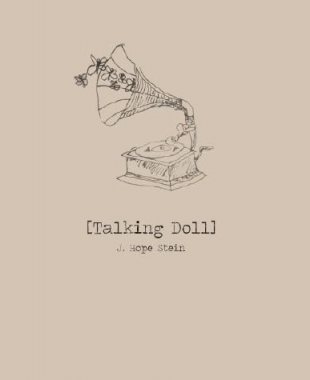
profiles in poetics: J. Hope Stein

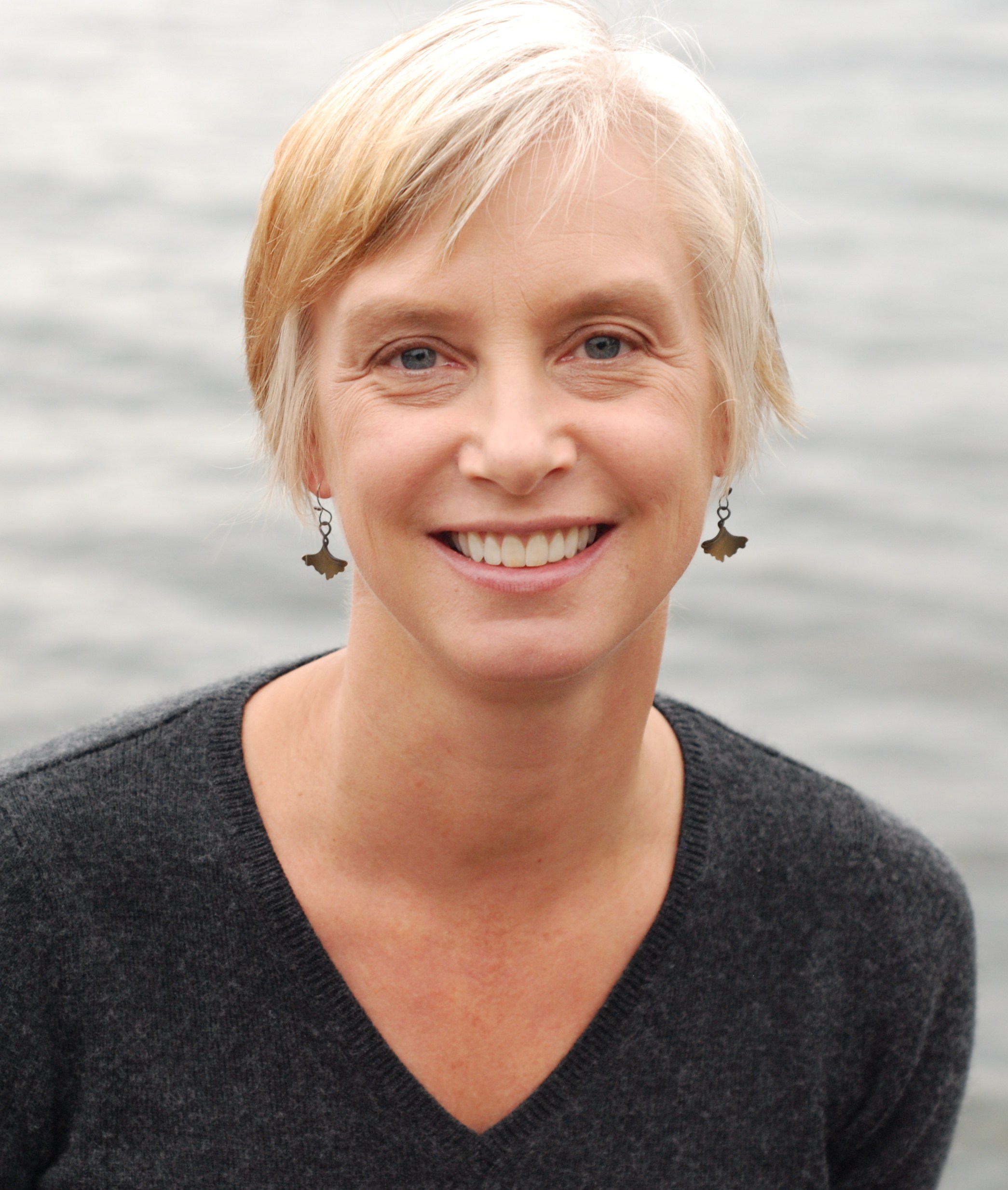
J. Hope Stein

Website: http://www.jhopestein.wordpress.com

http://www.eecattings.com

http://www.poetrycrush.com

J. Hope Stein is a poet that evokes the lyrical expression of her craft and human meditations through persona, pop culture, constraint, and our evaluative methods of communication. Music, Playboy, film, and technological intermediary of intimacy dance in a playground of invention and our perception of this space.

Stein describes herself more as, “a listener than a writer”. She articulates, “I am drawn to experiencing history as a citizen does – without hindsight. I get very little from text books and biography.” Persona, in Stein’s work permits her movement through the weighty abstractions of human experience; “some kind of urge for life”. It is here she extracts, “love is the great antelope we make of each other — to me that is a hopeful statement about love and our individual capacity for invention and reinvention.”

J. Hope Stein is the author of the chapbooks [Talking Doll]:  (Dancing Girl Press),  Corner Office (H_NGM_N BKS) and [Mary]:  (Hyacinth Girl Press).   Her full length manuscript The Inventor’s Last Breath was a finalist in the Alice James Books 2011 Kinereth Awards and her chapbook Light’s Golden Jubilee was a finalist in the 2011 Ahsahta Chapbook Contest.  J. Hope Stein is also the author of poetry/humor site eecattings.com, editor of poetrycrush.com. Her short film, The Inventor’s Last Breath, based on her full-length manuscript about Thomas Edison, was screened at the 2011 Cinepoetry Festival at the Henry Miller Library in Big Sur and will be screened in several venues in 2012.

1.)   What were the first inspirations that made you desire to become a writer? Who are your favorite writers and how did they change over time?

You’ve caught me at a good time to answer this question because I have been trying to figure out why I write the way I do and the answer I think is, that at the time I was learning to read (mostly children’s poetry: Robert Louis Stevenson, Shel Silverstein, Dr. Seuss kind of stuff) I was also sharing a bedroom with a woman who showed me tons of porn magazines–(long story). I would use tracing paper and colored pencils and trace pictures and words and put it together as a book and put my name on the cover. So, my writing has always been kind of a cross between Green Eggs & Ham and Playboy.

Over time I’ve taken in numerous influences– the best thing that I did in that regard is get an MFA at New England College which was kind of a boot camp in which I totally lost my ego– stopped thinking about what I liked and what I didn’t like — and just tried to read and absorb as much technique as I could.

2.)  Who have been the creative inspiration / mentor writers in your career?

My mother was a music publisher so I was consuming lyrics at an intense rate. While I was growing up she represented the lyrics of everyone from U2 to Rodgers & Hammerstein to REM to Sheldon Harnick to Irving Berlin to Leiber & Stoller. And she would bring tons of music home and I would listen to and memorize all the lyrics.

My parents divorced when I was 2. So, growing up, I would see my father on Sundays and we would drive around and he had a new mix of songs to listen to each week and we would just cruise around and listen and that would be the emotional soundtrack of our day and I think that is how I learned to understand him. I mean, I was 5, 6, 7, and felt a very strong sense of communication with him without him saying too much about what was going on in his life. So, lyrics were very important to me at a young age. I could kind of know my father better by the choices he made and my mother’s business was lyric.

My MFA mentors from New England College were rather magical – as artists and as teachers: Ilya Kaminsky, Brian Henry, Malena Morling, Carol Frost.

I am inspired by many of my friends who are in all fields of art and work, especially my husband who is also a writer.

3.)  How has your own work changed over time and why?

When I first started to try to write poetry it was when the person I loved most in the world died. I wrote a lot of short poems which were overwhelmed with grief and regret and guilt and self-loathing. One day I just woke up and took all my poems to the corner of 22nd Street and 7th Avenue and threw them in a garbage can and as a survival instinct I completely cut myself off from poetry and got myself a corporate job. It wasn’t until many years later— I fell in love again and got married, that I found myself writing again and it was at the insistence of my husband, who is also a writer, that I make writing a priority.

Around the same time I met Ilya Kaminsky at the Frost Place and read his book Dancing In Odessa on a train from Vermont to New York and by the time I was back in New York I was like– this is what I want to do. So I looked him up on the internet and emailed him and followed him to New England College.

When I started my first semester at New England College I was pretty determined to not write about the dead boyfriend. I think Ilya’s work helped me see how that is possible – his “we dance to keep from falling” attitude made an impression on me and the kind of writer I wanted to be. Also his love poems have this bringing-sexy-back to marriage spirit going on that is refreshing and I had just gotten married and it was a place I wanted to dwell in my own work.

To avoid the dead boyfriend I went to the New York Public Library and read archived newspapers. I think it was in his book Chronicles that Bob Dylan talks about when he first moved to New York City and started writing songs– he would go to the New York Public Library and read archived newspapers from the Civil War. He said that he did it because in writing his songs, he didn’t want to limit himself to his personal experience. So, rather than starting from a place of expression and emotion I was focused on research and technique and language. What resulted was a much more indirect dealing of my grief. One that inspired me rather than swallowed me.

I wrote a book length piece that was based on Thomas Edison’s last breath which was supposedly captured and saved in a test tube (on display in the Ford Museum in Michigan). So it was an exploration of that rather than personal loss. And I began to write longer narrative poems in voices of different characters. Focusing on technique and language and research and working in voices were all ways I think of protecting myself from what happened to me the first time I started writing poetry. So I was creating some distance from myself and I was learning a ton while doing it.

My second semester at New England College, I worked with Brian Henry and three really important things happened immediately in the first month which further changed my work. I read Brian’s book Quarantine, Notely’s The Descent of Alette and Inger Christensen’s It. They all have this incredible trance-y electric lyrical quality that mesmerized me. They are all experimental in nature and they all adhere to strict form.

The trance-y lyric made me realize what I wanted in the quality of my own lyric.  The experimental nature made me more confident in my individuality as a writer.  I began to trust my instincts. And with form – I finally understood form – not intellectually the way you are taught in school, but I understood it in my bones as a necessity for my poems to live. I really love Frost and I love to read his lectures, particularly his thoughts on form.

Currently, I am looking at all the material I have written over the past 3 years and there are lot of historical figures that I use — I kind of have my way with them to work out my own intellectual and emotional explorations.  In that sense I’ve been a bit of a coward.  Now I’m trying to pull a layer back and get a little closer to myself – not too close so that I will swallow myself up, but closer.

4.)  Have you been influenced by different genres, and if so how?

There was a 1-person play I saw by Anna Deveare Smith called Let Me Down Easy that haunts me and informs my work. There is a final scene which powerfully describes the moment of death and I think that has been in my mind through much of the writing of The Inventor’s Last Breath.

CocoRosie’s first album which they recorded in a bathtub moved me by it’s sheer creative force and is part of what got me to start writing again.

Kanye West is big for me.  When I first heard his 2010 album My Beautiful Dark Twisted Fantasy, I felt like someone had just broken through to the new century. As though everything had been still and dead before that and he just broke through. I love his other work, but it’s that album that just woke me up.

The honesty of the Violent Femmes and Tracy Chapman is important to me.

The camerawork in Robert Altman films (especially McCabe & Mrs. Miller) as well as Peter Weir’s Picnic at Hanging Rock has a lot to with how I think in image. Sadly I can’t quite transform it into words, but that’s the goal.

The use of musical refrain– the trumpet—in Fellini’s La Strada. It’s a masterful and moving and meaningful use of repetition. Again, I don’t get there in my own work but that is the goal in my mind. That movie kills me in the best ways. And it has everything to do with that trumpet.

I am inspired by the creativity and the liberties of Todd Haynes in his loose biopics of Dylan and Davie Bowie. Most of my work is loose bio.

I just restructured my manuscript to follow the structure of Hannah and Her Sisters (although no one would realize it).

Archived newspaper. I read so much archived newspaper and incorporate it into my work. The research I did on my Edison manuscript was almost entirely based on archived newspaper. I am drawn to experiencing history as a citizen does – without  hindsight.  I get very little from text books and biography.

I saw an early cut of the movie Compliance last spring which I think is coming in theaters this year. It directly influenced one of my poems called Ted & Sylvia. Compliance is based on a true and very disturbing story of sexual crime. And there was something in that film that made something click for me and it continues to inspire my new work. Craig Zobel is one of my favorite new directors. He has a gift for nailing some of the honest and often ugliest aspects of the human condition.

I was away most of January in a remote place in the central mountains of Oregon, where I lived in a cabin and had a spurt of writing that I am grateful for. I was listening to this playlist of like a 100 tracks in constant rotation: Beirut’s new album, Lovers- past 2 albums, Olof Arnalds – all albums, King Creosote & Jon Hopkins new album, live readings from Hayden Carruth, live readings of John Ashbery, Live readings of Wallace Stevens, the new album from Little Scream, the new album from Active Child and James Blake’s latest album. The energy of these works, in my mind, is very connected to energy of what I wrote.

That’s just the first few things that come to mind.

5)    What are your plans for the future?

I’m continuing my new work – Lob Story. I’m going to be a story editor on a film project. And have some other short film pieces I’m working on. I have a new chapbook in July called [Mary]: (Hyacinth Girl Press). I’m also collaborating on a project with Joanna Penn Cooper that I’m excited about. It is both artistic and philanthropic.

6)    If you were asked to create a flexible label of yourself as a writer, what would it be?

I’m more of a listener than a writer.

7)   In your chap book, Corner Office, published by H _ N G M _ N   B KS 2012, we enter into a world of disassembled bodies that unravel and crumble into the passivity of tombstones. But while the body remains inactive, love is an action that breaks through the technological experience of our present everyday lives. You comment on this intimacy as it filters through emails, computer programs, office supplies, and windows. Seemingly searching for the warmth to utter, “I lob you”. Can you discuss how you see intimacy interacting in our present technologically focused culture?

Hey, it’s funny you should pick that line “I Lob You”  because I’ve expanded on that and have just written a new 20page chunk of work called “Lob Story”. I have never really asked myself this question about technology, but now that you mention it I can see that it is all over my work.

I have a metaphor in there somewhere likening the skyscrapers as growing towards sunlight like coral reef…and I suppose I was thinking about how on the bottom of the seafloor where there’s no sunlight – there are still urges for life.

The experience this was loosely based on was when I was sharing an office cubicle with this guy and there was a lot of sexual tension between us. In that environment with people around us all the time– being able to hear what we say and see us– the urge seeped through in strange behavior– the details about how he took pictures of me from his desk and emailed them to me…he took a picture of a picture of my mother (and hung it over his desk), those are details that stuck with me of this kind of strange intimacy that we shared. There was also something withheld that stuck with me. And in moments like this I feel like one can feel oneself being governed by something that is not really them, some kind of urge for life.

Regarding your question about technology– There were times when we were sitting right next to each other in our cubicle and he would both call me on the office phone and instant message me on my computer at the same time. And on the phone he would be like “hey, how are you?” while simultaneously instant messaging me “fuck you fuck you fuck you”. Those were the days! Now our relationship is a completely normal friendship because we are not in that circumstance. The urges play against the structure of the circumstance. In much of my work I don’t start with language, like other poets do (although I spend a lot of time thinking about language). I start with rules and form and structure because my tendency is for all urge so when I give my urges a structure to live within, it ultimately helps me find the tension.

9)  Punctuation plays a commanding role in your collection of poems, Insomniacs. Described as “units of personality,” by your Thomas Edison character in the opening piece, we are visually able to see the subversive quality of punctuation. We witness how it affects our experience of language in the musical field of language in addition to how it is arranged on the field of the page. In the poem, “The Boy,” he “hears the earth/ in a series of dashes and dots”. And in “INVENTOR LOSES HEARING AS MOTHER READS WHITMAN,” there is a passage made up entirely of punctuation “You say you can feel it in your stomach. / .-.. — .- ..-. / — -. / – …. . / –. .-. .- … … // .– .. – …. / — .  loose the stop from your throat.” We are also given footers throughout the collection of poems. Can you describe your intention behind this confronting punctuation and how it is evaluated on a universal platform?

My manuscript was about an Inventor character (loosely based on Thomas Edison) and I was doing a ton of research and Edison proposed to his second wife Mina by tapping on her wrist in Morse code.  It was kind of like their secret language.

The second thing that gave me the idea was that Ilya had me reading Paul Celan’s “Death Fugue” – the version translated by John Felstiner–  and he noted to me that it was interesting how in Felstiner’s translation he chose to keep in some lines in German and the power of that. So that planted the seed for me to have something on the page that was not fully translated — something that was preserved within the experience that I was translating from Edison’s life.

The Morse code came out of an instinct to make the work more visually mysterious to myself. As though it’s inhabited by something that I don’t have full knowledge of.  This is similar to my use, which you mention, of the over 90 interruptive endnotes in my long poem Conglomerate. Like the Morse code, the endnote markings within the text represent something that is present but you cannot see it exactly. In that sense, there is something spiritual to me.  And I agree about your observation of punctuation being musical. To me it’s very percussive.

I do think there is a connection between the “units” of punctuation and the quote I use from Thomas Edison regarding his theory of life and death and man being comprised of “life units.”  I can’t articulate what, but I think you are right.

Regarding your question about punctuation on a universal platform.  Punctuation, generally works as a breath manager – determining when you get to breathe.   The book is called Inventor’s Last Breath and The Inventor has “breath experts,” so yea, I think that is all related.

10)    Talking Doll, a chapbook from Dancing Girl Press 2012, focuses on the “Inventor”. The inventor orchestrates artists that “pencil 60 straight-edge diagrams,” “breath experts,” that “mold 30 different breeds of diaphragm,” “experiments of the flesh”.  Love later we find out turns out to be an antelope head hanging over the mantle of a winter fireplace. As readers, we are confronted with the question: “is this love or experiment?” and when the response is love, “is it love for love or for the sake of experiment?” How do you see love functioning in these two separate roles and how does the role of the inventor or artist participate in this discussion?

To me, the inventor and artist are the same. Edison said you need to be a poet to be an inventor.  I guess I see love the same way. You need to be a poet and an inventor. Certain people bring out different things in you, so there is the chemical/scientific aspect.  Love has a lot of possibilities for experimentation and invention. The antelope over the fireplace image, just as I’m thinking of it now,  reminds me of Woody Allen’s dead shark analogy from Annie Hall – in which he says that a relationship is like a shark and needs to move forward and if it doesn’t it’s a dead shark. But later I say something like — love is the great antelope we make of each other — to me that is a hopeful statement about love and our individual capacity for invention and reinvention.

The “Is this love or experiment” line probably is asking the question of whether something is purely chemistry or if there is something deeper.  In the case of the Talking Doll (one of Edison’s inventions) – who is speaking in this poem as she is being put together by the Inventor — I think she is wondering if his motive is just to make her for the sake of a scientific invention – for his love of science — or if he is truly passionate about her. There was a crop of talking dolls that were defective — Christmas, 1889 or so — that were just piled up in Edison’s factory in a corner somewhere. One second they were the hottest Christmas item, the next, they were all returned to the factory because they didn’t work. Poor girls, I felt bad for them.
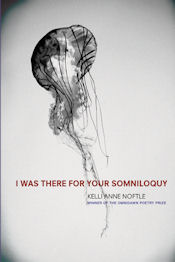
profiles in poetics: Kelli Anne Noftle

Kelli Anne Noftle

Website: http://www.kelliannenoftle.com

http://omnidawn.com/contest/contest_2010.htm

How much of yourself do you edit as you present yourself to the world? What is the position of artist to reveal inter-dimensional aspects of self that we connect to a universal consciousness that is breadth of experience? Poet, singer songwriter, and artist, Kelli Anne Noftle, whose book, I Was There For Your Somniloquy, winner of the Omnidawn book prize forthcoming next month, discloses that in her process, she “tend[s] to disappear, which seems essential to art-making. In those moments, imagery informs the language … following a trail of obsessions down the internet’s rabbit hole no matter how bizarre or unrelated the material may seem at the time.”

Take for example Noftle’s poem, “Mating Chain,” where she exorcisizes the bizarre mating sexual excursions of sea slugs and explores how this references, “human sexuality and nature vs. the ‘rules’ of romantic relationships”. Here, personal connection is mirrored in a “polyamorous experience,” and we are given opportunity to question intimacy, gender, and our more savage “animalistic instinct”. How does sleep and dream effect these deliberations? We face scapes of multiplicity, fear, and risk, present in the larger scope of her work. Noftle’s musical method evokes a more organic, “messy” quality that inspires chance and less linear examination.

Kelli Anne Noftle grew up in a small town in central Virginia. She has a B.A. in Visual Art and is a graduate of the Master of Professional Writing Program at the University of Southern California. Her work has appeared in several literary journals including Colorado Review, The Journal, VERSE, Blackbird, Cream City Review, Conduit, and Harvard Summer Review among others. Her first collection of poems, I Was There For Your Somniloquy, was selected by Pulitzer Prize winner Rae Armantrout for the OMNIDAWN BOOK PRIZE and is forthcoming in 2012.

1.)    What were the first inspirations that made you desire to become a writer? Who are your favorite writers and how did they change over time?

I saw the movie Poltergeist when I was four (way too young!) and started writing short stories about death and the supernatural. Consequently, I’m quite afraid of the dark even as an adult and themes of loss and fear are still very prominent in my work.

It wasn’t until my parents’ divorce that I started writing poems. I was extremely prolific as a teenager; I wrote a poem every night before bed in high school. Allen Ginsberg’s Howl was the first collection of poems I bought when I was fifteen. Today, my favorite poets/writers are Christian Hawkey, Mary Ruefle, Lyn Hejinian, Jorge Luis Borges, Angela Carter, Christian Bök, Roberto Bolaño, Jennifer Egan, and Gertrude Stein.

2.)    Who have been the creative inspiration / mentor writers in your career?

The first poetry course I took was in graduate school with the exceptionally talented and brilliant Elena Karina Byrne. Elena mentored me, introducing me to contemporary poetry as well as the Los Angeles literary community.  My fiction professor, Shelly Lowenkopf, is also a dear friend.  I am indebted to their support and encouragement.

3.)    How has your own work changed over time and why?

I learned to stop editing myself in the creative process. When I write, I tend to disappear, which seems essential to art-making. In those moments, imagery informs the language. It’s all about listening to that inner voice and getting lost following a trail of obsessions down the internet’s rabbit hole no matter how bizarre or unrelated the material may seem at the time. I’m usually pleasantly surprised by odd little connections the brain makes—what may seem like a non sequitur can become the driving force of the poem, a conceit that tethers it all together.  Overall, I trust myself more as an artist/writer than I did when I first began. Reading contemporary poetry has changed my work too.

4.)    What are your plans for the future?

To write a novel and produce/record another album using my laptop.

5.)    Who are promising women writers to look at in the future?

Emily Jayne Motzkus. The Offending Adam published her chapbook, The Henry Miller Remix, last year– it literally gave me chills, it’s so good. Another brilliant poet is Molly Brodak. She won the Iowa Poetry Prize a few years ago and is the editor of one of my favorite online lit magazines, Aesthetix. (http://aesthetixpoems.wordpress.com)

6.)    If you were asked to create a flexible label of yourself as a writer, what would it be?

My foundation is in visual art, specifically sculpture and installation. I want to be a writer who constructs the poem or narrative by building with the existing objects, language.  I’m a poem-maker. Read Larry Levis’s poem, “Linnets.” It explains everything.  (http://www.blackbird.vcu.edu/v8n2/poetry/levis_l/linnets_page.shtml)

7.)    The balance achieved between music and lyric must be uniquely balanced. Structure performs in distinct and similar roles in both song and poetry. Some argue the composition of the lyric in a song requires more precise articulated poignancy to deliver a message to the listener when digested in balance with the music that it is accompanied with. Just as there are different structures in poetry, we have the same in music. The possibilities of these unions address the promise of diversity in structure and aesthetic. How do you approach this complexity? Can you please elaborate on your methods of songwriting and poetry and how they aid, differ, attract the listener in different ways? Do you find that some structures are more apt to invite/alienate the reader/listener?

My song-writing brain gives my poetry brain a rest when composing music. I can’t say I’m “composing” because it feels sloppier than that, a very organic process that is heavily reliant on instinct and guessing. Unlike poetry that requires a great deal of editing after the primary creative burst, song-writing (for me) has a lot to do with luck. My songs range from the conventional verse-chorus-verse-bridge-chorus  structure to a more experimental soundscape. It’s sometimes difficult to play with other musicians because they will tell me to “play the verse again,” and I’ll play the chorus instead because we have different perceptions of song structure.

When writing lyrics, occasionally I borrow a line from a poem, but I tend to choose language I wouldn’t use in my poetry. For example, in one of my songs I’m just chanting the phrase “I DON’T LIKE YOU” repeatedly and it’s my favorite song I’ve ever written . (www.miniaturesoap.bandcamp.com) People seem to enjoy it more than others too. I love listening to pop music. I’m okay with lyrics that are completely banal and cliché. Britney Spears and Rihanna? Yes, please. Sitting in LA traffic makes me crave catchy hooks and fast beats.

8.)    Your poem, “Mating Chain,” begins with a description of the mating ritual of snails: “When three or more sea slugs mate in unison, the first animal in the chain acts exclusively as female, the last as male, and the others as male/female simultaneously.” The poem leaves us with, “But what’s the difference between this hunger and parasitic tendency? I twist and steer each tentacle, tying knots against the stillness. This one to symbolize love and the other, savagery. I’m learning the subtlety, braiding between them.” I am interested in the “subtlety” of gender/love/connection with one to “other” perhaps even these feelings within the self that you seem to address here. How does this relate to the body’s repetition in loneliness? Are you suggesting a tension between the actions of a body and their relationship to the savagery of the process or the connection to the mind? Where in your opinion does love lie in these subtleties?

This poem is one in a series about sea slugs (Nudibranchs).  The poems evolved after attending a marine biologist’s lecture on the mating habits of sea slugs. I’d fallen in love with two people at the same time that summer. It was thrilling and unexpected and messy. One of the people I was in love with became involved with someone else too, so it was this complicated, hopeless situation where I think everyone got hurt eventually. The presentation on Nudibranchs made me question human sexuality and nature vs. the “rules” of romantic relationships. I fantasized about being a Nudibranch engaged in a mating chain where the individuals involved could replace emotional connection with animalistic instinct and swap genders at will. I imagined it to be seamless. This polyamorous experience contrasted with the image of a lone Nudibranch presented in that same lecture—a sea slug that can only move by folding itself in half and reopening over and over as if hinged in the middle, like a snapping jaw or flapping wing. There was a video of it propelling itself upward into the currents, a repetitive motion of opening and closing against a backdrop of dark interminable sea. I identified with that creature, thinking that’s me— wanting desperately to relate to or connect with the “other,” but finding myself alone, working feverishly just to move forward. This is basic self-preservation but it looks terribly forlorn. We have more in common with a species as foreign as the sea slug than I’d ever imagined possible.

There’s a Jenny Holzer quote I love that says, “Having two or three people in love with you is like money in the bank.” To which I would have to respond with a quote by Biggie Smalls: “mo money, mo problems.” I think some of my loneliest moments in life were spent when I was in a romantic relationship (or relationships).  Savagery becomes necessary. At the end of the poem, I’m working to reconcile the two by braiding them together—realizing the difference between desire (hunger) and co-dependency (parasitic behavior) is only very subtle. How does love fit in exactly? I’m still trying to figure that out. Maybe the poem is about a struggle to find that balance.

9.)    In the introduction to your poem “I Follow You All Through the House with My Ears,” published in The Nepotist, you admit that sleep should be safe, prompting us to identify the alternative. The passage I am most interested in reads, “It is inevitable what language will do.// Do not repeat this, what I’m about to say—/Your hands will circle the kitchen/sink, making it clean.” The poem speaks to enveloping that in our dreams which we do not in our “awake” lives. Language here is able to traverse in both realms. This challenges our perceptions of real, our ability to perceive and communicate what are synapse register in a perceived grid of light. The limits of language’s fragility embraced in the miscellany of experience. I am attracted to the last phrase “make it clean”. The poem instructs, “do not repeat” “making it clean”. Do not make it clean. What in your opinion is clean and how does this relate to the conscious and subconscious nature of dreams?

Sleep is dangerous.  In evolutionary terms, if you look at the development of terrestrial mammals, sleeping with both eyes shut is a curious adaptation. Most reptiles, marine life, and birds sleep with half of their brain fully conscious while the other half rests – one eye is always open, on guard for potential predators. Some scientists theorize there are still active circuits in our reptile brain, alerting us to the risk of being harmed or killed as we sleep. This split brain behavior is evident in sleepwalkers and those who suffer from parasomnias/sleep disorders.

Years ago, I was in a relationship with a man who engaged in multiple parasomnias –sleep walking/ talking/eating, sexsomnia, night terrors, and bruxism. I found him eating my ice cream in the middle of the night, but he had no recollection of it the following morning. I researched case studies of somnambulists who inflicted pain upon their loved ones and partners because they were enacting dreams of being physically threatened by an imaginary predator. The speaker in this poem witnesses violence, but also partakes in it. Ambiguity in the voice emerges from the negotiation between a conscious and a subconscious place and bodily actions are dictated from a divided brain. Language is slippery and filled with holes, so sleep-talking (the somniloquy) further reveals its fragility. “Making it clean” can be seen as the act of erasing, trying to remove the inherent flaws of language, an impossible task.

10.) Published in The Off Ending Adam¸ your poem “what we make,” expresses,

Someone told me you can fall into bad habits if you use white consistently. It’s an analgesic. When you want to lighten the sky, you dab the zinc into your blue. When you want to push a little pathway across the thicket, you blot ivory into your Payne’s Grey. It saves time. That’s why I started dumping all my pigments into a bucket of white. It was mostly just to save time.

I am interested in this poem both because of your commentary and experience with studio art specifically in the medium of paint, as well as our cultural adhesion to the color white, and our western cultural perception of light. In this poem, white saves time. What then is color?

A fellow painter once advised me not to use white or black paint when mixing color. This was to preserve the intensity of color because tinting or shading a hue takes away from its particular vibrancy on canvas. Mixing primary and secondary colors to get the desired shade is more difficult than adding white and it requires skill, experience. White (often associated with religious purity and innocence) would actually diminish and dilute the “purity” of color on canvas. It’s an interesting concept; I had not consciously considered the western cultural values/perception of this color when writing this poem.

This is part of a series of epistolary poems addressed to an artist who challenges the speaker. An artist who is not afraid to make mistakes and risk loss.  Again, here is a relationship where fear plays a large role in the dynamic.

profiles in poetics: Lynne Thompson

Lynne Thompson

Website: http://www.perugiapress.com/books/bookpage.php?year=2007&pagetype=sample

Lynne Thompson is a story-teller. A poet whose cultural framework is rooted in her African-American and Cheyenne heritage. For Thompson, the responsibility of the writer is to “tell a story,” continuing, “I think story-telling is what captivates the human race above all things.” Although she did not grow up playing an instrument, “jazz, rock-an’-roll and the American musical theater” parade her poetic demonstration. She indulges, “distinctive rhythms and cadences are cemented in my brain.” The visual arts with an emphasis on mixed media, prose, and the structure of theater, are equally inspiring. She delectably describes these moments as “economy wrapped around big ideas made accessible through the personal.”

In retrospect of women writing in the past 20 years, Thompson asks us to recognize that “it seems women are increasingly exploring their worlds as they understand them in ways that are highly original and fresh; excavating the detritus of what has been previously thought to be unimportant or uninteresting by an academy largely composed of—and run by—men.” She comments in response to her own cultural duality, “I have taken on the responsibility for framing these family stories of displacement and dislocation and complicated the task by choosing the genre of poetry with which to tell them. Complicated because the poet seeks, in Dickinson’s words, to tell the story “slant” rather than straight on and therein lies the [sweet] challenge.”

Lynne Thompson was born and raised in Los Angeles, California, by parents born in the Windward Islands, West Indies. She received her B.A. from Scripps College and a J.D. from Southwestern University School of Law. She currently serves as the Director of Employee and Labor Relations at the University of California, Los Angeles. An active member of the Los Angeles literary scene and a Pushcart Prize nominee, her poetry has been widely published and anthologized.

1.) What were the first inspirations that made you desire to become a writer? Who are your favorite writers and how did they change over time?

Like so many young girls of my generation, Little Women, was the book I read over and over again (don’t think I ever got over Beth dying). I was lucky to have four older brothers who never complained about taking me to the library so I devoured everything that the stern librarian would allow me to check out! I do remember reading every Nancy Drew cover-to-cover before progressing to Cherry Ames, Nurse, Jane Eyre, Clara Barton, Emma Bovary…..seeing a theme here?

The love of poetry, in fact, of all language was inspired by my father who was a closet poet (my mother going in dread of such “romantic notions”). He read the classics to me, including those of African-American writers and, most particularly, the poetry of Langston Hughes. I specifically recall thinking how can I make words sound like that? My early plan was to study linguistics…

My reading habits have changed over the years with my willingness to read with greater attention and to tackle the work of writers whose approach to their material is more of a challenge. A good example of such a challenge is poet M. NorbeSe Philip’s Zong, a completely original work about the eponymous slave ship and the ordered death of 150 Africans so as to recoup insurance money. The book defies easy categorization—it’s more than poetry, prose or legal treatise—and requires an open mind in the reading due to, among other things, the choices Philip made in terms of typographical fragmentation and derangement on the page. But Zong is so satisfying if the reader stays with it.

2.) Who have been the creative inspiration / mentor writers in your career?

This is a tough question as I always feel sure I’ll exclude someone who was, of course, an influence. Someone I must always credit, however, is the east coast poet, Jayne Cortez. She came to my alma mater, Scripps College, for a semester, I believe, during my senior year and was a revelation. Here was a young, black, woman (very much alive; read: not a dead white male) who was not only writing and publishing poetry but breaking with tradition by eschewing punctuation and all the other conventions that I’d been taught about the craft. It was a transformative experience to hear her and read her work.

Other influences who come immediately to mind are Jane Hirshfield, Lucille Clifton, Pablo Neruda, and Toni Morrison – the latter not often thought of as a poet but should be.

And I’d be remiss if I didn’t mention as mentors two poets that I study with regularly because I have the fortune to live in southern California: Dorothy Barresi and David St. John. My workshops with them over the past several years have been invaluable in my creative development.

3.) How has your own work changed over time and why?

When I first began writing seriously, I went in fear of form. Too constricting, I told myself, when the truth was I didn’t think I was up to the task. Over the past few years, however, I’ve been experimenting with form, starting first with the glosa and now on to villanelles and pantoums and most recently, abecedarians. Because I’m still relatively new to this fixity, all I can say is that the writing requires a different kind of attention and willingness to follow rather than lead which feels right at this stage in my creative progress.

Nevertheless, I still go in fear of the sestina. One canzone I wrote reads like an overstuffed mushroom cloud…

4.) Have you been influenced by different genres, and if so how?

Not only different genres, which I’ll get to in a moment, but also different art forms, most obviously music. Although I play no instrument and can’t hold a tune, I have been very influenced by the music I heard growing up: jazz, rock-an’-roll and the American musical theater. These distinctive rhythms and cadences are cemented in my brain and are a feature, hopefully, in all of my work.

The visual arts have been an influence as well. In the fall of 2011, the Hammer Museum mounted an exhibit Now Dig This: Art & Black Los Angeles 1960-1980 and it is still gnawing on my imagination. One can’t see a mixed media assemblage like Betye Saar’s Spirit Catcher, for example, and not run for the pencil and pad.

Of course, prose—fiction or non-fiction—is also an influence. What’s coming to mind as I write this is Alice Walker’s not-to-be-forgotten The Color Purple and a really marvelous book of stories and essays, Haiti Noir. In the realm of non-fiction, I was knocked out by Isabel Wilkerson’s The Warmth of Other Suns, a superb example of engrossing truth-and-story-telling.

Finally, I love live theater and the way its structures work. For example, I’m captivated by the bang-for-the-buck Suzan-Lori Parks put into Topdog, Underdog: two characters, one small room–wow!—economy wrapped around big ideas made accessible through the personal….exactly what I’d like to achieve in my own writing.

5.) What are your plans for the future?

I have two concepts knocking around in my head that I want to explore, hopefully when I’m at the Vermont Studio Center later this year. One is for a stage play centered upon a question I held for years concerning my mother’s attitudes during World War II. Only recently, with a greater sense of empathy for her, I have developed a theory about it; unfortunately, it will always be a theory as I never discussed it with her before she passed away.

The second idea is for a collage of poems and prose pieces that will explore the last private moments I spent with my father within the historical context of his immigration from the West Indies and ultimate relocation to California. All of this should keep me busy for more than a while!

6.) What are your views on writing by women as it has occurred in the past twenty years?

Without unduly bashing our male counterparts, many of whom are engaged in writing amazing and original work (Douglas Kearney, Junot Diaz, and D.A. Powell come immediately to mind), it seems women are increasingly exploring their worlds as they understand them in ways that are highly original and fresh; excavating the detritus of what has been previously thought to be unimportant or uninteresting by an academy largely composed of—and run by—men. I’m thinking, to name just a few, of Martha Collins’ willingness to act as witness, once-removed, to a lynching that took place in her father’s hometown in Blue Front; of Harryette Mullen’s wild engagement with language and wordplay in Sleeping with the Dictionary; A.E. Stallings’ invitation to return to ancient Greece as in her recent, family-centric collection, Hapax; and, of Tiya Miles’ deep research and revelation of the almost-lost history of Afro-Cherokee relations in this country. These writers and many of their contemporaries are in the vanguard of a way of seeing how we all live that could only have been written by women; they rise with straight shoulders that I am very comfortable peeking over.

7.) Who are promising women writers to look at in the future?

Gracious, there are too many to name—and I’ll say right away, space considerations make this a necessarily limited list—but I’ll give you the names of some women whose work I’ve been reading lately: Lyrae Van-Clief Stefanon, Sarah Maclay, Louise Mathias, Aracelis Girmay, Tracy K. Smith, Marjorie Becker, Jennifer K. Sweeney, Yvette Christiansë and, Stephanie Brown. Of course, I don’t want to exclude those women who have already received and continue to receive recognition for substantial bodies of work: C.D. Wright, Natasha Tretheway, Linda Gregerson, Kimiko Hahn, Marilyn Nelson and the amazing, recent National Book Award-winning Nikky Finney.

8.) If you were asked to create a flexible label of yourself as a writer, what would it be?

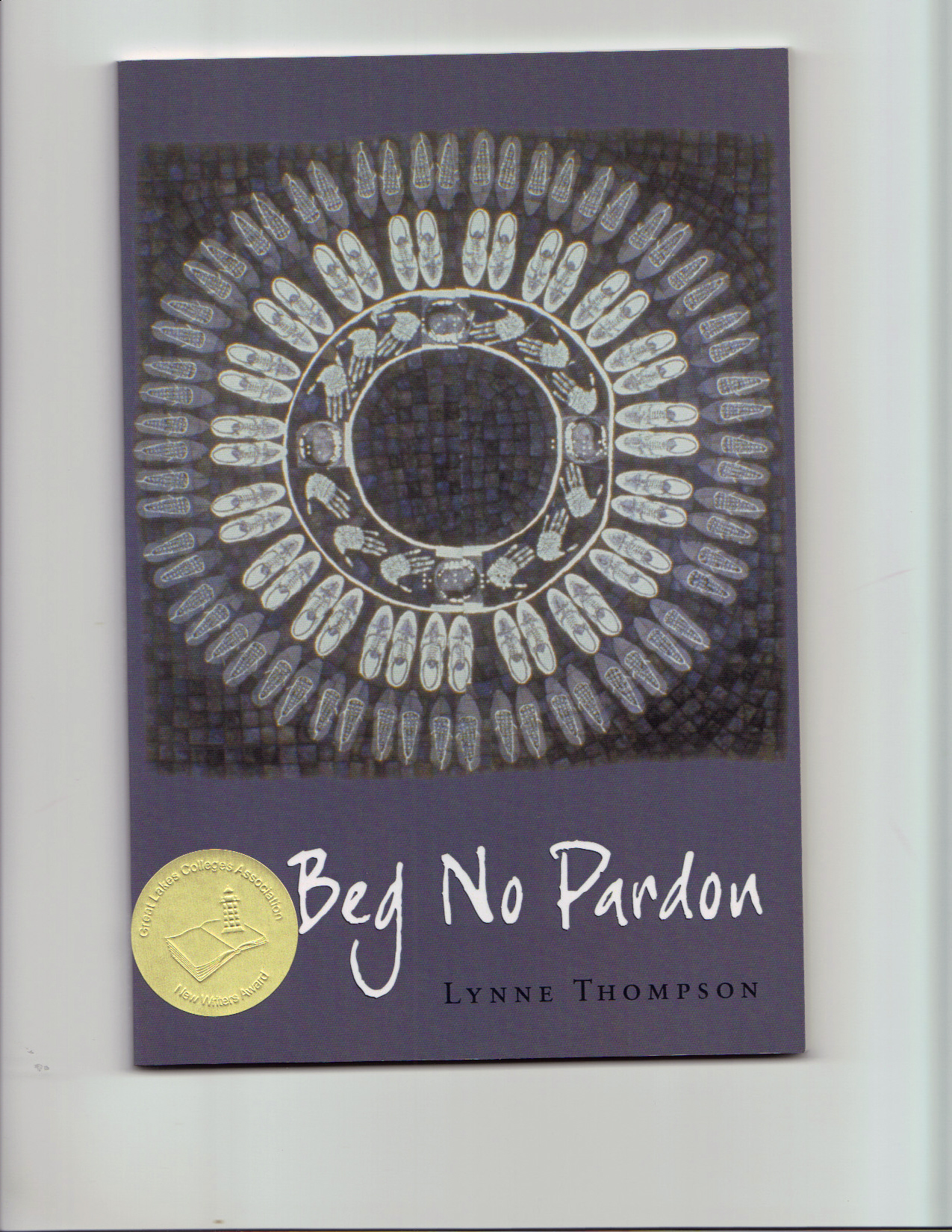
Reference the opening poem in my collection, Beg No Pardon: “The Poet Applying for A Job, Cites Her Previous Experience”– “Eccentric drop of ink. Gnome on a trapeze….Hand drum…Sizzling arrow.”

9.) You explain in a personal memoir that your poetry is seated in your own culturally rich, African-American and Cheyenne heritage, a scape you have created out of poetic responsibility. In a personal memoir you write the need to translate your familial, “treasure trove of stories that confirm[s] we have lived in the world.” For example you continue, “May—stories of all of our roots and interconnectednesses. As we laugh and reminisce, Mr. Jimmie is outside sweeping away leaves and fallen fruit in Irma’s backyard after a tropically brief downpour and, just as he finishes, the clouds swell and burst again, drenching the morning’s laundry. Mr. Jimmie chuckles.” Can you elaborate on the importance of storytelling and its role in our ability to exist and translate the self in to the world? How do you see yourself in this conversation as storyteller?

My desire as a writer is to tell a story. I think story-telling is what captivates the human race above all things. Whether it be a crime drama or a Shakespearean play, what we all want to know is what happened, to whom, and why. The poet, of course, seeks to distill this desire into sequential (or non-sequential) language that triggers the imagination of anyone who hears or reads it. The essay you reference in your question pertains to my effort to “excavate” the stories of family, which in my case is complicated by the fact of my adoption, what I consider my “duality”. I have taken on the responsibility for framing these family stories of displacement and dislocation and complicated the task by choosing the genre of poetry with which to tell them. Complicated because the poet seeks, in Dickinson’s words, to tell the story “slant” rather than straight on and therein lies the [sweet] challenge.

10.) I am interested in your address and ability to translate African-American and Cheyenne traditions, two very culturally rich discussions. There is a unique balance between upholding tradition, and translating tradition into a creative adaptation that acculturates rather than assimilates voice in a manner that is accepted and heard in different contexts. One also has to be aware of overly romanticizing tradition. How do these negotiations affect your poetic responsibility?

You’re right when you reference responsibility when taking on this task of translation—albeit in one’s original language—in writing. While I hear writers I admire and respect say that the poem must be more true to itself more than to the “facts”, the facts—often known to family and others—are the facts and, thus, hard to ignore. When I’m engaged in these negotiations, I’m also knee-deep in research on places or persons or situations that I’m trying to bring to life on the page. More often than not, the research into the “truth” gives way to the feeling that I want to convey. It seems that if I’m true to that, my responsibility will be met. After all, how do we ever really know the truth of past traditions?

Currently, I’m reading Annette Gordon-Reed’s The Hemingses of Monticello and the author has done a meticulous job of conveying what she can only reasonably assume based on the documented history that’s remains more than 200 years later but in the end, the question remains: did Sally Hemmings and Thomas Jefferson love each other as we conceive of love today? Provocative questions like that demand and demand and demand the constant negotiation that the writer can never be completely sure she’s navigated with success.

11.) Your poem, “Unworshipped Woman,” has a very distinct tone and meter. This is accomplished through the form you implement, particularly in repetition and use of a particular syntax.

Nothing

beat her

Break her down or reek so

the way she do

Nothing got her unzipped mind

her flypaper memory

She a riverbed will be

For a dog’s millennium

Does this meter ask the reader to recall specific musical genres or traditions and if so how do you employ this tool in this piece and others? If not, can you explain how melopoeia evolves and reacts with the logopoeia and phanopoeia in your work?

The goal in “Unworshipped Woman” was to give a roadmap to the reader of the page. That is to say, I wrote and conceived of this piece as progressing in s l o w m o t i o n and I wanted to ensure that it would be read and understood that way. I don’t recall that I had anything specific in mind in terms of established genres or traditions rather that I wanted to add a sensory perception to the reception of language.

12.) Can you share with us what you believe to be magic? How do you see poetry interacting with the everyday worlds we live in?

I’m repeatedly drawn back to Coleridge’s definition of poetry: the best words in the best order. It’s a source of amazement and sheer magic that the 26 letters in the English alphabet can continue to be combined and recombined and then set down (or spoken) one after the other in ways that give the tingle to the spine, make the head spin…

….or maybe, in a variation of what the artist, Miguel Covarrubias is reported to have said, poetry is the magic of dancing with words and lines….

profiles in poetics: Elena Karina Byrne

Elena Karina Byrne

Website:http://www.tupelopress.org/authors/byrne

http://en.wikipedia.org/wiki/Elena_Karina_Byrne

Elena Byrne is an assertive actuating poet who intimates, “I write and think like a sprinter”. Writing in transits of translation, she exposes a disengaging spirit, an “exotic explorer of the extraordinary, utilizing the beautiful mundane”. When asked to explain these transmuting experiences and how she as a writer is able to attentively shift these expressions, she describes her poems as “installations in a performance art setting–– they are live objects animated and embodied (made as part of the body) by the voice”. The expression is “physical,–– it’s erotic,” it is a balance of varying subtexts of power.

In this interview, Byrne exposes intuitive insight into our perceptions of truth. “Truth has a lively changing face,” argues Kafka, and this face Byrne invites, is a “wild cauldron of humanity with its many versions”. She elucidates that art is “lucid dreaming, waking dreams, hallucinatory clarity and all the oxymoron’s that exist as reminders that consciousness cannot exist on merely one plane and must be interrupted.” For Byrne, the “visibility” of women writers is what she sees as increasing in significance over the past twenty years. She confides, “it’s strange and necessary to even say that… But the stranger is endowed with hyper-awareness…the desire to be known means destabilizing what is expected of you.” Byrne imparts with us resonating wisdom: “art counteracts… it is remedy and opposes remedy…your word: access! It creates access.”

Former 12 year Regional Director of the Poetry Society of America, Elena Karina Byrne is a freelance teacher, editor, collage artist, Poetry Consultant / Moderator for The Los Angeles Times Festival of Books, a Contributing Editor for the Los Angeles Review of Books, a reviewer for ForeWord’s Clarion Reviews, Literary Programs Director for The Ruskin Art Club and the new Executive Director of AVK Arts. Her work has appeared in numerous publications. Her books include: The Flammable Bird , (Zoo Press /Tupelo Press 2002), MASQUE (Tupelo Press, 2008) and the forthcoming Burnt Violin (Tupelo Press, 2012), and Voyeur Hour: Poetry, Art and Desire (essays, Tupelo Press, 2013).

1.)    What were the first inspirations that made you desire to become a writer? Who are your favorite writers and how did they change over time?

At 14 I decided to become a writer … my parents and brother were artists, the majority of my cultural upbringing was centered in art. I found myself wanting to translate the visual world and in doing so, discovered language as an art of my own. I believe my mother first gave me copies of Edna St Vincent Millay, Sylvia Plath, Neruda, and Keats. I was one of those outdoor-till-dusk Tom Boy kids, and not an avid reader until late in life. However, I was lucky enough to attend private schools from the age of 10, which meant great literature was required reading and that also started the real fire in the belly.

At Sarah Lawrence College my favorite writers changed with need and desire…O, I loved (and still do) Theodore Roethke, Sylvia Plath, Hart Crane, Elizabeth Bishop, John Berryman, Wallace Stevens, Delmore Schwartz, and Heather McHugh, Jane Hirshfield, Mekeel McBride, Laura Jensen, Gregory Orr, and early Louise Gluck and Tess Gallagher, an unknown poet named Thomas James, and also …my professors Thomas Lux, Jane Cooper (who compared my work with Tomas Transtromer!), Galway Kinnell… Jean Valentine, Carolyn Forche, early Jorie Graham, early Brenda Hillman, Barbara Hamby…I was lucky enough to hear the brilliant Susan Sontag lecture.

I became friends with Irish poet Desmond O’Grady in Boston while having my “Junior Year Abroad.” He re-introduced me to the Irish poets and Anna Akhmatova with whom he read in Spoleto Italy. My Gosh, the great old long loves: Hopkins, Sappho and Shakespeare. To see and hear with the whole body! Sometimes I wanted to saturate myself in the language, other times I wanted to mimic constructs and forms of breath; my hunger for the visual representations of the intellectual and emotional life never wavered.

I think we often tend to re-visit old loves, but find new ones, new ballasts… I did not love Whitman or Dickinson until much later, same for Marriane Moore…then I was flooded with contemporary writers and tried to digest as much as possible, along with the surrealists, more great modern poets, more Spanish and Eastern European writers, anything to disengage my usual modes of thinking and hearing… Whether we love or dislike something, it seems some kind of disengagement has to happen. 

2.)    Who have been the creative inspiration / mentor writers in your career?

Hmmm Well, either directly or indirectly… taking me under their wing, or giving me long-time inspiration of one kind or another:  Simone de Beauvoir, Susan Sontag, Thomas Lux, Galway Kinnell, Brigit Pegeen Kelly, Sherod Santos, Lynne Emanuel, Gillian Conoley, Forest Gander, Agha Shahid Ali, and my dear friends, poets like Cathy Colman, Gail Wronsky, Brendan Constantine, Bill Wadsworth, David St John, Angie Estes, Lynne Thompson, Kathy Fagan, Molly Bendall, Beckian Fritz Goldberg, Sholeh Wolpe, Sarah Maclay, and Amy Newlove Schroeder… and my students!! To name just a very few of many … this makes me insane because I know I’ll think of so many more…that’s what it’s all about, one by one inspiration.

3.)    How has your own work changed over time and why?

My first book was a typical first book carrying the variety of poems and topics that were merely a result of hard labor contained within a 15 year passion… Family, Self, The Other…. Clichés are abhorrent, so I think my work has always been centralized in startling imagery and any physical surprise set against the language boundary— abstract ideas and themes have evolved through the emergence of the work itself…projects, that seem so dominant in the last book Masque and in the forthcoming new book, This Accomplice, have a mind of their own at first, then my mind re-exerts its power in formal uses of research and revision. Forms of address have also changed in my work, … from monologue’s rhythmic-like voice, to long weaves, to remaking the fuge with truncated bursts, a corpus choir and a distanced narrator… Now I think, in order to truly keep myself motivated and complacent-free, I shall challenge myself to try something entirely new for the fourth book of poems… we are exotic explorers of the extraordinary, utilizing the beautiful mundane. I suppose we can never truly re-invent ourselves, or our voice, but we can certainly try to shake things up a bit!

4.)    Have you been influenced by different genres, and if so how?

I love the great classic novelists, and in fact loved  teaching A.P English for that reason, but right now, writing a novel seems out of the question… I was a sprinter… I write and think like a sprinter.

Currently, I am writing a book of essays on art, poetry and desire because I love the art of non-fiction! I love reading it, I love writing it and my process is much the same as some of my own poetry writing process: a form of collage, of collection and puzzle-piece-this-together. I find non-fiction, despite its linear requirements,  can be as wonderfully alarming and creative unfolding its discoveries, as poetry… the times when expository flare can grab you between breathing, thinking, and feeling.

Visual art, conceptual art, performance art…have also re-appeared in my life in a big way. So many women artists, with whom I share similar concerns and ideation-focus, have made me want to return to making art:  my mother who was a wild painter, Ann Hamilton whose piece is on the cover of my second book (the first book is my own cover art work), Sophie Callie and Hannah Hoch especially…

5.)    In your essay “Father,” you write, “how quickly we see what we feel.” This reflection is attached to the sentiments you have looking at a sketch drawn by your father. Can you elaborate on the relationship between image and what we feel, whether this be body, mind, spirit, or all of the above? How have you utilized your experience with visual art in your poetry? 

Father’s drawing he made as a four-year-old boy represented/ reflected the future-father I knew as a man and artist. Image and feeling represent measures of temporality, the perceptual engagement with the worlds we know: the one we live in, the one we imagine, the ones presented to us by others, etc. Time is a material we move in and out of and it seems it can be slowed down and sped up by our experiences. The image and written word, the feeling and the objects all seem to be in a timeless motion when presented to us as art. Looking at that drawing, I believed what I saw was synonymous with what I felt. There’s a spontaneous narrative, visual and verbal, that recreates both the familiar and the unfamiliar…if you’re lucky, you get a bit of both. The process of seeing presents marvelous predicaments of conjunction and disjunction. Sometimes this involves translation of what we see, or it involves a hybrid projection of intellect and feeling, and certainly involves intuitive, non-cognitive understanding. Our memory effects/gives affect to our present-tense perceptions, don’t you think?

I’d like to think of my poems as being like installations in a performance art setting–– they are live objects animated and embodied (made as part of the body) by the voice. A doctor once told me that my poems were like trances and gave him the sensation that he was reading a Picasso. I knew which Picasso period he meant, LOL.

6.)    What are you plans for the future?

This Accomplice will be out in late 2012. My essay book, Voyeur Hour will appear in late 2013.

I am completing a new chapbook, will work on another new/new poetry book, and continue reviewing, editing, etc. I plan, I hope, to paint/collage and make boxes again…sigh…all of this in addition to curatorial work and many arts collaborative projects as Executive Director of AVK Arts, a quiet but noteworthy new foundation!

7.)    What are your views on writing by women as it has occurred in the past twenty years?

In America? On the international stage? 20 years is not that long ago..

Well, I think, despite or because of the “older white male dominance” of the past, women are coming up with some of the most innovative books written so far. I’d like to say I see more, than ever before, “visibility” for women writers. It’s strange and necessary to even say that…Sometimes I feel like a stranger in my own past…I say my own as a collective “our own.”

But the stranger is endowed with hyper-awareness…the desire to be known means destabilizing what is expected of you. So, I think women have managed to create a broader field of play within the writing genres. They offer new configurations of alarm and subtle variations within each… Twenty years has spawned an amazing flood of new, powerful, feverish minds. I’d like to think the growing appearance, in film and television, of strong female leading protagonists, is a universal trend that can be found in all the arts.

8.)    Who are promising women writers to look at in the future?

Oh boy—so many, let’s see if I can shake the old brain until some coins fall out… besides the already aforementioned: Kelli Anne Nofltle, Medbh McGuckian, Karla Kelsey, Rebecca Wolfe, Claudia Rankin, Dorothy Baresi, Vanessa Place, Carol Ann Davis, Anna Journey, Victoria Chang, Dina Hardy, Robin Ekiss…

9.)    If you were asked to create a flexible label of yourself as a writer, what would it be?

A Threshold Lyricist? In her essay “Facing, Touch and Vertigo,” Susan Stewart describes touch as a “threshold activity” that “traverses the boundary between interiority and exteriority.” I say that’s a pretty good description of what I hope to do with poetry. It’s physical,–– it’s erotic.

I am not a language poet, not a narrative poet, not a surrealist, nor a confessional poet, yet my lyricism devises a balancing act between all of those. I love Ann Hamilton’s idea of “arrested animation” as one description of what I attempt. There are things one wants to watch out for. Too much attention to the physical on the page mechanics of language bores and kills, especially if the breakdown of what is really being said is ordinary… However beautiful they may be, one also can get lost in sound poems, like drifting out to ocean in an open boat. Images (the inexhaustible frame by frame life we know and create) are key to me, but they really shift the vantage point of the poem when fevered by persuasions of thought and sound. Music and image drive the nail into the heart. I hope all the tools I use are available and capable of change as I am. I am always looking for a reciprocal pursuit, and finally a fresh positioning in each language variant. I love diverting the subject matter while keeping the theme’s feeling intact… sometimes emotional/visual cohesion saves a subject that seems indefinable. My forthcoming poetry book takes directions that are deliberately confounded–– this helped with the fact that the fable poems, for example, contain multiple meanings found and created for each single word title. The concordances double the voice (mine and the other’s) in a new context created by the conversation-weave… it was an open/close /open action.

10.) The epigraph of your poem, “Artifice is Enough: Mask,” a quote from Oscar Wilde reads, “Truth is entirely and absolutely a matter of style.” Truth takes place as a wonderfully mutating breath of language that beautifully bleeds in the inconsistency of language and the transition of music. Can you describe your perception of truth and how you use melopoeia, logopoeia, and phanopoeia to investigate / illuminate these concepts?

In Steven’s book, The Necessary Angel he says, “The exquisite truth is to know that it is a fiction and that you believe it willingly.” As you may have also noticed the quote in my first book: Kafka said the truth has a lively changing face, so one can imagine celebrating (logopoeia’s  “dance of the intellect”) not only the natural inconsistency of language, but also the subtext-influence of visuality, musicality that drives a poem toward an unexpected place. Imagine that changing face is this wild cauldron of humanity with its many versions of many religions, desires, abilities, fallacies and truths, and, and it many ways of perceiving.  One might argue truth is chained to a certain undeniable logic, but the universe defies that assumption, and so too, the poet willingly hopes to defy it.

Pound’s “phanopoeia” speaks of “throwing a visual image on the mind..” which is, in my  truth-experience, kind of backwards, since it’s the mind that is throwing out the visual image…having had two babies I can tell you we first find our way through the visual world, then we sound and vowel our way toward language, listening, touching, all becoming part of the same announcement of our being in the world. I sometimes have to battle with my natural urge to make music persuade the subject…it’s seduction and persuasion…

11.) Marty Williams in “What the Fire Said,” her review in SOLO 6, 2003 states that your “poems best are mercurial and possessed enjambment through a tumult of images and ideas that surprise and arrest. Even the poems primarily driven by formal experimentation exhibit substance and power.” Can you please describe how you utilize experimentation? Do you believe this to be alienating to the reader? How do you achieve the balance between your experimentation with language while continuing to infuse it with “substance and power”?

Arresting imagery requires substantive power to make it work… Experimentation for its own sake is a waste of time, masterbatory…

Some of my favorite poems are fairly plainspoken. I struggle with this, especially when I am asked to read my work to young kids. I look at it and say : Arrg, this is too dense! I may have to challenge myself with the task of making the work undress more, show more flesh… I don’t try to be mercurial, but I do find weaving and tethering to be a keen part of the beauty of writing. I love to push my language to new ledges, precipices of fresh word combinations, of tangential relationships, always asking myself, how I can “see” differently, how can I enter the poem and its subject?

I hope readers will walk away with some measure of recognition, discovery and delight.

12.) Can you speak to the use of surprise and juxtaposition, the concept of time, and the relationship between subjectivity and objectivity? How does this manifest in your work?

I hope I don’t repeat myself here. Thought is time and it is subjective, even though the objective tries to contain thought. With juxtaposition, the shifting attention arouses our investigative need to know, to know more…vertigo, entropy and misadventure realign meaning. The poems sometimes present themselves as an indiscriminate list, a totem…

It seems relevant, especially now that I feel I should try to get more “personal” (Yikes, alas, ugg!) in my work and the challenge is, of course how to do that without being solipsistic or boring, or ordinary or confessional LOL …I tell my young students again and again, they are what makes the work fresh. Universality arises out of our choices of specificity. There are only so many subjects to talk about, but an infinite variety of ways in which to present the feeling, the facts, the perceptions… I’m fascinated by the intimate-impersonal of say, facebook and twitter… I realize my work contains some of that, not deliberately by the way, at least not at first… The tone and forms of address, the levels of emotion, all feel personally intimate, yet so often they are contained in a persona or poly-vocal situation. It’s empowering to become someone/something else and speak through that person. You could say objectively my shirt is blue, but then I say, no its dead parrot blue, its my first ocean blue, it’s a sexual blue…there (here) is the subjective curve of the earth.

My best friend says I straddle emotional and intellectual word play at once. I “see” juxtaposed relationships often before I see the familiar alignments. I was a superb student, but I always felt my brain functioning was a little askew! Thank god I found a profession that celebrates that. Now I push myself toward surprise as a necessary part of revelation… and even when I don’t want a poem to contain any notable revelation, I still want it to offer some new mode of seeing, some new energy with which a reader can bring into their body. Juxtaposition surprises new understanding.

13.) In your essay, “Incongruity,” you affirm, “Art is not consciousness per se, but rather its antidote — evolved from within consciousness itself.” Can you explain how you personally access this space and / or lack of space and how our unconscious plays into this discussion?

We utilize our intuitive mind and it can co-function with the logical mind, and with the illogical mind-set… if consciousness was like a room full of doors and windows from which our “other” minds, unconscious, subconscious etc., could enter. Think: lucid dreaming, waking dreams, hallucinatory clarity and all the oxymoron’s that exist as reminders that consciousness cannot exist on merely one plane and must be interrupted… the interconnected parts of a body, and so on… art counteracts… it is remedy and opposes remedy…your word: access! It creates access.

profiles in poetics: Kathy Burkett

Kathy Burkett

Website: http://www.etsy.com/shop/theoddfactory

Kathy Burkett is a multiplicitous lensed poet. A creator that enjoys “the thought of nothing”. This poet “creates creatures,” whether this be through language, doll making, or music. She explains that her “best work is a combination of more than one mode of creativity.” Similar to that of many brilliant creative women that are merely “struggling to find a way to be heard”. She elaborates, “Yes, it is important to express ‘women’s’ concerns, and it is important to write from a female point of view, but I think writers of both sexes need to reach beyond those labels and write about things that go deeper than the skin.”

Burkett, who began writing about her experience with depression, expands her introspection around the idea of “nothing”. She states, “I don’t think that human lives ultimately have some great cosmic meaning beyond what we are while we’re walking around. Maybe that energy goes somewhere, floats off into the universe, but so does the energy of a dead toaster.” Instead, living “better, not necessarily longer” is of value. Burkett divulges to us, “I like the idea of nothing. I guess that makes the above response total overkill? Hey, it’s all a cosmic joke that we’ll never get anyway, right?”

Kathy Burkett plays kazoo for adoring audiences of odd dolls and kooky stuffed critters in Florida. She howls with her hound dogs and goes for long walks on her treadmill where the scenery never changes and she ends up exactly where she started.

1.)    What were the first inspirations that made you desire to become a writer? Who are your favorite writers and how did they change over time?

I first considered writing seriously in the third grade. We had assignments to finish stories, and then we had to read them aloud to the class. I wasn’t a pretty girl, but I found that my writing was something that got me positive attention from classmates. They would laugh & really react to my stories, so I realized that my creativity could be appreciated, even if I wasn’t pretty or popular. Of course, I have always been a book nut. My mom talks about finding me with a flashlight under the covers reading at night. That was before they made those nifty booklights!

Some of my favorite writers now are Russell Edson and Mark Strand. I found poetry as a teenager—things like Emily Dickinson and Carl Sandburg. From there, I found writers like Borges and Paz, and then I started reading small press publications. I think that my favorite writers changed as I discovered what was out there. I am always amazed when you say the word “poetry” and people think you’re talking about Robert Frost. I think most of the public isn’t aware of contemporary poetry, except maybe through slam poetry.

2.)    Who have been the creative inspiration / mentor writers in your career?

Russell Edson was a huge inspiration to me. When I first read his prose poems, I realized that I’d been searching for poetry that broke boundaries and really escaped reality. Emily Dickinson was an early influence, because she opened the door to the world of poetry for me, and I could really relate to her writing. She seemed simultaneously removed from, yet part of the world, and that was something I really related to.

3.)    How has your own work changed over time and why?

My writing has become less biographical and more imaginative, I think. I started out writing about my depression, which has been something that’s always been a huge part of my life. I find that in the last five or so years, I’ve wanted to get outside of my own skin and really create an alternate world.

4.)    Have you been influenced by different genres, and if so how?

I can’t think of major influences immediately, though I will say that the Bizarro genre has given me a fresh view of writing, though I myself am not a Bizarro writer.  I admire the way they don’t care about conventions and really strive for weirdness.

5.)    What are your plans for the future?

That’s a tricky question. I’ve had horrible luck in both my life and my writing as far as plans go. I find they don’t work for me. I think any plans I might have change from day to day. I have become very disillusioned about getting poetry published by “legitimate” presses, so I’ve not been submitting as much. I will say that I do intend to send out some of my picture book manuscripts in the not-too-distant future, though that market is dwindling too.

6.)    What are your views on writing by women as it has occurred in the past twenty years?

It really saddens me that this is a question that still needs to be asked, but it does! I hate the fact that writing is still dominated by men. I have never considered myself to be a “women’s writer,” though I do occasionally write about body image and other gender-related topics, though I feel that that the majority of my work isn’t about being female—it’s about being human and struggling with existence period.  I have always felt free in my work to adopt both male and female personas.  As far as women writers in general, I think we need more women who break boundaries.  Yes, it is important to express “women’s” concerns, and it is important to write from a female point of view, but I think writers of both sexes need to reach beyond those labels and write about things that go deeper than the skin.

7.)    Who are promising women writers to look at in the future?

Well, I am currently reading short stories by Kelly Link, and I must say that she has really impressed me as somebody who’s pushing boundaries and really using her creativity to break molds. Also, there are numerous female poets in the small presses that are wonderful. I love the way that Juliet Cook writes poetry from a strong female perspective. I admire her imagery and her fearlessness. I think that many of the promising women writers of the future are currently unknown. I think they are struggling to find a way to be heard. I think that through creativity and technology, we will be aware of them sooner rather than later, which is encouraging.

8.)    If you were asked to create a flexible label of yourself as a writer, what would it be?

This is a really difficult question for me, as I’ve never fit neatly into any box. I’m not academic enough to be an academic, but not quite gritty enough in my early work to fit into that camp, either. Also, while my earlier work focused on depression, I’ve taken a turn for the surreal, though I’m not really a surrealist either. I guess the word “floater” would work. I’m like a shape-shifting cloud floating by. Sometimes I’m grey and rainy, and other times fluffy white and wispy.

9.)    Your poem “Mad Scientist,” published in O Sweet Flowery Roses, raises questions concerning our conception of light and time and the participation of technology within this scheme. One line in particular conjures this question, “The mysterious power of stars and the odd coldness of technological progress.” How do you believe the “coldness” of technology has influence our experience of living and do you believe this to be positive or negative?

I have really mixed feelings about technology. I was one of those people who didn’t really want a computer in the beginning. I spent my first year of college really fighting getting and using a computer, but in the end, it really did become a necessity to get one if I wanted to further my education.  In the end, I think it’s like anything else—technology has positives and negatives. I think in some ways, it helps to bring people together. I even met my husband of eight years online. It helps people with similar interests communicate even though they’re miles apart. I also have an online Etsy shop, which allows me to share creations with people I’d never be able to come into contact with otherwise. On the other hand, I do find that it’s easy to spend too much time online, and I personally find that I ultimately feel unfulfilled if I don’t spend enough time off the computer. Also, I don’t like the fact that many people are kept out of this “progress,” because they simply don’t have the financial resources to buy the necessary new gadgets. My husband and I don’t have smart phones, and the outdated cell phones that we do have are only used for emergencies. When I tell many people this, they look at me like I have two heads or something. But I don’t think all of us need to be accessible to everybody 24 hours of the day. I have been out with friends, and they are checking their e-mail and Facebook at dinner. Is it really necessary? Do we really need to have personal conversations at the grocery store?  Of course, all those phones and phone plans cost quite a bit, too. I worry that new technology becomes something people THINK they need rather than something that they actually need. I worry about the people who will be left behind. I was laid off from my job over a year ago, and things like smart phones are a luxury I simply can’t afford. I think more and more people will be put in that situation. What if I lost the ability to afford online access at home? It seems that most job applications are online these days. Yes, libraries offer free access, but that’s small consolation to people left out of the loop. I do worry about technology making us even more a world of the haves versus the have nots.  Also, technology is great when it works. But it inevitably breaks down, and I worry that a lot of people are too eager to toss paper away in this wonderful world of progress. What happens when suddenly you can’t access all that stuff you stored on a microchip? Like anything, I think it’s a balancing act, and it’s a very tricky one.

10.) How does accessing various modes of creativity such as your music, writing, doll making, and collage facilitate your ability to externalize the internal and do you gravitate to certain activities depending on your creative intent?

I used to think I should choose one thing over the others. I used to say, “I’m really a writer, but I also sing and make dolls and art.” That didn’t seem right, though. Why all the clamor over labels all the time? I really enjoy all the different activities that I do. Doll making really lets me “externalize the internal,” as you say, in a really tangible, tactile way that I really enjoy. There’s a visual and childlike aspect to it that I don’t get from any other art form that I do. Everything else often feels so heavy and serious. Doll making is a real escape for me, and I like the idea of creating creatures. Of course, when I’m making a doll/creature, I usually find myself creating stories about it, and that often leads to writing—whether in the form of poems, stories or (more recently) songs.  I find that when I want to escape, I gravitate toward doll making to bring a sense of fun or feeling childlike into my life. Singing is similar to writing in the feelings it gives me, though it also has a more physical component. Singing my own words is particularly satisfying to me, as it gives me an outlet for two forms of creativity simultaneously. Singing, though it’s a physical activity, really gives me a transcendent feeling. Of course, so does writing.

The combination of collage art with my writing was something that was really satisfying for me. When I created my books PIECES OF SISSY LEE, BROKEN POEMS, and FORTUNE COOKIE SECRETS, the words and images worked so well together. I really had the feeling that I was completely expressing my own vision in those works. Sometimes I think that my best work is a combination of more than one mode of creativity. Currently, my husband and I are toying with the idea of doing recordings of my poems with music. I think I should mention here the huge influence of the band Algebra Suicide on my work. Their combination of poetry and music really influenced me in my teenage years and beyond. Also, the work of Laurie Anderson is a huge influence. I really think that combining different methods of creativity is something that’s important to me artistically. I don’t necessarily think it’s better or worse than other, more “pure” type artists; it’s just the way I feel most comfortable doing things.

11.) Another one of your poems featured in O Sweet Flowery Roses, “Vacuuming the Void,” addresses what you consider to be the void, the absence of something, the singular sustained thought of nothing. Here, “Sir Real has the unfortunate task of vacuuming the void on a constant basis. Any small particle that enters the void has to be removed promptly so that the void’s emptiness remains unblemished.” Can you elaborate on your conception of this space that both exists and at the same time not because of the negation of participating elements?

I have to say that this poem is a special one for me. I am not a religious person, yet I am acutely aware of the existence of things that we cannot see. I’m also really hung up on certain ideas of Existentialism. I don’t think that human lives ultimately have some great cosmic meaning beyond what we are while we’re walking around. Maybe that energy goes somewhere, floats off into the universe, but so does the energy of a dead toaster. I guess I like playing with the idea of nothing (which is still something, kind of) and the idea that we’re not as important as we like to think we are. I really don’t understand why people fear the idea of not existing so much. I fear pain, the pain of dying and suffering, but I don’t fear actually being dead. Why would I? I won’t know it, and I won’t feel it. I fear pain, but I don’t fear actual death. I guess I dread the dying part, but not the death part. I really don’t understand these people who want their consciousness to exist forever. To me, that sounds really, really dreadful. Why do you want to live for hundreds of years? What makes you so important? I think we’d be better off trying to figure out how to make life better, not necessarily longer.

In poems like these, I guess it’s kind of like expanding upon the feeling I get when standing on the edge of the ocean on a deserted beach. We’re so small! We’re not important! And that’s OK. We are important to ourselves, yes, but we shouldn’t kid ourselves that we’re important to the universe as a whole on some grand scale. I guess I find that idea comforting, while many others find it terrifying.

I stopped eating meat when I was 18 years old, because I couldn’t see why it was necessary for someone in an industrialized country to eat another living thing. We have plenty of alternatives. Animals feel pain and have feelings. Why should they die to keep me alive? Some people will argue that it’s natural, but really not much that we do is natural anymore. We piss in toilets; we drive to the grocery store to get our food. It’s just not necessary to kill animals for food in our “modern” society. Again, I think this mentality goes back to our feeling of being important—that we’re more important than the animals are. I don’t think so. Most dogs I’ve met are more loyal and better companions than most people.

I guess that was a really long way of saying that I like the idea of nothing. I guess that makes the above response total overkill? Hey, it’s all a cosmic joke that we’ll never get anyway, right?

profiles in poetics: Hildred Crill

Hildred Crill

Website: http://argosbooks.org/

Hildred Crill is a poet, artist, translator, essayist, who  intellectually grips our minds, guiding us through diverging terrains of fresh insight. We examine self, environment, perspective, and translation. Her anthropological lens unearths staples of our existence from varying points of view. We are prompted to question, “How wholesome are thoughts about any poisoned, rotting carcasses?” Continuing, “People have been condemning wanton destruction for a long time.”

As translator, Crill reveals the balance of her position as medium between her own sense of self, and the self of the original poet’s work. Similar to her own poem, “Portrait of Self,” translator is artist, she discusses, “viewing the model from an individual vantage point and interpreting and creating.” Here Crill reminds us as readers to importantly, keep our eyes fixed “on the artist behind the model” and notice if this “fidelity falls”.

Crill’s poems have appeared in numerous publications. Her chapbook The Upstairs Hammer was published in 2010 by Argos Books (http://argosbooks.org/). She has published book reviews in Web Del Sol Review of Books and Ars Interpres, as well as English translations of Per Wästberg’s poems in Ars Interpres and in Ortsbestämning / Determination of Place by Per Wästberg (trilingual edition, Ars Interpres Publications 2008). She was co-editor of Under the Legislature of Stars: 62 New Hampshire Poets (Oyster River Press 1999) and served as editor of Alien Matter by Regina Derieva (Spuyten Duyvil 2005). She holds an MFA from New England College. Since 2004, she has lived in Stockholm, Sweden.

1.)    What were the first inspirations that made you desire to become a writer? Who are your favorite writers and how did they change over time?

I grew up in a house lined with books, where everyone read and wrote.  The first poems I remember hearing were in my mother’s voice and they remain some of the poems that mean the most to me, that feel rooted inside me.  I still hear them in my mother’s voice,  Lewis Carroll’s “Jabberwocky,” Blake’s  “The Tyger,” Yeats’ “The Lake Isle of Innisfree,” Hopkins’ “As kingfishers catch fire” among others.  I found more poems I loved at school and became very involved with a small set of books in my twenties because of lack of time and money.  I read and reread what I had at hand, Plath’s Ariel plus three books by contemporary poets:  Linda Pastan’s A.M./P.M. and Seamus Heaney’s Death of a Naturalist and North. The first poets I became aware of made me want to write.

2.)    Who have been the creative inspiration / mentor writers in your career?

The beautiful state of New Hampshire is home to many generous writers from whom I had the fortune and pleasure to learn in small writers groups, during various community poetry projects we worked on together and over long friendships (Mimi White, Katie Towler, Mark DeCartaret, Donald M. Murray, Jean Pedrick, Marie Harris and many, many others). In Henniker, N.H., I  joined the first class of the low-residency MFA program in poetry at New England College. I am grateful to all the faculty and fellow students I met there especially for the conversation, made even more memorable by the intensity of long residency days. And all my life, the conversations with the members of my family and dear friends that take place, roam around in my head and sometimes are picked up again years or decades later have always inspired me.

3.)    How has your own work changed over time and why?

One change I have observed in recent years comes from moving from a woods in New Hampshire, where moose and porcupines sometimes wandered by and beavers built a dam and where I saw a barred owl feeding her baby chunks of fresh gray squirrel, to the middle of the city of Stockholm.  I have always been caught up in thinking about the physical production of language and the difficult act of communication between people, but now that I’m constantly in crowds of strangers walking through squares and traveling on buses, trains and escalators with a new language all around me I have become even more obsessed with all this and am struck with sheer amazement at the fact that language works, more or less.

4.)    Have you been influenced by different genres, and if so how?

I grew up in Washington, D.C., where I visited the awe-inspiring, free-of-charge museums on school field trips, family outings and on my own as soon as I was allowed to ride the bus by myself. It was wonderful to stand before and scrutinize such a wide range of objects chosen for display, from the heavily guarded Hope Diamond at the Smithsonian to the horrifying bottled body parts at the Naval Medical Museum. At the National Gallery of Art, images of paintings became permanently stamped on my brain with their shapes and full colors: Gaugin’s Self-Portrait, Whistler’s The White Girl, Cassatt’s Girl Arranging Her Hair, Carnevale’s The Annunciation, Manet’s The Dead Toreador along with The Tragic Actor, Dalí’s The Sacrament of the Last Supper and many more. Particular novels, especially those of Charlotte Brontë and George Eliot, also became fixed internally. Exposure early on to all sorts of genres exerts unavoidable influence, even if this becomes the impulse to struggle against elements within the genres. Music started to influence me more as an adult as my children were growing up. I love being introduced to fascinating, versatile, incredible artists. This week I’ve been listening to Leyla McCalla, who plays cello and banjo and sings; she plays Bach on the streets of New Orleans, Haitian folk songs, her compositions written to Langston Hughes’ poems as well as her own songs.  In recent years, scientific writing has influenced me because I have been teaching it and have thus needed to look at it really closely to see what makes some scientific articles successful: how clear, concise and straightforward  language can express astonishing complexities; how a clean line of argument holds remarkable beauty; how years of travel and physical and mental labor can be made coherent. These influences structure, move and challenge me deeply. The early images, words and sounds persist and I keep looking for more of the same.

5.)    What are your plans for the future?

I hope to keep writing poems, translating poems into English, writing poems in Swedish and drawing obsessively.

6.)    Who are promising women writers to look at in the future?

Poets whose next poem or book I am always eager to see include Susan Stewart, Louise Glück, Anne Carson, Heather McHugh and Medbh McGuckian. Particularly after their latest books, I am waiting to read what Jo Shapcott and Ann Jäderlund will write next.  I am excited by the work of poets who cross over language divides and/or move to a new country, Valzhyna Mort, Marina Blitshteyn, Zhang Er, Jen Hadfield and others, or who move across several arts like Bianca Stone. It is overwhelming in fact that so many new books of poetry by so many wonderful poets keep appearing. Also, since moving to Sweden, I’ve been trying to catch up on reading poets from early last century, especially Karin Boye and Edith Södergran.

7.)    Autumn at Peak, Pepperell Cove,” a poem of yours that first appeared in The New Hampshire Review, reads “I manage the afternoon/ as if I were a shadow,/ undoing the stun of sky.” Here the landscape of a relationship ultimately dips into the colors of the wind, a sky, a shadow, dampening time with a “mute”. Can you describe how the ascension of the self here is placed in the landscape of light & time, life & death, & music, and how this relates to your previous negotiations of our ability to express the self externally?

When I wrote that poem, I was living in New England, one of the stormiest places on the planet. I remember an emotional conversation on a night near the wild ocean in Maine followed by a bright morning. Everything collided in the storm and aftermath.

It’s hard to live in places like the far northeastern U.S. without the natural world entering in or without the solitary self being externalized there, but that produces hazardous impulses because landscapes can become generic blankets to manipulate. I try to remember what Charles Simic, who has lived many years in New Hampshire, says: “I distrust poets who have a mystical experience each time they look at a tree or a falling leaf. It just doesn’t happen. It’s a kind of fakery” (from The Uncertain Certainty). Simic goes on to point out how complicated and difficult cities are. People can see nature on their own terms in a way that just isn’t possible with cities full of other people.

And now more people belong to the urban landscape than to the countryside, which is one reason I really enjoyed reading and writing about John Kinsella’s Doppler Effect (in a review for Ars Interpres, which you brought up in another question you asked me about externalized self).  Kinsella writes beautifully and heartbreakingly about the landscapes of his native South Western Australia, home to monotreme and marsupial. The plants and animals are rapidly heading toward extinction, their habitats flattened by heavy-duty agriculture. Just when I have conjured up the simple version of  nature, in Simic’s words, with “all the good, wholesome thoughts it produces in human beings,” I remember how much more there is to it all. How many of us will be able to describe an echidna and its behavior in detail before it vanishes for good? How wholesome are thoughts about any poisoned, rotting carcasses? People have been condemning wanton destruction for a long time. Right now I am fascinated with the particular way history is playing out and with the portrayal of the human self in Kinsella’s book.  People arrive from their industrialized cities looking like agricultural machinery, and their machines have put photographic images of landscapes into their human interiors. Their mechanical eyes have extended far outward to examine the Doppler effect; it is possible for observer and observed to be far apart in a vast territory. None of it—space, time, nature, people, cities, self, other—could be simple. But altered distance could bring new perspectives.

8.)    In the review published in Ars Interpres, issues 8 & 9 “From the Labyrinth,” you quote Shaun Gallagher, who in the editorial of Janus Head 2007, says there is a difference between “living and experiencing body,” versus the way of being associated in a space such as that of a nonliving object. Later in the essay, the review comments on contemporary technological advances that have regarded the subject and found as stated by Ingar Brink, “artist and viewer have more in common than what distinguishes them.” The discussion then enters translation and role of artist in this interplay of commentary. In your poem “A Portrait of the Self,” first appearing in Interpoezia, you have a passage as follows, “each time he altered my look. My chin/ twisted toward the next day while my profile// jerked to the past.” This relationship is similar to the artist/viewer relationship as well as translation. Can you please elaborate on your own process of translation, the translator in a way being both artist and viewer as well as how these negotiations have affected your own work?

One particularly compelling aspect of that issue of Janus Head is how many ways the idea of “the situated body” has been interpreted. So I am happy that you mention this together with translation. A thinking, feeling person somewhere in the world now or at some time in the past makes a poem, a person who is a moving, physical being with many senses, with physical angles on what surrounds. Then a translator comes along with her own complicated situation and perspectives, physically, mentally, artistically. Imagine what the poet may have endured so that something resistant could be pushed into language, a particular language, through finding a rhythm or a phrase that lets loose energy, urgency and precision. Then someone else needs to find a way to push that into another language, simultaneously keeping track of what was in the poem and releasing it. Studying dead languages when I was younger was thrilling because I felt reading ancient poems from another culture in the original was about as close to time and space travel as I could get. But the number of languages people learn has limits so thank heavens poems are translated in spite of the impossibility. It’s horrible to contemplate having no chance to know some astounding poem about the human experience that’s out there. Ideally, great works of art are independent of culture and thus at some level independent of a particular language. Of course an enormous array of details must be considered when a person sits down to translate. So many decisions, so many levels to orchestrate in one language (individual sounds, structures of rhythm, syntax of sentences and phrases, word structure, scope of an individual word’s meaning, larger structures of meaning, style, etc.) as a faithful (in some way) response to someone else’s tight, perfect lines in another language.  At one moment, everything might come together, the distinct levels might integrate, the translator’s tracks might disappear and the universal emerges, but there will always be loss.

Each language and each poet create particular tensions for a translator, depending also on the target language, the moment in history, the type of poem and other aspects. Translating contemporary Swedish poems into English involves various interesting language-specific challenges. For example, translating Per Wästberg’s poems, I observed that searching for the exact word can lead to strange decision-making. Cognates abound in these language cousins so temptation to take the shortcut arises, sometimes a dangerous move even where connotation or scope of meaning differs only slightly. Some splendidly compact compounds of Swedish feel dismantled in English phrasal equivalents (e.g. “bärkraft”/ “strength to carry”). Increased borrowing of English words, altered to fit Swedish or seemingly taken as they are, can pose a problem when that Swedish use of English needs to be put back into English: a subtle tonal effect or emphasis by way of punch line can be lost. In a short lyric poem much of this is bypassed and the universal heart of the poem carried across.  Dryden’s dictum — about attempting to make Vergil speak the English he would have, had he been born in England — might be upheld. But what about long poems like The Odyssey that are bound to have rich cultural detail, much of it unfamiliar to us, as well as words that occur only once? Or what about some physical element — such as the extreme light and dark in Scandinavia — being translated into American English and culture in such a way that all of its manifestations can be construed as mystical even when that element may occur in the poem largely because the Earth was carefully observed? Are we just glad the reader found something? Or do we wish a translator’s tracks might be a little visible at times?

But not too visible. Some Swedes, who have excellent command of English, actually read some English translation of Swedish and will fortunately catch this kind of overstepping, as in the case of Auden’s version of Dag Hammarskjöld’s book—I won’t mention the English title since even that has been called into question. (See Mike Hoge, “Swedes Dispute Translation of a U.N. Legend’s Book.” The New York Times: 22 May 2005.) Translation is an art but it requires fidelity to someone else’s art. This doesn’t mean a so-called literal translation, which can’t really exist; going from one language to another involves real transformation. Remaking someone’s poem involves all the artistic skills a translator can muster. So how fidelity happens is a complex endeavor made up of a host of small language brushstrokes as well as a large-canvass vision. Fidelity won’t be the same every time and is thus open to interpretation. So the translator is like the artist in that poem “Portrait of Self” viewing the model from an individual vantage point and interpreting and creating, but that translator also keeps a steady eye on the artist behind the model. If that slippery fidelity falls, we can hope someone notices.

The conflicts and less than perfect attempts continue. For timeless poems, new generations want time-restricted language renewed in new translations. Publishers still manage funding for wonderful bilingual editions, which help with maintaining a reasonable perspective whether the languages appear in different writing systems as in Chinese-English editions or look like parallel universes as in Swedish-English editions. All this teaches intense engagement with language at all levels, which I hope can be internalized and will come back out when I write without my knowing about it at the time.

profiles in poetics: Joannie Stangeland

Joannie Stangeland

Website: http://joanniestangeland.com/

http://www.thesmokingpoet.net/

http://ravennapress.com/books/title.php?tid=10028

Poet Joannie Stangeland untethers the self, “between those black and white extremes,” she states, “the gray area that’s fertile for poetry.” Here we enter into a deep-seated report between poet and reader. Fragmentation in noise and silence enhance renewed breadth in the interactions with the text. In this field, Stangeland promotes movement and a constant sense of “suggest[ed] fragility”. This unscrambled space elucidates us to question, “What’s under the surface?” She explains, “The rest of her story.”

Stangeland’s new book, Into the Rumored Spring, published by Ravenna Press, is important in its own right as a text, but also because of its connection to the larger community. The book is a collection of poems that Stangeland wrote for a friend coping with breast cancer. She describes the work as,

a book about healing, and I’m hoping that it can do as much healing and good as possible. To help with that, I’m going to donate author proceeds (my portion) to breast cancer organizations—so the more books I can sell, the more help the book can give.

Stangeland invites us as readers to examine self beyond “surface.” Here poetry negotiates unity of mind body and spirit, which Stangeland explicates, “the body is the hand you’re dealt, the changes beyond your control. The mind is how you process change. And the spirit is perseverance, the desire to heal, the effort to heal, the will to change.”

Joannie Stangeland is the author of two poetry chapbooks—A Steady Longing for Flight, which won the Floating Bridge Press chapbook award; and Weathered Steps from Rose Alley Press—and a winner of the Dallas Poets Community National Poetry Competition. Joannie was accepted into the Jack Straw Artist in Residence program, and she has taught classes at Richard Hugo House in Seattle. Currently she is the poetry editor for the online journal The Smoking Poet.

1.)    What were the first inspirations that made you desire to become a writer? Who are your favorite writers and how did they change over time?

My earliest inspirations were art and music—in the form of Mother Goose. I had—and still have—a thick volume edited by Marguerite de Angeli that included detailed line drawings and sumptuous color plates. I imagined the worlds in those rhymes and those pictures, and I wanted to go there.

In the past, I’ve felt odd citing nursery rhymes as my first creative influence—but those rhymes offer music and concrete imagery. They’re visual and sensual and memorable—good patterns to have.

Later, I was drawn to Joni Mitchell’s music—especially the images in her lyrics and the way she’d manipulate a line, draw it out, put the rhyme where I didn’t expect it—and it worked, and worked better.

In college I found Rising Tides, an anthology of women’s poetry. That introduced me to a selection of poets, including Anne Sexton. The Furies—not only did I wish I’d written those poems, or my version of those poems, that I’d had the idea first, but they introduced me to the idea of poems in a series, which has become a near-constant pursuit for me.

I’ve also found inspiration in poems by Frank O’Hara—and I revisit them when I feel like I’m playing it too safe, coloring strictly inside the lines.

These days, the poet I return to most often is Lynda Hull, and I also keep close by the works of Cole Swenson, Roberta Spear, Louise Glück, and Oliver de la Paz.

2.)    Who have been the creative inspiration / mentor writers in your career?

First and foremost, Nelson Bentley. I had to stay in college an extra three quarters (long story), and to offset all the physics and chemistry I was taking, I signed up for his poetry workshop. Previously, I’d had a fairly scathing poetry workshop experience with a visiting professor. Nelson’s class, and his welcoming generosity, gave me back my permission to write, to fail, to learn, and to try again.

Years later, Nelson’s wife, Beth Bentley, introduced me to a new commitment to craft. (When I was in Nelson’s workshop, I thought of Beth’s class as “those really serious poets upstairs” and was intimidated by them.) Encouraged by a friend, I signed up for Beth’s workshop, only to find out that it was the last one she was going to teach. I was that lucky!

I learned a lot that quarter and continued learning with a group of her students that met regularly. I’ve been fortunate to be a part of that group now since 1992.

Judith Skillman, another member of that in that poetry group, has also been an important mentor to me and a touchstone as over the years we’ve sent our poems back and forth in the mail.

3.)    How has your own work changed over time and why?

I think my work stayed mostly the same for a long time—perhaps some strengthening, some sharpening of craft, and a greater comfort with sonnets and other forms.

But my real adventure started about two years ago. First, I finally began to understand (in my way) prose poems, and I noodled around with them, trying to get into their surreal spirit.

Then, I took a workshop from Sarah Vap and started to experiment with fragments. My fragments aren’t very broken up inside the line, but I’ve been exploring fragmentation of narrative sense—juxtaposition.

My favorite analogy is Delacroix’s color theory—the idea that instead of blending the colors into one shade, you place two colors side by side and let the viewer’s eye and mind blend them. I’m placing sections side by side and hoping that in the space between them they create a new relationship.

Later, after reading “Fog” by Mei Mei Berssenbrugge, I started to work with sequences by tightening the framework (introducing uniform line lengths and stress counts) and building the ideas from sequence to sequence.

It’s been fun! First the opening, the breaking apart of the fragmented lyric and then the sequences’ cohesion. I’m still working in those forms and also trying to get back to some poems that I’d like to think of as simple and yet layered—present for the widest possible audience but also to be rich enough to come back to and read again.

4.)    What are your plans for the future?

Ravenna Press is publishing my new book, Into the Rumored Spring, this autumn—and my first priority is to get it out into the world. The book is a collection of poems that I wrote for a friend, a book about healing, and I’m hoping that it can do as much healing and good as possible. To help with that, I’m going to donate author proceeds (my portion) to breast cancer organizations—so the more books I can sell, the more help the book can give.

Then I have two more manuscripts—the fragments and the sequences—that are in the nearly ready stage, and I want to put the finishing touches on them (one at a time). And I’m collaborating with a friend who’s a photographer to create a book of poems and photographs that explore loss and grieving.

Eventually, I’d like to spend more of my time writing. How? I haven’t figured that out yet. It might be after I retire from my day job.

5.)    What are your views on writing by women as it has occurred in the past twenty years?

I think it’s hard to narrow the question to twenty years, or even to women (although I find that, without consciously deciding, I read mostly women poets).

I’ll find some amazing poet and think the poems are experimental—revolutionary! Then I’ll find out that the work is 30 or even 40 years old.

Yes, I get behind times, but I try not to let that stop me. I look wherever, whenever, and see who’s doing what interests me right now. To that end, I have a stack of books by Fanny Howe packed for my vacation—and I’m so excited to read them!

6.)    Who are promising women writers to look at in the future?

Do you mean writers who are less known now? Younger writers? I realize I’m answering a question with a question—and it’s probably because I don’t have a better answer.

To me, promising implies that more is coming—the poets who will keep writing, creating a body of work that readers can follow. I’m looking for poets who can teach me something, women who are pushing poetry’s boundaries in new ways—taking risks, but risks I can catch up with (eventually).

Some of the poets I’ve been looking to and looking for recently—Susan Browne, Alexandra Teague, Tracy K. Smith—but it’s likely that everyone else has been reading their poems for years. I don’t want to miss the poems by Martha Silano, Lillias Bever, and Katrina Roberts. Now I’m sure I’m inadvertently omitting many others.

The poet whose poems I want everyone to have a chance to read? Pat Hurshell. Her poems are phenomenal—detailed, precise, and yet vast, operatic. I hope she’ll have a book out soon.

Also, you recently published an interview with Beth Myhr, and I’m really looking forward to her new book. I saw an early draft of the manuscript, and I’ve thought of that work often. I’m eager to have that book on my table, in my hands.

7.)    If you were asked to create a flexible label of yourself as a writer, what would it be?

Working, Playing Poet. I write as part of my day job. Occasionally, I attempt an essay. I keep a blog. But poetry is the center, and I remain committed to writing and learning poetry.

8.)    The poems from your next book, Into the Rumored Spring, forthcoming in October, 2011 include poems that concertedly negotiate how the body admixed with our transient senses of self, live in a space of dark and light and love and how this is expressed in how we live. The poem, “More than the Sum,” reads, “If a part of herself is missing, / it is no longer a part of herself. / If she has a new body, / she has her own same self.” I am interested in how you see the body in relation to the sense of self. Our senses located in the body inform our sense of self and allow us to love and connect to a deeper spirituality beyond mind and body. How do you perceive the expression of self inside and outside of the trine of mind, body, and spirit?

I’ve been obsessed by body and body image for most of my life—not always in a healthy way—so I’m not sure I can write from a different view point.

Working within that context or limitation, I see our bodies as our vessels to the world and, through the senses, our conduits to the spiritual. But they are not the whole story. When we see someone, we see her body first—we experience a surface. What’s under the surface? The rest of her story.

“More Than the Sum” specifically speaks to the sense of losing a part of your body, which changes you in the present but doesn’t tell the full story. You’re still the same person who grew up inside your body, with all your memories. I’ve been looking for a visual image of this, and I think of a first-day-of-kindergarten photograph. As an adult, you’ve grown older, you’ve changed, and now you’ve lost something, but you’re also still that girl in the picture and all the people in all the years since then. You’re still your valuable self.

As for the entire trine—in this case, the body is the hand you’re dealt, the changes beyond your control. The mind is how you process change. And the spirit is perseverance, the desire to heal, the effort to heal, the will to change.

9.)    Linearity of language suggests a fragility of our concept of time, memory, self and how our bodies interact in this eclectic dance. Your poem “Impossibility Multiplied,” seems to comment on these threaded ideas on several occasions including one line, “the sea won’t keep a story whole,” and later in the last, “draw your own hours in the dirt.” How in your opinion do we expose these fragilities in and outside of language?

“Impossibly Multiplied” is one of the poems I refer to as fragments, so the fragility is a part of the form. The poem is also informed by Virginia Woolf’s novel To the Lighthouse, which to me invokes a truth through stream-of-consciousness. The shifts of observation and perspective offer a broken, and authentic, sense of experience.

Speaking specifically to your question of language, I think that sentence fragments help (and I realize that the two examples you provide here are not fragments; they have verbs—and I love verbs and pursue them).

And the disconnections, which reside both in the poem and are mirrored in the day—any day (even now I’m jumping up every few minutes to try to mollify the cat or keep him out of trouble, which creates a disjointed experience).

In “Impossibly Multiplied,” the images around “the sea won’t keep a story whole” move through that passage:

.

The images connect but often by implication (or maybe they’re more obvious than I realize). Really, I think that movement, like the sea’s constant movement, suggests the fragility, but I think it also brings a strength—a breadth of references for the conversation between the poem and the reader.

Finally, I think that the poem’s silences provided by the short lines, short stanzas, and the dashes add to the fractured experience, which evokes the fragility while it gives the reader more opportunity to fill in the blanks, to interact with the poem.

10.) In your poem “Having Made My Beds” the last two stanzas of your poem read,

.

I am attracted to your conceptions surrounding the “love for wild things,” versus a notion of the “romantic” that is buried in a definition of love the poem seems to be confronting. Can you elaborate on this passage and further negotiate this broken open definition of love and how you belief this to affect your own life and work?

I hadn’t thought of this passage as defining love—to me it suggests unintended consequences (quickly, be careful what you wish for).

The first of the two stanzas does refer to fairytale love (think of Sleeping Beauty, with all those roses growing over the castle) and the idea that in the romantic, you just get the Prince or the Princess. You just get saved. It’s all the beauty without any of the work or risk. (While the princes did some work, Beauty slept through it). But in the prickly present, on the ground, those thorns are real and sharp.

Here, I’m trying to acknowledge both the risk and the failure—how we can want something but let it slip through, until it overwhelms us. Yes, I wanted unbridled abundance—and yes, I love it, but now it’s completely out of hand and my own failure to do the work haunts me.

This push-pull, carrot-stick, want-fear or want-regret conflict drives pretty much everything for me. It isn’t an easy way to get through the day—but in between those black and white extremes is the gray area that’s fertile for poetry.

profiles in linguistics: Halina Duraj

Halina Duraj

Website: http://www.randomhouse.com/anchor/ohenry/spotlight/duraj.html

As a child, Halina Duraj describes her attraction to “strong-voiced, female writers,” whose “power and honesty of their bold expression” presented her a grounded model and avenue of self-expression.  Duraj’s fiction enters a sphere of honesty that focuses on the domestic tensions of historical, public and private relationships. She asks us as readers to focus on memory, time, experience, and intimacy.  Negotiations of historical influences and how these life events affect generation to generation cross. We are confronted with and asked to examine the intimacy of relationships and tensions presented between personal and familial frames.

Duraj tells us that her growth as a writer depended on her confidence in language; that “the language itself would unfurl the story’s events,” delineating her ability “to enter stories without knowing what was going to happen.” In this way, participating in the story as much of a reader as a writer.

Duraj’s most recent novel, Fatherland, was a finalist for the 2010 UC Davis Maurice Prize in Fiction, and other work has been recommended for the PEN/O’Henry Award, the Best American Non-Required Reading anthology, and the Pushcart Prize. Her teaching interests focus on fiction writing, the literature of war and trauma, and the intersection of literature, science, and nature. She is currently working on a collection of short stories.

1.)    What were the first inspirations that made you desire to become a writer?

I discovered the writing of authors Lorrie Moore and Pam Houston when I was in high school. I was drawn to their strong voices. Growing up in my household, children weren’t really supposed to have opinions or a say in how things happened. I don’t think I understood that at the time, but I was probably drawn to these two strong-voiced, female writers for exactly this reason. The power and honesty of their bold expression gave me a model for expressing myself in the one place available to me: writing in my journal. Eventually, that same honesty became something I strive for in my fiction writing.

2.)    Who are your favorite writers and how did they change over time?

Lorrie Moore and Pam Houston, of course. I also love Anne Lamott, Alice Munro, George Saunders, Ron Carlson, Amy Bloom, Aimee Bender, Carole Maso, Chris Abani, Abigail Thomas, Jeanette Winterson, and Selah Saterstrom—for living writers. Katherine Mansfield and Chekhov are writers I’m always learning from. In terms of how I’ve changed, I think I’m now more drawn to innovative and experimental writers such as Carole Maso. My novel has challenged me to find a suitable formal approach for telling that story, and studying formal innovators has been helpful.

3.)    Who have been the creative inspiration / mentor writers in your career?

My undergraduate creative writing instructor, Kirk Colvin, showed me that not only did I love to write, but also that I loved fiction in particular. Laurel Doud and her writing group welcomed me into their circle and helped me grow as a writer during the years between college and my master’s degree. During my master’s work, I had the great fortune of working with Pam Houston, whose generosity and attention shaped my writing profoundly and gave me confidence. During my doctoral work, I had the pleasure and honor of learning from Francois Camoin and Melanie Rae Thon. Melanie’s encouragement to explore a topic while constantly refining what the piece is really about showed me that writing is process of endless discovery. Francois has a gift for seeing possibilities where, to me, none exist. His suggestions always multiplied the options I thought I had available to me. I think I’m a more open-minded and risky writer because of them.

4.)    How has your own work changed over time and why?

When I began writing stories, I was terrified of plot. I didn’t think I could come up with “surprising and convincing plot,” to quote Alice LaPlante. I wrote only the stories whose event-frames had pretty much happened to me or to someone else in “real” life, and I used that scaffolding to support my fictionalized scenes & characters. This was a crutch: it felt safe, because if something surprising or interesting had happened in “real” life, there was at least a chance that it would be surprising and interesting on the page. But it also meant my stories had a planned, or plodding, feel to them. As grew more confident that the language itself would unfurl the story’s events, I became more willing to enter stories without knowing what was going to happen, what we’re leading up to, how it’ll all end. Sometimes the story doesn’t go anywhere; but sometimes it surprises me, and that’s become a thrilling experience.

5.)    Have you been influenced by different genres, and if so how?

I’ve been influenced by poetry. My first fiction teacher, Kirk Colvin, told our class that fiction writers should pay attention to the way poets use words—especially verbs. And I think the best stories are more like long poems than short novels in the way each word seems carefully, meaningfully placed. Kirk told us that reading poetry would help us find the “mot juste”; I think he’s right. I’m a little obsessive about diction.

6.)    What are you plans for the future?

I’m revising my novel, adding short stories to a collection in progress, brewing another novel in the back of my mind, and trying to fend off a million short story ideas as I work on what’s already in progress.

7.)    Who are promising women writers to look at in the future?

I’m excited about Jodi Angel’s writing. Also: Rachel Marston’s. They’re very different writers. Jodi has a tremendous voice, and I admire Rachel’s subtlety with language. I think both of them are “ones to watch”!

8.)    If you were asked to create a flexible label of yourself as a writer, what would it be?

The word that comes to mind is “diver,” in the sense of deep-sea diving, or Adrienne Rich’s “Diving Into the Wreck.” I think stories—or story ideas—are often inviting me to dive under the surface and identify and develop the true heart of the story. A friend who once worked as a barnacle-scraper told me he spent hours underwater, in diving gear, scraping barnacles off navy ships. In some ways, I think this what we story writers do: dive under the water, sound the depths, and work on the details, even when it’s boring, to chisel the story into its true expression.

9.)    In your story “The Family Cannon” the main character struggles to humanize and then later understand fervently her father’s personal horror with his experience of and later liberation from Auschwitz. In this manner the main character witnesses her father as both a boy quivering in fear and his strength in survival.

.         What is your belief of history and memory?

I believe memory and history are deeply intertwined in complicated ways, especially around traumatic events such as the Holocaust and war.

.         Do you suppose we are able to let these experiences go?

I think that depends on so many factors. Some people seem to be able to “move on from,” “forget,” “get over” traumatic experiences. Some people seem to find peace. But some people don’t—they seem to re-enact elements of the experience throughout their lives, either through storytelling or unconsciously through other life events, never really leaving them behind.

.         Do these life events die with the individual?

No, I don’t believe they do. I think the next generation carries the impression and consequences of those life events inside them. Marianne Hirsch suggests the existence of something called “post-memory,” a phenomenon in which parents’ memories of a traumatic experience get so vividly imprinted in children’s minds that the children think of them as memories, too, rather than stories of memories their parents report. These children relate to the narrated events, during which they weren’t yet alive, as if they had been present for the events.  This is a controversial idea, and one I don’t entirely subscribe to, but I find it interesting because it points to the ways in which history ripples across generations.

.         What in your perspective is the importance of oral storytelling and tradition?

Oral storytelling keeps a story alive—maintains it as a living, breathing, adaptable entity. Leslie Marmon Silko’s novel Ceremony comes to mind. In this novel, the oral tradition allows space for stories to evolve according to the needs of the generation. In Ceremony, Tayo needed a different story than the one traditionally told for warriors returning home because he’d been fighting a new and different kind of war. The oral tradition could accommodate that need.  In my story, oral storytelling is also malleable and subject to change; different people hold versions of the same story (the father has one version, the mother has another), and the narrator tries to stitch together her own account by matching those versions up with each other.

10.)    In the same story can you please describe the significance of the tree, the wall, the sign and the cannon? I am specifically interested in how these staples reference and examine the fear of the “other,” the linearity of time, and the meaning of living in the present.

While only one of those four items is a literal sign, all four serve as signs in the father’s world. The wall is not merely a wall: it’s a sign of enemy encroachment. Cutting down the tree is a sign, or message, to the enemy. The sign itself and the cannon stand in for shame and violence; the father uses a kind of suburban semiotics in reading, understanding, and acting within his (deluded) world view. That worldview is, as you’ve noted, poisoned by a fear of the “other”—the fear that the “other” is always an enemy. Ironically, of course, this very fear is the basis for the historical events that so profoundly shaped the father’s own way of relating with the world around him.

In terms of linearity of time, the cannon is probably the most evocative of time and living in the present. The cannon is a replica from an old war, and I think this aspect is important in the sense that the neighbors’ conflict is, for the father, a new battle in a very old war, a life-long war. The father’s present is entirely tainted by events of the past. This makes it impossible for him to live in the present—to see neighbors as merely neighbors, rather than agents of malice.

11.)    In both “Terrible Driver,” and “The Family Cannon,” and yet again in your novel Fatherland, there are heavy character tensions that study the environment of the domestic. Family in contrast to personal relationships gives insight as to how family is entangled in these affairs. Can you elaborate on your examination of the private/public spheres and how you utilize these themes to give complexity to your stories?

I do often position my characters’ romantic relationships alongside their family relationships, evoking contrasts or parallels—or just letting those tensions drive the story. I think it comes down to intimacy—the first place my characters learn about human intimacy is in the private sphere of the family home. That intimacy may be underdeveloped, distorted, or somehow affected by larger, historical currents, and the characters naturally will carry that formative experience when attempting to create new families of their own. It’s another kind of ripple effect, from the historical to the familial, from the private to the public, from the familial to the romantic, and so on.To me, these tensions are provocative and productive in fiction because one character or the other—a family member or a romantic partner—is always tipping the balance. A new family member introduces new currents, new ripples into a family pond, which changes all the dynamics. In turn, two people creating a romantic relationship are also creating a kind of “pond” between them, but their respective families influence the shift of ripples in this pond both through their influence on the two partners, and also overtly—no relationship is a vacuum.  As soon as there is an upset to balance, I start to feel the presence of story, dynamics trying to right themselves—what my teacher Melanie Rae Thon calls breach. Breach leads to conflict, conflict may lead to crisis, and the story unravels from there.

profile in poetics: Amber Nelson

Amber Nelson

Website: http://www.alicebluereview.org

thecheesestringery.blogspot.com

Young lover of Goosebumps and Mary Shelley’s Frankenstein, Amber Nelson, co-founder and poetry editor of alice blue review, divulges her splay of reading attractions from the enticing mythological labyrinths of horror, fantasy, and science fiction, to feminist texts, film, and other pop cultural facets. These interests allow Nelson as a writer to sculpt diverging landscapes onto the field of the page in a manner that externalizes cultural staples in innumerable ways. She tells us that part of her development as a poet was to “understand the power of sound, the power of stranging an image, and the true scope of what language can communicate”. The reader is therefore asked to negotiate these complex issues on a very cerebral level.

Nelson is a poet who embraces the feminine on a highly intimate intuitive level. She explains that each poem desires a unique approach, an appreciation of its own being, that which gives homage to sound image and idea. She states, “I have realized, over time, that I am a sonically motivated poet. Which is strange to me since I think that the art form I have the weakest relationship to is music.” This makes us question the semblance of music to language, linear to complex, mind to body, and the ways in which poetry has to ability to unite these polarities, through as she delineates “language/sound, and a sense of structure”.

Nelson is the author of 3 chapbooks: This Ride is in Double Exposure (h-ngm-n), Your Trouble is Ballooning (Publishing Genius), and Diary of When Being With Friends Feels Like Watching TV (Slash Pine). 

1.)    What were the first inspirations that made you desire to become a writer? Who are your favorite writers and how did they change over time?

My first inspiration was my mom, as cheesy as it might sound. First and foremost because she encouraged me as a reader, reading me Grimm’s fairy tales when I was very young, and then she was avid reader herself. There was on time I remember where she challenged me to a reading race. She would finish a whole book before I finished the second half of Charlotte’s Web. She did beat me. When I was growing up, she read a lot of Stephen King and Dean Koontz and it was under her influence that Horror ended up being one of my first loves as well. I read Goosebumps and Fear Street, and by the time I was in 5th Grade, I had moved onto Dean Koontz and Stephen King. In fact, one of the first “Great Novels” I ever read was Mary Shelley’s Frankenstein. I read this in elementary school and did not understand much of what was going on in a subtextual level. But I loved the horror of it.

But it wasn’t just as a reader that she ended up as my first inspiration but as a writer as well. The first time I ever put pen to paper for creative purposes was because of her. I was about 7 and bored at this Italian restaurant we used to frequent. We were waiting for our food. Normally my family would play hangman while we waited at restaurants, but this time my parents were talking and I didn’t have anything to do. I was bothering my mom and she convinced me to write a story. When I asked her what I should write a story about, she told me to write a story about a frog named General Jim Jumpingbones. After that, I wrote and wrote, filling notebooks (since lost) and from that moment on I knew I wanted to be a writer. True, I thought I would write the great American novel, but that was my moment.

It wasn’t until college that I realized that I was much more interested in poetry. I had a great teacher, Julia Mae Johnson (a lovely poet in her own right) at Hollins University. It was in taking her class that I realized that ‘story,’ in the traditional sense, wasn’t my main mode of travel. Poems suited me better. That, and my friend Chelka, who I met at Hollins, who had such a beautiful sense of language. A born creator and lover of art, which I admired.

All of this is to say, that my greatest inspirations have not necessarily been the writers themselves. Not to say I haven’t loved and been inspired by writers. Favorites for me now include Stacy Doris, Lisa Robertson, and Alice Notley, of the living. And of the past, the NY School: Frank O’Hara and James Schuyler most specifically. If I were to be completely sentimental, I would say that James Schuyler is the keeper of my heart. I have a tattoo quoting his poem “A Few Days” on my forearm.

I will say that what I look for in a poem has changed over time, but my favorite writers have pretty much been my favorite writers since my first introductions to them. And they are my favorite writers, perhaps, because they speak to me in ways that have nothing to do with the surface stuff—the language, say, or structural decisions. It’s not about the simple line level. If Schuyler speaks to my heart, then Lisa Robertson speaks to my brain, and Notley to my…gut or something. And Stacy Doris, I don’t really know her though we’ve shared a few emails, but I think I feel something akin to…well, kindred. I feel very comfortable in her work, despite the fact that I know other people find it challenging. It feels right to me.

2.)    Who have been the creative inspiration / mentor writers in your career?

When I think of the people who have supported me the most, or had the most impact on me as a writer, what comes to mind are peers—they are the people who I have worked through my creative difficulties with. And for that, I have to thank Will and Sarah Gallien, Jodi Chilson, JR Walsh, Russel Brakefield, Maged Zaher, Bruce Covey, Nate Pritts, Kate Greenstreet, Timothy David Orme and Andrew Hughes. Also, Joseph Wood though we’ve only just started talking. Some of these people I met as classmates, some I met as visiting writers, some I developed correspondence with as a result of some kind of publishing relationship. But they are all people who I respect and admire as both writers and as people, and with whom I have worked through my own creative processes. And, I think and hope, I’ve been there for them as well.

3.)    How has your own work changed over time and why?

My work has changed greatly and often. At least, structurally, tonally, and the subject matter of my poems changes project to project.  The reasons are two-fold: a) I see no reason in tackling the same things in the same way, and b) I believe that each poem has its own way that it needs to come into being.

What I will say that I think sticks to my poems from project to project, poem to poem, is a sense of language/sound, and a sense of structure. I don’t think each poem sounds the same, or looks the same, but that each poem has a shape to it, and the shape is specific to each poem or project. And I have realized, over time, that I am a sonically motivated poet. Which is strange to me since I think that the art form I have the weakest relationship to is music.

4.)    Have you been influenced by different genres, and if so how?

I’ve already mentioned my love of Horror. I also very much enjoy Science Fiction, the occasional Fantasy novel, sometimes I read YA. But I don’t know that I’ve seen any of these influence my work. Of course, I am a composite, as all people are, and my love of these things is certainly a part of me, so they must influence my work in some way. They are a reflection of my utter geekiness. Still, I don’t feel that they’ve made that much of an impact on my own writing. The things I have seen have a direct influence on my writing, however, have been the non-fiction things I’ve read—feminist texts, mythologies, philosophies and sciences. And television. I have a love of TV and bad movies and pop culture. Allusions to that world certainly appear in my work.

5.)    What are your plans for the future?

In the immediate future, I am taking up the fiddle. I want to play folk music.

6.)    What are your views on writing by women as it has occurred in the past twenty years?

Right now, sitting in my apartment, if I look around at the books that are out…not the books on the book shelves or stacked on the floor, but the books lying out because I’ve been using them, reading them, picking them up, quoting from them in an email, whatever they are out for…I find Lisa Robertson’s XEclogue, Kirsten Kashock’s A Beautiful Name for a Girl, the anthology Moving Borders: Three Decades of Innovating Writing by Women edited by Mary Margaret Sloan (and recommended to me by Maged Zaher), Alice Notley’s Reason, Anne Carson’s Decreation, Laynie Brown’s The Scented Fox, and a just finished ms by Brooklyn Copeland that I have been taking notes on. Obviously writing by women in the last 20 years is important to me. But I also think it’s important culturally, and important for readers that aren’t just other women.

I’ve been talking with a friend, a male poet, who believes that the most interesting writing today is coming from women. It’s hard not to agree with that, at least on some level. I feel like the greatest risks I’ve seen—be it aesthetic or emotional—has often (not always) been by women. Not to say the men aren’t doing it too—Matt Henriksen’s book from this year blew my freaking head off. And this isn’t something I can qualify, or quantify. It’s just that I am really excited by a lot of the writing I see by women these days. Which is wonderful.

7.)    Who are promising women writers to look at in the future?

There are more, to be sure, but I think Brooklyn Copeland. I’m biased, I know, but she’s the writer I am most excited to see continue to develop. She is so much younger than I expected after first encountering her work—as in, she is younger than me. But I think that the way she carries herself, which is with elegance and wisdom, translates to the work. Her poems are elegant, precise and good.

Also Karena Youtz has been getting some attention recently, and I hope that continues. She’s an amazing human being as well as a poet. I have met few people kinder. And you should buy her second book, which is forthcoming from 1913.

8.)    If you were asked to create a flexible label of yourself as a writer, what would it be?

I like this: flexible. I would also like to say that I hate labels. And I do, in theory, because they are too simple, they are never complete. So if I was being flexible, I would go back, in part, to the old joking label that Will, Sarah, Andrew (another friend of ours) and I used to use: Mad Lib Poetry School. The idea of it was to mad lib out the things that, as writers, we too heavily relied on. Our self clichés, our easy ways out. But I don’t really use that as a method anymore, so I’m not sure it’s entirely accurate. However, I think the spirit of it remains apparent in the work I’ve done, and it certainly speaks to a certain part of my development as a writer.

9.)    In the first section of your chapbook, This Ride is in Double Exposure (h-ngm-n), the world of the material blends into public and private spheres. The female character assumes material characteristics of this world with focus on her body. For example, in ­­“The Girl at Monceau Bakery,” there is a line that reads, “May was a clock. A basket. Her proximity, a tapered string of pearls.” The male character on the other hand seems less objectified; instead more connected to superfluous notions of money, morality, and at one point is even named a god. Can you elaborate on the discussion behind these gender roles and how they fit into your landscape of non-temporal time?

The relationship between man and woman in this project was kind of a byproduct. An interesting byproduct, yes, but still a byproduct. I have long been interested in the relationships between different art forms, such as poems that are written about or from or in relation to films. But while I am interested in the process, I am also often frustrated by the product. A lot of the poems I see end up as strict descriptions of the film, with none of the feeling or experience. Or, more exactly, I often feel that the poems aren’t taking advantage of their poemness. They rely on the film to do all of the legwork, as though the poem doesn’t need to do anything else. And maybe it doesn’t, but I feel like it should. So, after speaking with my friend JR about this, I decided that I wanted to try my hand at sort of translating the film—both the story, and the ambiance and mood and general feeling—into a poem. In so doing, I wanted the poem to stand on its own as a poem. I wanted it to become its own thing. I wanted to be able to remove the filmic reference (title it something entirely different) and still have the poem seem to hold water.

I wrote these poems in time (speaking of temporality). I watched the movies and I wrote, I wrote somewhat quickly, intuitively, responsively. I never paused the films. And I think, with Rohmer‘s films, I was forced into his own male gaze. His films are very much of the male gaze—men looking upon, admiring, sexualizing women. As a viewer of his films, I think you are intentionally put in the viewpoint of his male protagonists. I can’t say this exactly because I am not watching the film now, but that is certainly my memory/feeling of watching those movies. And in rereading the poems, that is the sense I get from my response to the films through the poems. And frankly, I think they end up interesting me exactly because of that. I’m not valorizing the way he portrays gender roles, or even approving of it (though I will say that in these films, the women do have power—it’s a product of their being sexual objects and so not the kind of feminism I necessarily adhere to—but Rohmer definitely gives his women characters power). Anyway, there it is.

10.)    There is heavy emphasis on the perception of light in your same piece of work. Passages such as “hourglass of light,” shifts to “light misleads in chords,” to “so few boxes of light”. Would you please describe your perception on the concept of light, your intention behind this demonstrated malleability, and how you perceive this concept to take place in our everyday lives?

The concept of light makes a greater appearance in the Lynch poems. And I wrote those with the same project and process in mind as the Rohmer pieces. Frankly, Lynch’s films have a beautiful sense of lighting. The lighting calls attention to itself. And it does so in every beautiful stinking film. Even if you aren’t into the films narratively—and I wouldn’t blame you even though I wouldn’t agree—his films are shot beautifully. And I think putting that sense into the poems was necessary for interpreting my own relationship to his work. His films explore the underbellies of things, and still finds and creates beauty with it. I find his films are very much struggling inside these two ideas. And I think they lean a little to the dark…so the appearance of light matters.

11.)    In all three of your chapbooks, you take on very unique and varying tones. The chameleon like effect is accomplished through your precision of melopoeia, phanopoeia, and logopoeia. Can you divulge parts of your aesthetic craft, tools that you use, and ways in which your poetic voice has evolved over time?

If we’re going for evolution here, well, I’ll skip the teen angst and go straight to where it probably matters. After deciding that poetry was where I wanted to live, I wrote a certain kind of poem. My friends at Evergreen called them “relationship poems.” It was fair. I literally couldn’t find a way to write about anything but relationships.  Probably because I was 20 years old and didn’t really have anything to say, didn’t have a strong relationship yet to the possibilities of the poem itself, and well… I was 20 years old.

While I was at Evergreen I had two amazing teachers in this year-long creative writing program: Bill Ransom and Leonard Schwartz. They couldn’t have been more different, which was the most perfect experience for me because Bill tapped into my need to have writing to connect to my feeling side, and Leonard sparked my interest in the more cerebral side of linguistic play. Leonard taught me about process-based work—collage, erasure, n+7s. In writing within these oulipian constraints, I came to understand the power of sound, the power of stranging an image, and the true scope of what language can communicate. And with Bill there to remind me, I never lost touch with that more emotionally motivated space. (As a sidebar: this is not to say that Bill wasn’t absolutely brilliant, or that Leonard was an emotional void. I think nothing could be further form the truth, and that’s what made them both great at what they do.)

Anyway, what I realized was that what we see and what something sounds like carries emotional weight. Otherwise paintings, films, music—these things wouldn’t have the profound ability to affect us. But I had never truly connected that to the poem until this class.

So of course! Poems have all of those components. I came to understand a failure in my own poetry: to not acknowledge that poems are visual, poems have sound, and poems have words that signify things. The shape of a poem, the sound of each word used and its relationship to the next word, these things mean as much as what the words themselves mean. After this class, I spent a lot of time working on making each poem carry each of these things.

Which brings me to the first manuscript I ever had accepted for publication, graciously, by Adam Robinson of Publishing Genius.

In Your Trouble is Ballooning I wrote the poems using collage—one of the processes I learned about at Evergreen. I came to this project trying to get out of my own head. I was such a young writer, writing “relationship poems” and relying on specific words so much that my friends had taken to calling them “amber words.” And then they would instruct me to “Mad Lib the fuck out of it.” I still wanted to write poems where I was in control of the saying…but I needed a way out of my own head. I needed a filter. So I decided to write poems where each poem used the structure from a poem that I had read and enjoyed—thereby getting away from my own syntactical tendencies. I then, using word lists, collaged over these poems, replacing each noun, verb, and adjective. I did this consciously and thoughtfully and with the knowledge that I still wanted these poems to “mean” something to me. I needed to have more intent than splattering words on a page, or being clever or cute, and so I came to each poem with that—with an ear to the sound, and my mind to what these poems might culminate.

But after I finished that manuscript, I was ready to tackle writing without a net.

With This Ride is in Double Exposure, Dutch Baby Combo, and  Diary of When Being with Friends Feels Like Watching TV I did just that. These poems happened from my brain to the page. They were “projects” but not “processes.” I had practiced creating so many poems, first, using those oulipian constraints and processes, through that mental and linguistic exercise, playing in the language, feeling out how words feel, how they look on the page, rolling them in my mouth, that now when I sit down to write I can do so without looking outside for a language, or borrowing somebody else’s architecture. The language is already inside.

profiles in poetics: Juliet Cook

Juliet Cook

Website: http://bloodyooze.blogspot.com/

http://13myna.blogspot.com

The linear left brain of the mind is an intricate component of language. So is music which is located in the concentrated tethers of the right brain and that of the body. If these infused connective webs of sorts are altered, how does this affect our tie to language? How does this affect our tie to self and voice? Do we lose voice if we are unable to recall language specifically in the example of an experience of aphasia? Or does music guide our travelling minds? Juliet Cook is a poet that has experienced the heightened mind of writing poetry and the conquering body of writing poetry. Courageousness and daring darts from a feminist embrace to denial and confrontation, fetish to horror, love to dishonor, we are lucky to listen to Cook; a passionate poet that faces head on these diverging challenges.

Living as a successful poet, in January 2010, Cook underwent a carotid artery dissection. She tells us that this “caused that area to bleed out by 99%, which caused several aneurysms, which caused a stroke, which caused a side effect called aphasia.  The area of my brain most affected was a part that had to do with word retrieval.” The devastation of losing control over ones voice is unimaginable. Cook did  not. And she tells us that while aphasia affects her in a kaleidoscope of degrees, she is still able to read and write poetry. Her personal work different maybe, but perhaps even more unique because of the intimate emission from some deeper part of the mind and body. Cook’s story is difficult. We are gifted to listen to her experience as she confronts both identity and the space of self in voice and language.

1.)    What were the first inspirations that made you desire to become a writer? Who are your favorite writers and how did they change over time?

I remember liking poetry in elementary school – writing rhyming poems as a child. I don’t recall being exposed to contemporary poetry writers during those times.  I guess I just loved words and poetry was my brains style.

I knew that my college major was going to be creative writing with a focus on poetry.  Before starting college, I found a poetry book by Marge Piercy and loved it.  Not long after that, I got into Anne Sexton and adored her.  Sylvia Plath did not move me very much when I first encountered her, but in later years, she did.

Other poets I found incredibly moving and /or powerful early on included Frank Stanford, C.D. Wright, Raymond Carver, Tess Gallagher, Brenda Shaughnessy, Tory Dent, Lucia Perillo, Margaret Atwood, Marie Howe, Lucie Brock-Broido, Larissa Szporluk, Sapphire, Evelyn Lau, and Lynn Crosbie, just to name a few favorites.  Many of these writers are still alive, still writing, and still quite liked by me – although interestingly enough, I seem to prefer some of their earlier collections better than their more recent ones.  That is not the case with all of them, but it is with about half.

In more recent years, I am more interested in/attuned to reading poets who are my age, give or take 15 years or so.  I have oodles of favorite contemporary poets that fit into that spectrum; just a couple handfuls of them are Ariana Reines, Lara Glenum, Danielle Pafunda, Johannes Goransson, Karyna McGlynn, Chelsey Minnis, Rebecca Loudon, Kristy Bowen, and Margaret Bashaar.

2.)    How has your own work changed over time and why?

After years of working hard on my poetry writings, I started to meld and fuse and garner success about five years ago.  I went from feeling semi-unsuccessful and unappreciated to feeling wonderfully confident and passionate about my poetic infusions, which began spurting forth more quickly and resiliently and becoming more widely published by magazines I had adored for years.  I also started my own small press, Blood Pudding Press, publishing small, hand-designed, oddly artsy chapbooks by myself and others.  I also had lots of other chapbooks published by other small presses, plus my first full-length poetry book, Horrific Confection, published my BlazeVOX in late 2008.  I read and wrote large amounts of poetry and loved doing so.

Then early in 2010, I suffered from a sudden unexpected health issue – a carotid artery dissection, which caused that area to bleed out by 99%, which caused several aneurysms, which caused a stroke, which caused a side effect called aphasia.  The area of my brain most affected was a part that had to do with word retrieval. For a couple months after, I could hardly read or write; could barely remember certain easy little things or memorize.  I felt terribly upset that I might not be able to read or write poetry anymore, when poetry had been my primary passion in life for many years, and now all of my passions seemed to be ebbing.

Fortunately, I did get substantially better and found out that my poetic passions did not die.  I could still write poetry, but my recent poetry is shorter and otherwise different than it used to be. Shorter and different is not a bad thing.

I  am still a slower writer and reader  than I used to be, though, which sometimes makes me worry that other writers might think I’ve become less passionate, less interested, or less supportive, because I’m not buying anywhere near as many books as I used to. This is not because I’ve lost my interest in poetry, but because I already own more than 100 unread books, from literary magazines to chapbooks to full-length poetry books.

I do think it’s important for poets to try their best to help support other poets by buying (or trading) other poets’ books, publishing other poets, and/or occasionally writing reviews of other poet’s books.  Unfortunately, at this time, I really can’t afford to design/print /mail as many chapbooks as I used to; nor can I write reviews or articles as well as I used to.  That sometimes saddens and disappoints me, but I haven’t given up.

Since I can’t afford to create as many print chapbooks as I used to, I started an online blog style literary magazine called Thirteen Myna Birds.

I do still publish occasional print chapbooks for Blood Pudding Press – most recently including two of my own chapbooks as part of my involvement with the Dusie Kollektive – Soft Foam in 2010 (which includes poems written before my stroke but was designed/published shortly thereafter) and POST-STROKE in 2011 (my first small chapbook filled with poems written after my stroke).

I also published Angel Face Trailer, a chapbook including my poems with Italian translations by poet/translator Letizia Merello.

I am currently working on a new poetry chapbook, LETTERS FROM ROOM 27 OF THE GRAND MIDWAY HOTEL by Margaret Bashaar.

In addition to chapbooks, I am also submitting my second full-length poetry collection, Deadly Doll Head Dissection.

3.)    Have you been influenced by different genres, and if so how?

In addition to poetry, I have been influenced by different kinds of art, music, and movies – sometimes aesthetically and sometimes content wise.

Content wise, my influences have often included, in one form or another: eating/being eaten, fetish-ism, desire, horror, and deviation from the norm/not fitting in to a mold.

If I re-read some older poems of mine with darkly fetishistic slants, I feel like some of their content is filled with kinky desires; unsure whether I want to control or be controlled.

More recently, although still interested in kinky desires, I do not want to control anyone else or be controlled by anyone else on any large scale. I want to be myself – and ideally, I want others to like and desire me for being myself.  However, that would not be easy because I am often insecure, unsure and undesired by myself.

I seem to be brimming with issues and mixed feelings galore. Most of my thoughts and feelings are not clear cut or black and white.   Instead of becoming more confident and secure feeling as I get older, I seem to become less confident, more uncertain, and more second (third fourth fifth sixth) guessing.  All of these multi-shaped, multi-colored formations of me infuse my poetry.  As a result, some readers have perceived my poetry as feminist, some as anti-feminist, some as horror movie like.

Some people consider me to be quite open minded; others have called me close minded. I definitely don’t consider myself to be close minded, but sometimes my mind malfunctions and/or expresses itself wrong when I try to speak too quickly.  Oftentimes, I would rather express myself via writing, especially poetry.

Strange content repeatedly affixes itself then bursts itself out of my head, sometimes repetitively. Despite such repetitions, these are real pieces of me. My poetry is not fake. One thing I hate is fakery.

4.)    What are your plans for the future?

I am unsure.  I seem to be in the midst of a weird, unstable, uncertain part of my life.

Part of me craves love; part of me doesn’t quite believe in love anymore.

Part of me is unhappy about my reading skills being so much slower than they used to be. Instead of those skills working as naturally and enjoyably as they used to, I have to concentrate much harder when reading – and if I do that for an extended time period, I often get a headache due to that intense concentration; sometimes it even bothers my stent-infused ear area.

As a person who used to love reading quickly but in detail and in-depth and for lengthy time periods, my current reading skills trouble me.

I used to subscribe to and enjoy several magazines, but I don’ think I’ve read a single magazine issue in its entirety for over a year now.  As far as literary magazines, every time I’m in one (plus sometimes when I’m not) I used to be super-excited about reading ALL of its content, mere days after I received it.  Now I have quite a few literary magazines which I’ve received more than a year ago and also have not finished reading yet; ditto for poetry chapbooks. I hope to read all of this material eventually, but what if by then I am way behind on more recent poetry.

When I think too much about my slow reading skills, I often feel so sad and borderline depressed that I sometimes start crying, because what if it is going to be this way for the rest of my life now? Having to concentrate so hard while reading, that anything more than a small dose often gives me a headache? Ugh. That is very much less than ideal for someone who used to be an extremely passionate reader as well as writer.

Reading used to really inspire me, turn me on, create a passion-infused tingle-fest!

I desire to experience those special tingling sensations again.

5.)    If you were asked to create a flexible label of yourself as a writer, what would it be?

A pussy-centric, sometimes darkly delicious, sometimes awfully horrific, mixed feeling lexicon often on the brink and uncertain what my brink is.  I feel like I’m ambiguously circular and sometimes oddly misshapen. I hope my poetic passion continuously infuses itself into me. I hope that my circle shapes  slowly rise up.

6.)    I am interested in your thoughts on memory and love. In, “Alternative uses for love letters,” you state, “Personally, I think that dissemination of or creation from would be a more respectful, fitting, and celebratory way to honor love letters rather than destroying them. Creating something from them strikes me as a better way to honor memories.” Are your ideas of transforming the language of love letters consistent with a desire to change the memory of love?

No I am not very interested in CHANGING memories. I am interested in KEEPING memories; keeping personal remembrances, even if they are parts of the past rather than the present.

I don’t like the idea of love letters being easily thrown away, even if that love is now gone.  It used to exist; it meant something; it must have been real for a time, in one way or another.  Just because something ended does not mean every remnant should be pitched as if it didn’t even exist.

Some people would disagree with this perspective and might think something along the lines of, ‘Get rid of it, forget about it, move on’.  My perspective is more like, ‘Keep pieces of it, even while you are moving on’. I don’t think moving on should involve forgetting or ignoring.

My poetry chapbook “Soft Foam” relates to this subject matter to an extent.  Here is a piece of that collection’s ‘Concept’:

“My husband lost his first wife to cancer, suddenly.  When he & I became involved, I found myself surrounded by the artifacts of a past life… The dead have the power to impact even those who did not know them in real life through               residual documentation and more. There will always be mixed feelings, uncertainties, what ifs.  There will always be       others at the peripheries. ‘Soft Foam’… could be the calmed down version of a violent frothing, but it could also be something that is purposely sprayed into rifts and crevices to contain the  gaping.  To put it another way, it could be ebbing & flowing expression versus repression –  and although I usually think that expression is far preferable to repression, I also understand that defense mechanisms take place for a reason”.

I know that if you have lost love, it can be hard to think about/deal with your feelings a lot, so to some extent, you do zone out sometimes.  My husband noted above is now my ex and part of the reason we lost each other is because he couldn’t deal well with my health issue.  The ending of our partnership was no fun at all, but does that mean I’m going to throw away all of our photos, letters, and other pieces of him plus all my memories about the good parts of our relationship as if they didn’t even happen and didn’t really matter or mean anything; as though eight years of my life barely even existed? No.

Even if some people think I should forget about it and move on (or only remember the negative parts of our relationship and move on), that is not how I want to be.  I don’t want to focus on only the negatives; nor do I want to exaggerate only the positives; I want to remember parts of both. That doesn’t mean I don’t need to zone out from time to time, but I am not going to quickly permanently zone out.

Instead a lot of our photos and letters are stored in boxes for the time being. Sometimes I feel as if some of my emotion is temporarily stored in boxes too.

7.)    Your blog post “Challenging Words & Images” – illustrates your relationship with language after your experience with a stroke one and half years ago. You say, “Words used to be easier for my brain than images, but with the way my brain is working these days, it sometimes seems to be the other way around. Although I don’t think that’s a particularly positive or negative thing, sometimes it really overwhelms me.” Has this prescribed a different avenue for you to share your poetic craft and or changed your poetry aesthetic?

My writing and reading is considerably slower than it used to be. Also, my poems tend to be shorter than they used to be. However, thoughts and lines and art snippets suddenly pop out of my head faster than they used to sometimes – and some of them are odd images.

I wonder if perhaps I should try to experiment with painting again.  I consider myself a real poet; I don’t consider myself a real painter; but I did undergo an oddly enjoyable painting phase many years back and perhaps I ought to give that another whirl soon.

One of my sister’s owns a paint your own pottery shop and I’ve been helping there from time to time in the last year and a half, as well as painting there occasionally.  I’ve mostly painted skulls.

A few months ago, a poet friend of mine gave me a red skull heart journal – and suddenly I realized that after having a health experience from which I could have died, but luckily stayed alive, I now seemed to suddenly be semi- infiltrated with skull art, as though skulls were a semi-scary, semi-scarred, darkly creative part of my life.

I’ve received skull jewelry from a man with a skull tattoo, who I happened to be in a Day of the Dead skull art space with last year.  I’ve received skull socks from poet and artist friends.  I sent skull cards out the end of last year.  I’ve painted skull magnets and a skull box at the pottery shop.

I’ve also used the word skull in several new poems of mine.

8.)   Your poem Aftermath reads, “I could be a super-sexual séance underneath/ a more luscious arrangement of teeth./ My porno-horrific rippling sensations will turn/ into telepathic tinsel. My misshapen tonsils will grow/ into succulent ornaments to float over your head./ I’m not a nightmare./ I’m a dark delightful dream.” Has the relationship to your body, mind, spirit, and feminism changed in your post-stroke experience?

My stroke did not affect my body in a significant visual manner, although it did cause substantial depression for many months, which seemed to cause a succession of gray hairs. Also, my surgery involved having a stent inserted into my upper neck area beneath my brain area and even though that has healed, occasionally the area below my left ear feels oddly uncomfortable, particularly when I get stressed out.

I still have trouble with lots of easy little words and am not able to explain certain things as well or specifically as I used to. Other than that, the stroke did not affect my ability to talk.  It did not affect my ability to walk or otherwise physically maneuver, although for a long time, I felt nervous about exercising.  It did not affect my off-kilter feminist sensibilities.

It did not change my overall personality, but it did (and still does) seem to have a significant impact on my mind, in terms of some of my thoughts/feelings/spirits.  Actually, I don’t think it’s the stroke in and of itself that had this effect; I think it was more like the quick fusion of having a serious health issue and then losing my husband too.

I thought he was the love of my life, but he is not a significant part of my life anymore, and so my thoughts/feelings about love have changed. I don’t know what it is and I don’t know if I believe in it anymore, at least not on a romantic level. Despite that, part of me still craves romance and affection and passionate intensity, but…

I tend to have low self-esteem, feel even more insecure than I used to, and more uncertain about everything including my own future.  I sometimes feel like I’m not really sure who I am anymore.  I’m unsure what to focus on for the rest of my life.  Other people will give me suggestions, but they’re not me and they’re not my brain.  Me and my brain need to figure this out.

I’ve heard stories about people who suffer from a serious health issue, live, and then feel so lucky to be alive, that they become MORE loving, feel more strongly about what is really important to them, and know more about what they need to focus on for the rest of their life. Not me. I sometimes feel LESS.

I feel like I have less power, less strength, less belief in love, and sometimes I even feel like I have less passion. To me, the ‘less passion’ is the worst part. I used to feel very good and lucky about being someone who had a lot of passion, but now I’m not entirely sure that I do, but maybe I still do and those mixed feelings are just fusing with my mixed love issues.

I sometimes feel as if I am buzzing around from one feeling to the next like an unstable swarm; like a bee sea creature hybrid who doesn’t know how to fly or swim.