profiles in linguistics: Kirsten Lunstrum

KPhotoAug12

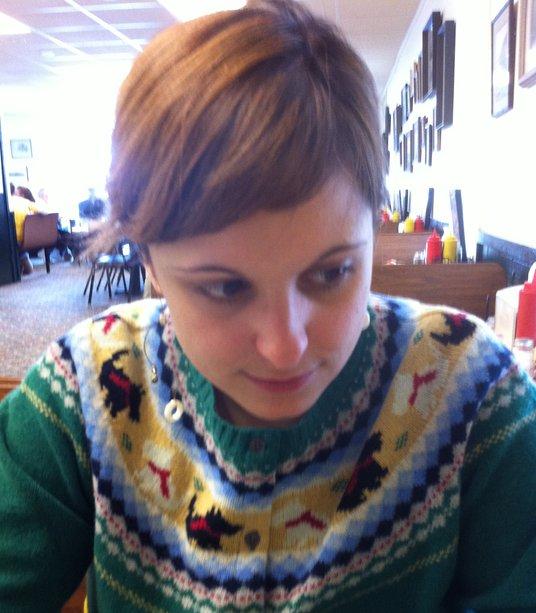
Kirsten Lunstrum

Websites:  www.kirstenlunstrum.net

Gender dialogues differ and our conversational styles reflect these personas to the outside world. Seen as sexual entities,  this complicates how our message is received.  How does sexuality affect our action and intention?  In other words, how can we empower our bodies without defining the social markings of entrapment?

Kirsten Lunstrum’s short story “The Remainder Salvaged,” listed as a distinguished story of the year in the 2012 Best American Anthology cascades these remarks. The story is centered around a man Nils who experiences two different female relationships. Iris is a secular emotionally unavailable lover and Sister is a Catholic nun who wittingly permits non-judgement and peace. Nils is unable to deeply connect to Iris in a way because of their traditional sexual attachment and gender binaries. Sister and in this case his mother allow him a genderless report,  but why the double standard? This piece questions how we handle emotional “wreckage,” how we heal, and the relationships pursued in order to “[move] forward”. We acknowledge regret, anger, grief, and acceptance, of not the precise re-translation of the past, but of humanity’s ability to listen and take action.

Active listening transforms stuck emotive frequencies and dissipates dualisms. Community is necessary to this process, as we watch Nils, see the snow fall, and nurture self. In this story we encounter “a complex faith and a wide worldview,” behind the characters and also the writer; an “ability to see beyond [life’s] immediate circumstances.” This is how we fall into committed love regardless of gender stereotype. Lunstrum writes to teach, to connect, to recognize how others “recharge [one’s] own creative energy”. And also to remember as readers we, “can actually fall in love with a story.” What are the stories that we fall in love with? They are ones of time, of colliding concepts that interact in memory and intimacy. They are ones of sexuality and friendship. How do women affect this landscape as women and as writers? Lunstrum describes, “Obviously, I’m invested in this as a woman writer; but simply as a reader I feel strongly about the contribution women writers have made to literature, especially recently.” The women in her story here reflect this sentiment as well.

Kirsten Sundberg Lunstrum is the author of two collections of short fiction, This Life She’s Chosen and Swimming With Strangers (both published by Chronicle Books). She has been the recipient of two Pushcart Prize nominations, a PEN/O. Henry Prize, and fellowships from the Sewanee Writers Conference and the MacDowell Colony. Kirsten has taught writing at a number of colleges and universities, including Saint Mary’s College, the Inland Northwest Center for Writers, and Purchase College (SUNY), where she was a member of the Creative Writing Program faculty from 2008-2012. She now lives in the Seattle area with her family and is at work on a novel.

1.)      What were the first inspirations that made you desire to become a writer? Who are your favorite writers and how did they change over time?

My parents are both the kind of readers writers dream about, so I think credit goes first to them. My mother reads a novel a week (truly!), and when I was a kid we made weekly trips to the library. My father has shelves and shelves of books, and during the long and tedious summers of my adolescence he kept me from whining about boredom by letting me pick and read whatever I wanted from his collection. I was lucky to grow up in a house in which books were sacred objects and in which literature and the arts were valued, and I think that probably shaped my desire to write more than anything else.

And, of course, there are also particular books that caught me, that made me want to write. The first book I loved completely was Willa Cather’s My Antonia, and I still love it. I read it once a year and am always just as smitten with Cather’s stunning prose, her sense of landscape, her very real characters as I was when I first read the book as a girl. I could go on and on listing favorite books – The Great Gatsby is at the top of the list for me, as is Marilynne Robinson’s Housekeeping, Anthony Doerr’s Memory Wall, everything Alice Munro has ever written, John Berger’s To the Wedding, Gina Berriault’s Women in Their Beds…  And because I have a soft spot for the short story, I’d have to include several individual stories that have stuck with me and taught me about writing—stories like James Baldwin’s “Sonny’s Blues,” Andrea Barrett’s “The Behavior of the Hawkweeds,” David Long’s “Attraction,” Lauren Groff’s “L. DeBard and Aliette,” a beautiful story by Andrew Sean Greer titled “Darkness”… Again, I could go on and on. One of the things I love about teaching fiction writing is getting to make reading lists that allow me to share the fiction I love with other readers (readers who get that you can actually fall in love with a story).

I do think my reading tastes have changed over time. When I was a teenager I pretty exclusively read mysteries—and the trashier they were, the better. Now, because I’m a mother to two young children, one of whom has just learned to read himself, a good portion of my reading is kids’ lit. My son is obsessed (obsessed!) with the Harry Potter books, and I have to say they’ve pulled me in too. We’re on our third go through the series right now, and I’m still enjoying it. Beyond that, in part because I have even less time for reading than ever before in my life, I tend to be fairly finicky about what I read. I just don’t have time for something I’m not going to love. I still go to the library weekly, and I always come home with a huge stack of books, but I probably only finish a book every month or two. I’m a sadly slow reader these days. I still read more short stories than novels, and I spend a lot of my reading time re-reading, trying to figure out how a writer accomplished something, or just seeking comfort in a book that I’ve read so often it’s become a kind of home.

2.)      Who have been the creative inspiration / mentor writers in your career?

I’ve had some fantastic teachers. Rich Ives was my first creative writing teacher, and he really shepherded me when I was still very young and not at all certain that I should pursue writing as a career. My wonderful undergraduate literature professor at Pacific Lutheran University, David Seal, encouraged me and challenged me. And then, when I went to graduate school at UC Davis, I was so lucky to get to work with Lynn Freed and Karen Joy Fowler and Pam Houston—women who mentored me as I wrote my first book, and who still serve as the models, in my mind, of what it is to be a successful woman writer. I owe Pam, in particular, a huge debt of gratitude; my first book would not have happened, I think, without Pam’s guidance and insights into my stories. She changed me as a writer and gave my book its chance in the world. There’s always among writers an argument about what the value of attending a graduate program in writing really is, but for me it was the community I got at UC Davis. Many of the writers I look to for encouragement now that I’m out in the world, writing on my own, are those I met there—both the faculty and my fellow students. That community shaped me when I was just getting my feet on the ground as a writer, and it sustains me now.

3.)      How has your own work changed over time and why?

I look back at the writing I was doing in my early twenties, and it’s all very imitative—and though I think that’s okay (imitation is part of how one learns to write) and I’m not embarrassed by that early work, it’s very different from what I’m writing now. I feel like as I’ve grown up and seen more of the world and of life, I’ve become a little more confident in writing what and how I want to write, and I’m grateful for that. I think being a writer makes aging easier, actually. Writers tend to only get better with age.

But I’d say the biggest change in my writing has actually come about as a result of becoming a parent. For a long time after my first child was born (he’s six now) I couldn’t write. It wasn’t exactly that I couldn’t write, now that I’m thinking about it—it was more that I didn’t care to. I’d sit down to work in the brief windows of time I had free, and all I felt was ambivalence about fiction. I was so wrapped up in living fully in the real life happening in front of me that any time spent in the imagined world of a fictional narrative felt thin. I just couldn’t get invested enough to care. And that was difficult. I worried that I’d never write again, that I’d never want to. I worried that I’d killed something necessary for writing by choosing to become a mother. But, happily, all of that eased with time, and when I eventually got back to writing I found that the experience of parenthood had taught me things that were important for writing too. I have more patience, for one thing, since becoming a mom, and I’m better able to let go of control in a narrative, which is something that really scared me for a long time. I’m better able to wade into a story without knowing where it’s going or how it will develop than I was before I had kids, and I think that must be directly related to learning to live with the risks and uncontrollable variables that are part of parenting. I feel hugely thankful to my kids for helping me grow in that way.

4.)      Have you been influenced by different genres, and if so how?

A couple of years ago I went through another phase of disillusionment with fiction, and in the midst of that I started reading literary nonfiction—a genre I hadn’t read much of before. It was like opening a door in my mind! I suddenly felt freer to explore different narrative structures, to push at the boundaries between what is imagined and what is not, and I came back to writing fiction with a very different perspective on process and form. I owe a lot of that shift in my thinking to the students in a class I taught on literary nonfiction in the fall of 2010. I taught the class right in the thick of my own little literary depression, so the class might have gone terribly. But I lucked out and had some of the best students I’ve ever had in that class. Their questions and creative leaps challenged me and reminded me what I had loved about writing in the first place. I always left class feeling stirred, still thinking… It’s another testament to the value of having a writing community—people invested in the process of writing to talk to so that you can recharge your own creative energy.

In terms of your question about genre, I’d also add that while I don’t write poetry, I do read it pretty avidly, and that, too, influences my fiction. I tell my students that prose writers must read poetry—and read it often—because it reminds us to pay attention. Poets are excellent and careful observers, and they listen to the sound of language in a way prose writers often either forget to do or dismiss as unimportant, which is a shame.

5.)      What are your plans for the future?

Hmmm. Golly. Hard question. I don’t know. I’ve just completely uprooted my life, left my teaching job, and moved across the country—in part for my family and in part to nurture my writing life more fully—and I’m not entirely sure yet where all of those changes will lead me. I’m trying to be open to possibility right now, both in life and in writing. I’ll have to get back to you on the end result.

6.)      What are your views on writing by women as it has occurred in the past twenty years?

Like a lot of women writers, I’ve been paying close attention to the discussion happening regarding American literary culture and women writers. The women at VIDA have done us all an incredible service by opening up that conversation, and I’m hopeful that the process of talking about the ways in which women writers continue to be marginalized will mean more opportunities for literature written by women to be published and seriously considered by the larger community. Obviously, I’m invested in this as a woman writer; but simply as a reader I feel strongly about the contribution women writers have made to literature, especially recently. Women like Alice Munro, Margaret Atwood, Lydia Davis, Marilynne Robinson, Anne Enright, Yiyun Li, Sharon Olds, Lucille Clifton, and Joyce Carol Oates have changed the shape of literature, and it infuriates me that their contributions and the contributions of other women writers are often ignored or dismissed primarily because of the (female) name on a book’s jacket.

My feeling is that pointing out the inequities in publishing and criticism is essential, as is speaking loudly and positively about the good work women writers are doing. I’m hopeful, too, that as the publishing industry undergoes the kind of massive changes we’re beginning to see happen now, independent presses will flourish and accessibility to a wider ranger of literature will be possible.

7.)      Who are promising women writers to look at in the future?

Jodi Angel, Alix Ohlin, Lauren Groff, Laura Van den Berg, Julialicia Case, Lauren Gordon, Jennifer Chang, Robin Elizabeth Black, Allison Amend, Halina Duraj, Monica Ferrell, Jacqueline Kolosov, Karen Russell, Aimee Nezhukumatathil, Jessica Griffith, Hannah Tinti, Lily Hoang, Frances Hwang. These are off the top of my head, but I could probably come up with a list a mile long. Elliott Holt has a book coming out that I’m very much looking forward to reading, and I loved Catherine Pierce’s recently released book of poetry, The Girls of Peculiar.

8.)      If you were asked to create a flexible label of yourself as a writer, what would it be?

I’m laughing here at home about this question. I’m not sure about a label. My first book was marketed to fit solidly in the “literary chick lit” category (it had a pink dust jacket), and that label really never sat well with me. I don’t know. My fiction is all primarily interested in the domestic. It’s been called “quiet” on a number of occasions, and though that used to worry me, now I see it as a compliment (most of the time). And I hope it’s accurate to call it “literary” fiction.

I think what I’d really like is what all writers want: to write work that readers feel is true.

9.)      The main character Nils in the short story “The Remainder Salvaged,” listed as a distinguished story of the year in the 2012 Best American Anthology, vacillates between two female relationships. One with Iris, an emotionally passive and removed lover, and Sister, a Catholic nurse who is potent in her philosophical exigency and listening ear. These characters exonerate character weakness and strength in Nils through their relationships. My first question pronounces Iris as trapped in the “mess” of her life with a dead husband whom she hates. Her inability to forgive the domestic traction of her past tangles her inability to physically connect with Nils, and she ultimately leaves him because he “[needs] too much”. From the perspective of Nils, Iris is “running from her dead husband.” Nils works for a search crew who sifts through the snowfall of winter searching for the dead bodies of an overturned train. In the stenciling of these parallel interactions can you delineate your intention behind femininity as it is projected through Iris and Nils? Do you believe that forgiveness is achieved in her ultimate departure from Nils? Or is it perhaps Nils who is the one ultimately seeking a way out of his own patriarchal sense of masculinity as he arbitrarily chases and dismisses his relationship with death?

I’d say that it’s true that Nils, who is still struggling with the grief of losing Iris when we meet him, finds some sense of redemption (maybe not forgiveness, but definitely a kind of redemptive grace) through his relationship with the sister—as well as through the physical act of searching through the snow for survivors of the mountain train wreck. Iris leaves him because she cannot let go of her own regrets and losses, and at first it seems that Nils will suffer in the same way, unable to move forward with his life because of a need to hold onto his past. But over the course of the story he begins to let go. He begins to accept the wreckage—both the literal wreckage of the train, and the emotional wreckage of his lost relationship—as inexplicable and horrible, but not the end. And in accepting that, he’s able to forgive Iris at least a bit, which is necessary for his own movement forward. I tried to show that through his burial of the dog he finds dead in the snow. The burial as a kind of merciful and tender act.

9). “The Remainder Salvaged,” initiates a conversation with nostalgia. This nostalgia relates to our things, our pets, our past lovers, family members, experiences; these are the roots of our past. For Nils and Sister, this negotiation is settled in the frozen bodies buried in snow and secrecy. They find remnants of past lives. The last body found is a dog whose ear has been sliced off. One that they rebury after it reassembles Nils’ dead mother. Nils shares his past dissonance with spirituality and the priest’s failure to acknowledge his trauma at his mother’s passing as neglecting the importance of acknowledging the unsayable. Why is the mother-son relationship with Nils paired with nostalgia and regret, whereas his relationship with the sister, who is removed from the possibility of a sexual relationship, one of connection and acceptance?

Well, his relationship with his mother would presumably also be one devoid of sexuality, so in that sense it shares something in common with his relationship to the sister. My sense is that his mother’s death is relevant in that it is another loss (like the loss of Iris) that he hasn’t known how to grieve, how to let go. At the time of his mother’s death he began to express grief and was more or less shut up by the priest. When he recounts this to the sister and she expresses shock and indignation at the priest’s response, instead validating Nils’s sadness and doubt and anger at his losses, she offers him a way out of silence and withholding. She allows him his grief, and I think that’s where the graces comes into the story. I think that’s why with her he feels acceptance and connection.

10.)   Branching from this scene, Nils says, “It wouldn’t have made any difference. I wanted him to say nothing. I wanted every noise to stop without her there to hear it.” Admitting, “What you’d will doesn’t matter. There’s no stopping. And that’s all. I didn’t see it then, but now I do.” His fingers trace the found clock he holds in his pocket, he buries the dog. He asks the sister if she is okay. Time here is placed in a transformative landscape of the feminine alternative of spirituality. The Catholicism of the sister, who remains a compassionate friend, is juxtaposed to that of the priest, who speaks to Nils about his mother’s death and remarks in insensitive passing. The sister then prays, they walk away together in a solitude that has friendship and a sense of fragile closure. Can you please comment on the threads of religion, spirituality, masculinity, femininity, linear and nonlinear juxtapositions of time?

I suppose my answer has to do with the models for the story. Several years ago I taught at a Catholic women’s college, and during that time I led an autobiographical writing workshop for the retired sisters who lived in a senior care facility on the campus. I am not Catholic (I’m Lutheran, actually), and had until that point understood Catholicism as a fairly rigid kind of spirituality, with a very prescribed, black-and-white version of morality and belief. I couldn’t have been more wrong. As I worked with the retired sisters, listening to their stories as we workshopped their writing, my understanding of their faith deepened, and I came away from the experience with deep respect for them and for their faith. So, when I sat down to write this story and the sister appeared, I had a solid model on which to base her. I wanted to write her as a woman with a complex faith and a wide worldview. I think that because of her faith, she understands time more broadly than does Nils, who, in comparison, has fairly limited life experience and little ability to see beyond his immediate circumstances. When I wrote the story, I wasn’t honestly thinking about that as a commentary on the masculine or the feminine. I was just aiming to write believable, real characters, whose actions suited their backgrounds. I do hope, though, that by the end of the story the reader sees Nils as changed by his interactions with the sister, who I think helps him see a way forward through his losses toward a future less bound to doubt and regret.

profiles in poetics: Lori Anderson Moseman

Lori Anderson Moseman

Websites: www.stockportflats.org/index.htm

www.stockportflats.org/lori.htm

Writer Lori Anderson Moseman connects to this conversation through the comparative sedimentary and turbid landscape of difference. Our discussions amass around DOUBLE | VIGIL, a collaborative book with poet Belle Gironda who was in Cairo for the first year of the Egyptian Revolution. The project begins, she measures, as a way for her to calm the distress of Belle’s environment. But the mirroring of creative gesture here opens the self to a communicative nurturing breadth. One that safely encounters the unease of a politically unsettling time handled with coalescing congruity.

We are able to articulate violence, distress, and cultural gaps, unified and displaced in a similar and foreign rhetoric. She acknowledges, “Belle and I exchanged poems because the role of the military in Egypt’s future remained/remains uncertain.” Moseman, “seeks to close the gap created by difference.” And furthermore, as a diction of the experience as writer and reader, “This is what we do together: exchange writing, images, then write more, and offer more images. It is a space we build.” At the age of four, Moseman reflects an, “imperative for life—stay afloat, breath. I turn to this memory because it speaks to an awareness of text as an ancient, sacred, human activity and because writing in the margins is where I have found space as woman.”

Publisher LORI ANDERSON MOSEMAN founded Stockport Flats in the wake of Federal Disaster #1649, a flood along the Upper Delaware River. Anderson Moseman’s poetry collections are All Steel (Flim Forum Press 2012),Temporary Bunk (Swank Books 2009), Persona (Swank Books 2003), Cultivating Excess (The Eighth Mountain Press 1991) and Walking the Dead (Heaven Bone Press 1990). Anderson Moseman has two Masters of Fine Art: one from the Iowa Writers’ Workshop and one from iEAR Studios at Rensselaer Polytechnic Institute. Her Doctor of Arts in Writing, Teaching and Criticism is from the University at Albany. She’s been a forester tech, a farm reporter and an educator.

1.)  What were the first inspirations that made you desire to become a writer? Who are your favorite writers and how did they change over time?

The first place I ever remember writing was in the margins of a bible my grandmother gave me. I was four-years-old, and I wrote “bob.” Bob could be my godmother Lena’s oldest son, or it could an imperative for life—stay afloat, breath. I turn to this memory because it speaks to an awareness of text as an ancient, sacred, human activity and because writing in the margins is where I have found space as woman. Mark-making is a tool for building relationships with living beings as well as for participating in some pre-existing tradition. Writers I return to time and time again are Flannery O’Connor, T. S. Eliot, Marguerite Duras, Denis Johnson, Anne Michaels, Czeslaw Milosz, Michael Ondaatje, Bruno Schulz, and Jane Miller. Other writers haunt me for intense periods: Ai, Frank Bidart, Ema Saikō, Tarjei Vesaas, Jorie Graham, Anne Waldman, C.D. Wright. Anne Carson, Carolyn Forché, Joy Harjo, Franny Howe, Pierre Joris, Pentti Saarikoski, Goran Sonnevi, Cole Swensen, and Cecilia Vicuña. There are always new obsessions: Charles Olson, Paul Celan, Meredith Stricker, Melanie Noel, Marzanna Kielar, Michele Glazer, Arthur Sze and Per Petersen. What I need from a text varies: a conversation, a cadence, a vocabulary, a particular landscape, a structure, a scold, a lesson; I always read to generate more energy. This list is lopsided in that I might learn more from texts I dislike. Also, for every poetry book open on my desk, there are four non-fiction books I am reading at the same time.

2.)  Who have been the creative inspiration / mentor writers in your career?

First, you must know that from age 9 to 19, I trained as a runner; nightly, in hordes, we took to California hills as if we were a herd of zebras. Each girl had her own markings, but we read each other’s ear-twitches and muscle-ripples to know where the mass will move next. Consequently, all my answers to your questions feature multitudes. My mentors/inspirations have been legions. Here goes. Those who trained me: Deborah Digges, Jane Miller, Jorie Graham, Dee Morris, Shelly Berc, Judith Johnson, Judith Barlow. Those I trained with: Sujata Bhatt, Suzette Bishop, Mary Ellen Kirkconnell Ionas, Sheila O’Connor, Sheila Griffin Llamas, Jane Ann Devol Fuller, Cynie Cory, Robin Reagler, Michele Glazer, Meredith Stricker, Callie Cardamon, Hilary Sideris, Stephanie Brown, Laura Mullen, Myung Mi Kim, Jill Hanifan, Tess Lecuyer, Amy Schoch, Roz Lee, Druis Beasely, Esperanza Cintrón, Lillien Waller, Jan Ramjerdi, Belle Gironda, Katie Yates, Cindy Parrish, Lale Davidson, Carla Steinberg, Nicole Peyrafitte, Sally Rhoades, Miriam Herrera, Nancy Klepsch, Karin Maag-Tancik. The women I publish: Mary Olmsted Greene, Cass Collins, Victoria Boynton, Pramila Venkateswaran, Nancy Dymond, Sheila Dugan, Tracy Gass Ranze, Lisa Wujnovich, Liz Huntington, Dorothy Hartz, Deborah Poe, Katie Yates, Belle Gironda, Belinda Kremer, Melanie Noel, Deborah Woodard, Kate Schapira, Laura E. J. Moran. The women I exchange work with: Sharon Jefferis, Carolyn Manring, Talia Bloch and Ingrid Arnesen. Good thing you did not ask me about the visual artists who inspire me. Here’s a few I cross paths with often: Sheila Goloborotko, Rebecca Szeto, Diane Schaefer, Sylvia Taylor, Kathleen Hayek.

3.)  How has your own work changed over time?

At the core of my writing is my mother’s syntax (blunt Badland blurting with lots of leaps) plus my father’s rhetorical savvy and whimsy (he’s good for a tall tale or an acerbic retort) and my brother’s encyclopedic curiosity and mathematical exactitude (genius inventor with wicked humor). My writing, no matter how much I train, doesn’t seem to stray too far from dinner table discourse of my Wonderbread years. I like to juggle a lot when writing: a memory, an intellectual puzzle, an historical fact, a contemporary political conundrum, a musical project and a formal structure. The more I write, the more I try to juggle. Although, I do hope that as I age I will seek “utmost brevity.” I am answering these questions in the wake of Hurricane Sandy, and I am contemplating trading in writing for gardening. Although I began my press, Stockport Flats, in the wake three 100-year floods (Federal Disaster #1649) to help a community of writers and artists (not all healing is physical), I do wonder if words will become less important in our future survival.

4.)  How you been influenced by different genres, and if so how?

I have degrees in Forestry and Technical Journalism. My first editorial jobs were at a Forestry Research Station and at Oregon State University’s computer department.  I was immersed in scientific writing, field reports and computer manuals. Then, working as an agricultural reporter for a farm weekly, Agri News, I discovered the joy of writing feature stories. I have written poetry since I was a child, but my professional writing was heavily informed by the structures and concerns of natural resource management. This can be seen most in my first book, Cultivating Excess and my recent collection All Steel. See Trickhouse.org for an interactive Variable Plot Cruise I did at H.J. Andrews Experimental Forest. I have also studied playwriting and integrated electronic arts; some of the work in my collection Persona first had a life on stage or in video or flash animation. Currently, Clear Hawse, a collaborative project with artists explores the journal of a German sailor during California’s gold rush; this is featured in the online Drunken Boat. Basically, I am hungry for information, for writing technologies, and for physical play. If I can find a community engaged in exploration (be it scientific, artistic, political or spiritual), I will engage with the language and technologies at hand. The word “genres” can hardly contain it all.

5.)  What are my plans for the future?

My immediate future involves ushering three new Stockport Flats titles through the printing process: Deborah Woodard’s Borrowed Tales, Melanie Noel’s The Monarchs, and Belinda Kremer’s Decoherence. We have a full slate of books lined up for next year. Lisa Wujnovich and Brandi Herrera are editing an anthology on human relationship to water, The Lake Rise. Tomorrow I meet with writer Sarah Jefferis. The day after that, I get our river house furniture out of flood-formation. I have a novel in progress and three other hybrid books (part poem, part image). My future I will be creating and helping other writers and artists make books amid the messy aftermath of extreme weather events. Creation is a collection of intaglio prints by Sheila Goloborotko and Stockport Flats poets (Katie Yates, Deborah Poe, Lisa Wunjovich, Laura E. J. Moran, Belle Gironda and myself). Once Goloborotko’s studio in Brooklyn is mopped up, we will have a book launch. Mop and make, mop and make.

6.)  What are your views on writing by women as it has occurred in the past twenty years?

There is so much to celebrate, where would one begin? This question could be several dissertations. Let’s just pay tribute to how woman have taken control of the means of literary production. When I went to the Associated Writing Program’s annual conference in Minneapolis back in 1992 to work at the book table for The Little Magazine and 13th Moon, there were at most 30 publishers. We only needed a single room. Last year in Chicago, 600 independent presses were featured at AWP Bookfair in 2012. I’d love to know how many were women owned—hundreds, I am sure. Back in 1992, I was living down the street from Rachel Levitsky in Albany, NY; she was not yet a poet. An activist and educator, she knew what to do after she became one under her tutelage with Judith Johnson and Ann Waldman. Belladonna Press and Reading Series is a fine example of how women writers have worked together to create venues for each other and to intensify each other’s poetics of engagement. This online interview forum is another. Anne Gorrick’s Cadmium Text Reading Series is another. Gorrick teams up with Lynn Behrendt for PEEP/SHOW: A Taxonomic Exercise in Textual and Visual Seriality. Mary Olmsted Greene hosts the Upper Delaware Writing Collective.  I could spend all day listing spaces (page and stage) women writers have opened for each other.

7.)  Who are promising women writers to look at in the future?

All women who ever wrote/write/will write are the best of our future. Poetry is not horseracing: we do not need to bet on the young to win; we do not need to retire any texts or oral traditions because of their age or some perceived limp. Readers can keep the fullest range of poetry alive and pulsing. For example, poet Laura E. J. Moran has just written a choreopoem using the last words uttered women executed on this continent during the 1600 and 1700s. Her words and their words are the past and the future.  Translators are teaming with technology to allow women’s poetry—new and old—to cross the globe. My goddaughter, the poet Léna Cintrón, knows Spanish, Quechua, English (and she plays the harp). Her work is in my future. Cora Louise Larsen, three months old now, might become a poet: her father—a white artist from Tennessee who is fluent in Chinese—is already reading her bilingual poetry. Cora will no doubt find promise in Wallace Stevens, Gertrude Stein as well as Zhang Er and Deborah Poe. I wish the fullest writing life for all the women I publish and the women who inspire them and the women who inspire them and so on. As Melanie Noel, author of The Monarchs, said to me: “you like to gather a democracy about you.” Indeed. Riffing off of Stein’s “Useful Knowledge” in Making of Americans (“one and one and one and one and one and one…), my poem for the future is called “Prayer Diet” and it goes: “dear dear dear dear dear dear dear….” On in to infinity. Collaboration is key. No need to single any one of us out.

8.)  If you were to asked to create a flexible label of yourself as a writer, what would it be? 

Until this year, I wanted my tombstone to read “EEK!” which could stand for “energetic, eclectic kook” as well as “OMG, there is afterlife!” But now, I would be pleased if my grave marker read: “well fed.” Serious, if I ever get around to making a will, I will request to be cremated and scattered on water. I do not need a label. If I were asked to make one, I would resist. There was a time when it seemed important to be a Resistant Post-Modernist Feminist, but I was too ludic to qualify. You could call me contrary, but I am too normative for that. I think I would love to be called a “generous, generative wind.” My mantra these days is “gather and give.”

9.)  The first image in your collaborative piece DOUBLE | VIGIL with poet Belle Gironda who was in Cairo for the first year of the Egyptian Revolution, tenuously unfolds as if tucked in an envelope, a photograph of a soldier asleep with a rifle tucked in the fold of his shoulder. His face is slouched against the sleeping prop of his left arm. The humanity of the image is juxtaposed to the intrinsic tension his attire brings to the argument of the presentation. At once we become the traditional male gaze witnessing his unintentional vulnerability. But the position of militia is employed to interact on these same terms when at attention and awake. The first poem of your collection reads, “I sort photos/ study glyphs/ how light is cast/ in the workers’ temple.” We mix employment with religion and a gaze turned upon itself. Can you discuss the intention behind this image as an opening statement? How do you believe photographer and writer interact in this space and furthermore, how does the male gaze affect and also challenge the perceptivity of this space?

I took this photo at Deir el-Medina a workers’ temple outside Luxor, Egypt, two weeks before the January 25 gathering in Tahrir Square initiated a revolution. My companion, Belle Gironda, then teaching at the American University in Cairo, knew of the planned uprising, but who could guess at what all would unfold. I inserted this image in an InDesign file stateside during the first week of that revolution; I was awaiting word from Belle Gironda. Writing and sorting images was a way to calm my concerns: was she safe? what exactly was she witnessing now? and now? and now? I was left with images I had gathered back then. When one is on vigil for another, should one inhabit a shared, lived past or imagine a new future? Or, can one—in the act of writing/imaging—create a new space to occupy, to be occupied by? For us, the sleeping soldier image became as much about the postures of vigil or vigilance as it did signify a relaxed male gaze.

I kept the image as an opening for DOUBLE/VIGIL during the whole year Belle and I exchanged poems because the role of the military in Egypt’s future remained/remains uncertain. The “militia”—no matter how active—could “wake up” and intensify its presence.  Before I took this picture (man using his rifle as pillow), I had asked Belle (in the Valley of Kings) what the Pharaonic past means to most Egyptians? How important are hieroglyphs, as a writing technology, to the average Egyptian? Her answer focused on the present: the Egyptians she knew—colleagues, students, monks, souk-owners—were intent of the living conditions of the present. As the year unfolded, the lives of women protesters seemed more and more imperiled.

While I have your ear, let me tell you about the images that are under this sleeping man. Deir el-Medina was the temple for the artisans (labors, painters, carvers, craftsmen) who worked on the tombs for kings. One striking difference in how images were used in these two sacred spaces was this: the cobra showcased in vaults of royalty is stylized and repeated until it, en masse, forms a border. In the workers’ tomb, paint was more vibrant, and the scene was realistic: amid a field of grain, a single snake stretches across the wall to strike at a farmer, but the serpent is beheaded, cut to the quick. By a machete? By a fanged rabbit? I cannot remember (no photos allowed). I remember the realism, the active resistance, and the engagement.

As the photomontage of Double | Vigil unfolds, images still come from my pre-revolution visit to Cairo, but the text is taken from sources I access on the internet, from newspapers, from emails with Belle. My vigil becomes increasingly focused the plight of activists in Tahrir, particularly, female activists and the violence against them. Why? Because I had feared for Belle’s safety. I had seen how she had to steel herself just to walk through the streets even before the uprising. I had seen the Saudi army across the street, Mubarak’s thugs at the corner, and Egyptian military at the tombs. Where were they positioned now? How do I wrestle my fear from afar?

Belle did not see the full montage that opens Double | Vigil until she was stateside a year after the revolution; therefore, her “perceptivity” of this space was no doubt different for her that it was for me. You’ll have to ask her how if functioned exactly. She said she cried. I do know it invited her to write more poems, to offer her images from Tahrir Square. This is what we do together: exchange writing, images, then write more, and offer more images. It is a space we build. You’ll have to tell me how you enter it.

10.)  Included is a passage copied from Susan Brind Morrow The Names of Things: A Passage in the Egyptian Desert, 1997: “I walked downhill to where the ferry was … if this was where we waited to board the boats. ‘Yes, but you are a foreigner,’ he said. / ‘There is no need for you … he lifted me up over his head and passed me on to the next person. / I was passed like a sack of grain over the heads of the.” Amidst every culture we encounter gaps. Generational, environmental, religious, political, sexual; difference.  These traits are exemplified when we travel further outside of our comfort zones, particularly when we become “other” as foreigner. The fascinating ability of poetry is its ability to cohere difference. The personal encounter becomes a translating exchange. Your project complicates this further in the ways in which the creative prowess between you and Belle mirror the mirror; translate an alienating experience into an intimate one. Can you describe the process of this creative teamwork, the ways in which the stories developed, and how this affects cross-cultural communication?

Susan Brind Morrow can read hieroglyphs, Greek, Hebrew, Arabic, and probably a host of other languages she doesn’t use in The Names of Things : A Passage in the Egyptian Desert. She can also read the landscapes from which words are formed. Next to her, I am illiterate—not only of the languages but of the tools and technologies used to write in stone, on papyrus, in metal. She says, “The word carries the living thing concealed across millennia…. the Nile, was once clotted with papyrus, thriving, gigantic, mobile, filled with animal and bird life, as it is today only in the Sudd, the great marsh in South Sudan. In Egypt, the plant no longer exits. It survives only in the hieroglyph for green.” Can that be true? What extinction does any word on papyrus mark? For example, the words on Oxyrhynchus Papyri? A text + a question + another question + more text + a lived experience fuel my exchanges with Belle Gironda. This is not just the process for this DOUBLE | VIGIL; this is how we talk to each other.

I encountered The Names of Things in New Orleans post-Katrina. The store was dank, and I ended up throwing away the book after I read it because of mold. But I gave a new copy to Belle Gironda. Susan Brind Morrow grew up in the same neighborhood that Belle did in Geneva, NY. Susan and Belle lived in the same Cairo neighborhood in different decades. They don’t know each other nor do they know much about each other’s writing, but their bodies have lived in the same landscapes. Can I use words to make a mirror between them? I doubt it. But each of their texts helped me enter the other’s work—and, perhaps, the work of the Other. Can we use difference to forge bridges? Belle and I hope so. But most often we think of ourselves as two writers sending poems back and forth within a friendship.

In the Brind Morrow scene cited in DOUBLE | VIGIL, I am captivated by how Susan surrenders to the swarm. Is that like Belle’s yielding to the masses when she smuggles medical supplies into Tahrir? In the early days of my vigil for Belle, I turned to Susan Brind Morrow to understand throngs, to watch a single body within a mass movement. Brind Morrow’s words were a safe passage to contemplate. As news poured out of the streets of Cairo, there were the sources to consult, say, the ones we cited in the opening montage of DOUBLE | VIGIL. Now, thanks to the videos of director Leil-Zahra Mortada, we can watch/hear/read Words of Women from the Egyptian Revolution on You-Tube. We can hear perilous first-hand accounts from Rasha Azab, Sabah Ibrahim, Evelyn Ashamallah, Nada Zatouna, Hanan Sadek & Mona El-Sabbahy, Mariam Kirollos, Madeeha Anwar, Om Ahmad Gaber,Maryam Alkhawaja, Mahienour El-Massry, and Aya Tarek. We can hear how then navigated the throngs, what they believe they accomplished, how the conquered their fears. The Facebook portal for Leil-Zahra Mortada’s is http://www.facebook.com/HerstoryEgypt.

Another fine example of cross cultural collaboration is Belle Gironda’s videopoem “You make a better door than a window.” In the video, she works with Egyptian poet/journalist John Ehab (camera work by Aras Ozgun). This “translating exchange” is an elaboration of a poem featured in Gironda’s book Building Codes (Stockport Flats 2008) and in her collaboration with Shelia Goloborotko in High Watermark Salo[o]n v.1 n.4 (Stockport Flats 2006). The relationships Gironda built in Cairo allowed her to give the poem a larger cultural resonance than it had in her previous stateside printings. Gironda’s piece was part of a collaborative multi-channel video installation called Windows, on the roof of a gallery in Cairo, involving mostly Cairene artists and organized by New York based Turkish artist Aras Ozgun and Armenian curator Angela Harutyunyan. PYROMEDIA, the website featuring this poem speaks to the ability of poetry and new media to try and close the gaps created by difference.  See http://www.pyromedia.org/windows_project/belle.html. The exciting work done by Aras Ozgun and his experimental media arts collective is worth exploring.

profiles in poetics: Sarah Maclay

Sarah Maclay

Websites: http://www.sarahmaclay.com

If you could create your own language, what etymology would you pull from? From what linguistic logos, from what pathological stain? Whose histories would you disrupt, three dimensional in language? Can we flesh our forgiveness in the subjectivity of object? Sarah Maclay is a poet who “[braids] external references and observations with a kind of voiciness that [pops], so the surfaces are a little more distressed and the journey is less straightforward.” She quotes Paul Valery: “Seeing is forgetting the name of the thing one sees,” continuing with her hope that the poems emerge as her artist friend Kristi Hager once experienced them: “if my poems were butterflies, they were not trapped and pinned down, but the wings were still beating.”

The feminine/beauty conflation conundrum from Maclay’s perspective dissolves strict gender universals. She refers to recent poems of female friends:  “as with the work of many of my favorite male writers, [it] does seem to me, often, ‘beautiful’ or, to be more precise, ‘potent’— [is] in highly various ways, utterly alive—in its connections, its silences, its erasures and utterances, its senses, its dazzle, its dun, its restraint. So, in short, I think we may have been writing outside of that closed cycle for a long time.” Here we are able to “ultimately, [tumble] with some relief, into a state where boundaries seem to be erasing—boundaries between self and ‘other’ and between present and past and future, between waking and sleeping.”

Sarah Maclay is the author of Music for the Black Room, The White Bride and Whore (all, University of Tampa Press)—and three chapbooks: Ice from the Belly (FarStarFire), Weeding the Duchess (Black Stone) and Shadow of Light (Inevitable), as well as Fugue States Coming Down the Hall, collected in the Kostelanetz anthology Scenarios: Scripts to Perform. Her poems and criticism have appeared in APR, Ploughshares, FIELD, The Writer’s Chronicle, Poetry Daily, VerseDaily, The Laurel Review, Hotel Amerika, Ninth Letter, The Offending Adam, The Best American Erotic Poems:  1800 to the Present, and numerous other publications including Poetry International, where she serves as Book Review Editor. A Montana native, she received degrees from Oberlin College and Vermont College and has worked in the software and film industries. The recipient of a Special Mention in Pushcart Prize XXXI, a 2009 Grisham fellowship, and the Tampa Review Prize for Poetry, she teaches creative writing and literature at Loyola Marymount University and conducts workshops at The Ruskin Art Club and Beyond Baroque.

1.)    What were the first inspirations that made you desire to become a writer? Who are your favorite writers and how did they change over time?

I started writing as a child, inspired mainly because my mother read to us every night, so I fell in love with literature, starting with the great fairy tales. Though I can’t explain why, I think an equal inspiration was listening to a lot of Debussy and Beethoven as a very young kid, and staring for hours at a book of pictures from the Louvre.  Also, I lived in the country, long before computers, and with minimal TV and phone, so there was a lot of time and room for an active imagination. There was some kind of productive loneliness there. Starting in high school, Beckett, Anne Sexton, Cummings, Merwin, Lorca, and then later Gluck, Atwood, Valentine, Woolf, Djuna Barnes, Stevens, HD, Rilke, Transtromer, Edson, Sontag, Faulkner, Char, Eliot, Hart Crane—these were some early touchstones. And then later, Anne Carson, Barbara Guest, Celan, Mary Jo Bang, Linda Gregg, Beckian Fritz Goldberg, CD Wright, Zagajewski, Trakl, Emanuel, Bachelard, Salamun, Bowles, Durrell, Koetzee, Duras, Forche, Kelly, Greenstreet, Schutt, and a whole growing spill of writers, starting with the folks I’m about to mention.

2.)    Who have been the creative inspiration / mentor writers in your career?

I was at Oberlin at a time when Franz Wright, Tom Lux and David St. John were all there,  along with David Young, Stuart Friebert and Diane Vreuls and David Walker, who are still there—and I also got to hear many poets and writers who passed through, among them Atwood, Rich, and Transtromer. When I got back into my own writing, many years later, I became a regular at workshops held at Beyond Baroque, The Midnight Special, The Church at Ocean Park and then Yellow Bay, Idyllwild, Squaw—so, everyone there and especially Bob Hass, who I run into more often, and Jane Miller and Carl Philips at Tomales Bay. I took generative workshops in LA with Cecilia Woloch, who kept on me to complete what became Music. . ., and I became part of David St. John’s ongoing master class. And then Ralph Angel, Mary Ruefle, Bill Olsen, Roger Weingarten were mentors at Vermont College. I also had some important conversations there with Jody Gladding, David Wojahn and Gillian Conoley, who pointed me in fruitful directions. Roger, along with my California and Montana poet/mentors Sandra Alcosser and Bruce Boston, encouraged me to write reviews. Ralph was the mentor who shepherded and believed in Whore as a book, and urged me to submit it to contests, which led me to my publisher, U of Tampa. I continue to study with David St. John whenever I can—he has provided me with profound ongoing mentoring and belief in my work, and I think he’s seen nearly all of it. And I think more and more about Lynn Blumberg, who I studied with in high school, and out of whose classes and crwr mag advising, a number of us are still writing. And recently I’ve gained a lot of inspiration from my various collaborator and braided reading poet-pals—Holaday Mason, Gail Wronsky, Louise Mathias, Molly Bendall, David Dodd Lee, Mariano Zaro, Brendan Constantine, and Elena Karina Byrne.

3.)    How has your own work changed over time and why?

In the 90s, I was able to isolate something about the poems I most revered that I also hoped for in my own work—that the poem was a form of transport, some kind of transport mechanism—to a place I somehow recognized, often some internal place but, to get there, as Camus says, “A writer needs things and flesh,” even though the space we get dropped into may be “the ineffable.” In my more successful work, as my artist friend Kristi Hager put it, if my poems were butterflies, they were not trapped and pinned down, but the wings were still beating.

And then this, from Paul Valery, became a fundamental key: “Seeing is forgetting the name of the thing one sees.” So here’s the paradox: as writers, how do we do this in a naming art? Because when we start to practice this more and more consciously, letting the labels slide gives us a chance at bringing back the mystery and presence of what’s underneath them; we can get closer to that unmediated initial experience. This paradox began to pre-occupy me more and more consciously, not only in my own work, but in the poems that really got under my skin, and it keeps leading me to investigate the many ways poets move toward this point via both subtraction and addition.

The poems of Music . . .are earlier (begun between the 1970s and very early 00s), so they may still feel most accessible, and the prose poems of The White Bride (a return to a form I’d used decades earlier) felt like a necessary chaser to the poems of Whore. These prose poems often started as assignments that would slip into my brain as titles, sort of like lines sometimes slide in—and then I’d have to find a way to fulfill the assignments. Sometimes this took years. Other times, it happened right away. Etymology is at the heart of the poem “Whore” as a way to disrupt the stability of that word, and I also used it increasingly in the prose poems, often having to use multiple meanings of a word in the same poem. And there was also a sort of pick-up-sticks braiding of external references and observations with a kind of voiciness that would pop up, so the surfaces are a little more distressed and the journey is less straightforward. A lot of those poems are also ekphrastic or quasi-ekphrastic. Ultimately, there’s a psychological journey going on that can be traced, but I didn’t know I was doing that when I jumped into the first poems. It was deeply refreshing to turn my focus outward.

The touchstone I always seem to come back to and find myself wanting to access even more deeply right now appears in the titles of the classes I’ve been teaching recently: the poetry of silence, the poetry of night, the poem of the dream, the poem as dream. If I have to isolate the movements that continue to speak to me and seem to swirl around all of this, symbolism, surrealism and the work of the Deep Image poets (as well as the people they have translated) provide me with a continuing sense of home base. My sense is that some of the more elliptical work I am also drawn to now is also somehow connected to this.

Listening to, reading and writing about other people’s work is what has most moved my own writing, and continues to. I find it indispensable. As Bill Olsen says, “If you can’t write, read.”  Meanwhile, I think my poems have been growing more elliptical, the weaves more open, perhaps because I admire the spaciousness this creates in some of the poems of friends, and perhaps because I’m more likely now to feel claustrophobic if anything about a poem feels cramped.

4.)    Have you been influenced by different genres, and if so how?

Different genres and different art forms, very much so—in addition to various prose forms (some of which I refer to above), music, film, the performing arts, the visual arts: Wenders, Lynch, Bergman, Herzog, Bertolucci, Malick, Laurie Anderson, Joni Mitchell, Leonard Cohen, Eno, Glass, Rothko, Kandinsky, Matisse, Bonnard, Cy Twombly, O’Keefe, Kahlo, Cage, Cornell . . . Hope Sandoval, Gillian Welch, Moby, Gorecki, Arvo Part, Pina Bausch, Robert Frank, Rocky Schenck, Spaulding Gray . . . all of them have held me in their sway. And this is a partial list of course, but you get the idea. My experience is that aesthetics are not bound by genre or art form, but cross over, cross through. I was involved for many years in music (as a singer/songwriter, ten years of choirs, piano), theatre and film and performance art (“Fugue States Coming Down the Hall” was performed at Oberlin and Beyond Baroque and appears in Kostelanetz’s anthology Scenarios: Scripts to Perform, and there were also many years of working as a script analyst, in freelance development, acting, some loose dramaturgy), and I’ve had just enough experience with drawing, painting and photography that they have given me the tools to understand and experience (with hand and eye) that Valery notion that so rocked me. My participation in all of the performing arts has increased my awareness of the power of silence, the power of stillness, as well as giving me a sense of the magic of anything that deigns to appear in an otherwise blank space, whether an image, a gesture, a sound, or a mark. Film—and in particular, the way its plasticity and montage allow for a fluidity that approximates dream, which I also see and experience in some modern dance—is an art form I feel particularly akin to, and I’m very intrigued by the poemfilms that are emerging now (including yours!).  A number of my poems have been infiltrated by the work, ideas, thoughts of musicians, artists and filmmakers, in particular—and I edit aloud, for music, or sometimes look at larger swaths of work with particular music in the background. Bergman figures in the making of some of the new poems (including “32,” below). Herzog once gave me a great editing tip. He said that he’d look at footage as though he’d taken it all out of the garbage, to see what he wanted to save. That allowed him to see it afresh.  It can be so hard to get distance from one’s own work. I think this is a good technique.

5.)    What are your plans for the future?

To get “She” into the world (my braided collaboration of 50 poems each with Holaday Mason). To return to my essays, starting with “The Root of Saying” (10/04 Writers Chronicle)—I want and maybe need to complete a book of them. To complete a tiny chapbook of tiny old poems. And to see what begins to open up as the next cycle of poems.

6.)    What are your views on writing by women as it has occurred in the past twenty years?

It’s healthy, vibrant, alive, wildly pluralistic, burgeoning, and I’m thrilled to see women of all aesthetic stripes also taking the reins and actively propelling the present and future in every possible way, from forming presses to running reading series to leading writer’s organizations to writing significant criticism, to conducting workshops and teaching. It’s like watching some brilliant time-lapse explosion that seems only to continue, and that I think will be even more visible to us in 20 years.

7.)    Who are promising women writers to look at in the future?

Oh, so, so many—it’s burgeoning. Most of the people I’ve already mentioned have more than one full-length out, and there are a lot of terrific poets with at least two, so I want to focus here on some who, as I write this, have released one or fewer: Louise Mathias, Natalie Diaz, Alison Benis White, Kelli Noftle, Anna Journey, Lynne Thompson, Dina Hardy, Mia Carli, Frankie Drayus, Stephany Prodrimedes, Yvette Johnson, Olivia Friedman, Maureen Alsop, Jan Wesley, Amaranth Borsuk, Marci Vogel, Beth Ruscio, Angela Penaredondo, Charlotte Innes, Hilda Weiss, Barbara Blatt, Alexis Orgera, Megan Kaminski, Jessica Fisher, Mandi Smith, Carrie Olivia Adams, Marsha de la O . . . and there’s another nascent wave I’m tempted to add here, but will wait.

8.)    If you were asked to create a flexible label of yourself as a writer, what would it be?

The Un-Labeler. One Who Is Pre-Occupied With Getting Below the Skin of Language. Below the skin, below the scrim.

9.)    The first three poems, in your work Whore, women’s bodies are cast in a palpable organic light. In “A Crescendo in Rain” we listen to lines such as “I am made of leggy petals / and you grasp them.” The female figure is represented in an organic nature, but she is also caught within the logic of her skin and the Patriarchal power structure under this codex. Speculative thinking which is intransient outside of knowledge seems to suggest freedom from this. How do you see your poetry reinforcing gender binaries or disrupting them?

Given any either/or choice, my tendency is always to want to kick the door open, to get beyond the realm of rods and cones and into full-spectrum color—so I’d say disrupting binaries and breaking silence and also wanting to get beyond even the either/or of a binary frame—that I want to write from some place on the other side of anything that feels self-limiting and into something that simply feels true; in this case, to celebrate aspects of the human body in a state of unusual well-being in a rare moment of intimacy, to celebrate the sacredness and joy of that connection, to try to come anywhere close to the suggestion of what those moments are like. If there is a logic of skin it is also a logic of soul, of spirit, of psyche enacted in the flesh as the boundaries begin to erode, which happens in the rest of the poem via association and syntax and rhythm and a kind of slippage between outer and inner.

It’s so interesting that you mention those first three poems—“feminine, winter, cold” is essentially figureless—it’s an existential poem focusing mainly on landscape, a deeply quiet, essentially solitary, nearly hermetic moment of at least the illusion of renewal, of having cast all baggage aside, of surrendering to these particular  “aspects of yin” which the title names, and though there is some sense of a lyric speaker, I think the poem would read the same way, whether read by a male or a female voice. The hint I will give about the second poem, which comes from a dream, is that there are no gender indications. People tend to read both dual genders and a particular type of intimacy into the poem, but it did not begin that way for me, and I like the preservation of that ambiguity, because I think it speaks, whatever the nature of the growing intimacy (whether friendship or a more traditionally “romantic” relationship) to both the excitement of discovering any type of genuine connection with someone as well as the actual oddness of an exchange which suddenly also comes not just with baggage but with an exchange of baggage, of histories, of pasts, of ongoing dilemmas. So you start with something magical and transporting and then suddenly you get the whole family in the hotel room—and then this is actually also part of the intimacy; it’s just not whatever you had, initially, in mind.

10.) Music for the Black Room, “Demeter Before the Return of Spring,” reads “I could watch / the delicate, unconscious strip of the tree / until the fifty-eighth of November, / the eighty-fourth of November— / this tree that stands on its hill like a prop, / letting go of its sewn-on leaves— …  because there will be no end to November.” The figure of the tree here is almost figureless in the values placed on the subjectivity of identity as object. The poem is dependent on the architecture of this listless system. In reference to the body as feminine and beauty, what does this speak to in terms of women’s bodies and in your opinion is there a way out of this cycle?

First, to the poem itself, for a bit of context: this poem came out of a deep and piercing grief, to the point that there was a sense in which everything perceivable seemed somehow unreal, dislocated, two-dimensional, “as if”—the day, the speaker observes, could be called “beautiful,” but the speaker cannot feel that but only observe that the day has qualities that others would name in this way—that it could be called “beautiful” is not a comfort, but a sharp jab of irony. The “light” delivers not warmth, but “cold.” The “park” looks like a “sandwich on a concrete plate.” The tree, its “toothpick.” The hill itself looks “manmade” and “shallow.” The tree “sheds leaves like crackers.” The speaker feels completely cut off, displaced from nature.  Nature itself seems cut off from itself, unreal. The only nourishment available, in this sort of hallucinatory search for metaphor and simile to get at the way things appear in this perceptual state, is sort of weirdly festive and manmade and processed—a giant, inedible sandwich festooned with a toothpick. It is only in the stepping out of its “red dress” and into eventual nakedness that the tree also resonates as specifically female—and this, I think, to some extent, could be seen as a momentary projection of the speaker, some kind of self-identification, as well as another search for metaphor.  The speaker can only imagine watching this process until the tree is “naked”—in this case, not a comfort, as it will be unprotected from winter. The speaker is immobilized in a place that feels both fake and bleak and cannot imagine an end to that state, or a way to leave.  Curiously, the piece did not start as a persona poem, but quickly became one, which allowed for its ending—which allowed, I suppose, the poem to have a way to end, even as the “November” seemed to refuse an ending.

And so, in this case, I’m not so sure that there’s a correlation being made between “feminine” and “beauty,” so much as the opening of some desperate and strange bundle of metaphors that allow the saying of anything at all that feels something like the feeling of this moment—in some sense, it’s expressionistic in its impulse, while confined to expressing through what it sees and the way what it sees feels.

But to the more general question of a way out of the feminine/beauty conflation conundrum, I cannot speak to the culture at large, but when I think of poetry (my own and the work of many of my female pals), the word “beauty” does not come up much, in regard to what we’re compelled to write about or write from, which is sometimes quite harrowing, except sometimes where it is problematized or else in response to some experience of the world/nature/a moment that strikes us that way (and the word “beauty” itself may not be used, in that case, to give us a sense of “beauty,” since the label most often diminishes that sense) but the work itself, as with the work of many of my favorite male writers, does seem to me, often, “beautiful” or, to be more precise, “potent”—in highly various ways, utterly alive—in its connections, its silences, its erasures and utterances, its senses, its dazzle, its dun, its restraint. So, in short, I think we may have been writing outside of that closed cycle for a long time.

11.)   Can knowledge exist without linear time? There is a tension of space between the sense of a self in persona and a search for a core identity or origin. In your work “32” from the “She” series, which debuts this month in Superstition Review there is a passage: “People held their clothing on, / Tightly / It was hard to know / What to hear / Was a film already empty / The script had been written / The sound of birds / Infiltrated me / A huge, swaying texture / Like Beethoven / Soaring out of the Schonbrunn / A moving curtain surrounding the windows / In and out of sleep / Walking silently through trees.” This is a conversation between the solitude of oneself and the connection to a larger discussion of “other”; the diversity of our ego states. So then is identity in your work a disintegration of self and how we connect or is there a self that we are able to grasp and hold onto? How do dreams interact in this exchange?

I imagine your questions here as signposts or triggers for further exploration  . . . perhaps they will lead me to a new map or to some endlessly unmapped and unmappable woods. But I think, basically, in this particular poem (which begins, “Because identity had gone / and no one was waiting . . .”), that it’s being written out of a state in which any sense of self as something that one could “grasp and hold onto” (in other words, some past self, or passed sense of self) has vanished, and so there’s a sense of freefall and foreignness—self-foreignness as well as the sense of being a stranger in an actual but unfamiliar (un-daily, un-quotidian) place, that then begins to blend (merge? fall?) into memory and fever-memory, so that, line to line, as it emerges, it is moving both forward and backward, as many of the phrases are multivalent—there’s a kind of spatial and chronological indeterminacy at the same time as it seems to be tumbling ahead. Perhaps, ultimately, tumbling with some relief, because into a state where boundaries seem to be erasing—boundaries between self and “other” and between present and past and future, between waking and sleeping.

And perhaps we can say that one of the thresholds of these places is the dream—where a boundary would be, there is actually an opening, a state of liminality not quite as porous as the hypnogogic state referenced at the end of this poem. If Bergson was right and we are always essentially in the process of becoming, dreams seem to me to be the harbingers of becoming, or perhaps the guides. There is something similar to the feeling of beginning a poem, not knowing what cargo it will haul up—not always welcome. But somehow true. The new truth. I am thinking, as I write this, of a teacher of mine—Peter Flood, rather brilliant—who once pointed out that an old meaning or root of the word “weird” was “what we are becoming”  (Old English: destiny; to become). So there is this sense of strangeness, of lack of familiarity, caught in the experiences that we label with this word that we ourselves are not immune to. Perhaps the act of putting them into words begins to reveal what they might “mean,” sometimes immediately, sometimes a long time later. Meanwhile, the poem of the dream state, the dream realm, emerges as equal in potency to those that draw on other sources, in poetry as in other forms of art.

profiles in poetics: Lauren Gordon

Lauren Gordon

Websites:

http://poetrycrush.com/tag/lauren-gordon/

We enter into oil slicked rainbow versions of “Truth”. As poet Lauren Gordon permits, “Truth,” the “big T” discussions are ideologies of our humanity, in transit, communicated though our Art; language. Our communication gives permission to our thumbs. Gordon segments, “We live within a system that has been complicit in racism, militarism, discrimination, intolerance, classism, and injustice.” We know this. However while our ideologies can be masked in the very alphabet we use to prescribe our definitions, the good, the spectrum of this alternate blooms. We grow, the backbones of our tongues, in beauty and even in violence she describes, “doesn’t make that ‘fondness’ any less ‘True’.” Continuing, “The image is powerful. As for finding our way out? Education. Critical Thinking. Literature. Unconditional Love. Self Awareness. Wisdom. Question why Johnny Depp is portraying a Comanche Native American in the Lone Ranger film.”

Gordon’s work traverses these sedimentary scapes discussing in this conversation, “a girl who has a genuine love of her world, which is not always so small … the tension of the self, the tension of the self in nature – and later, with the father and sexuality.”  We enter a wonderful inner monologue that entrails our perception in music and imagery. The writing of women in America she states, “has been paved by fierce, brave, crazy, amazing, honest and notable women. I think the road, in general, still needs quite a bit more paving … My vote is for more empowerment, more feminism, more women, more more more.”

Lauren Gordon’s poetry has appeared in a variety of journals and anthologies, including Inlandia Journal, Verse Wisconsin, Midwest Literary Magazine, Knocking at the Door from Birch Brook Press, Web Del Sol and has been featured on Iowa Public Radio.  Lauren holds an MFA in Poetry from New England College with an undergraduate degree in English from University of Iowa.  She currently resides in Madison, WI with her husband and daughter.

1.)      What were the first inspirations that made you desire to become a writer? Who are your favorite writers and how did they change over time?

I have always loved writing, but it never occurred to me that I could make a college career out of studying and writing poetry until a little later in life.  I was a non-traditional student at a community college taking night classes when a professor encouraged me to go for it.  I was an avid reader as a kid and I loved Judy Blume.  She has such a way of marking the deep interiors of a girl’s heart with indelible images.  When I was studying at the University of Iowa, I couldn’t get enough Louise Gluck – The Wild Iris saw me through a divorce.  Everything has meaning when you’re in pain, but that particular book still moves me.  Niedecker and Plath are favorites, too.  At this point in my life, I want humor!  I want to be tickled, whether it’s from a play on words or in the imagery.  David Sedaris consistently has me laughing aloud, but I also really appreciate more subtle playfulness in poetry.

2.)      Who have been the creative inspiration / mentor writers in your career?

I have been so privileged to have the chance to workshop with many wonderful writers and poets.  Robin Hemley is the program director at the University of Iowa and I took one of his workshops and was profoundly changed.  He questioned the big T word: Truth- and as a result, I spent a semester immersed in being mindful and present in my writing; something that really informed my poetry.  He taught me how to write the Truth without writing the truth.  I also really valued my mentorship with Ilya Kaminsky who taught me how to sing.

3.)      How has your own work changed over time and why?

The simplistic answer is that as I change, my work changes.  I spent a long time writing what I knew; literally, every poem was about what I knew.  I think my poetry now is more about what I don’t know, which is nice, because that is a lot more fodder.

4.)      Have you been influenced by different genres, and if so how?

I have a great story.  I took a workshop with Michael Waters and before the workshop, I heard quite a few horror stories about how hard he could be on poets.  I was a little nervous and had chosen a relatively short poem that related the sport of hawking to marriage (write what you know).  Mr. Waters was very praising and approving of the poem which was surprising and amazing – and then he said, “Jesses.  What a great word.  What motivated you to use this particular word?”  I answered, way too excitedly: “Romance novels!  I was just reading a romance novel and they mentioned the jesses because there was a big hawking scene…”  and I will never forget the look on his face.  It was like someone literally deflated him.  He said “ohhhhh kaaaaayyyy.  Moving on to the next poem…”  Hysterical.  So yes I’m influenced by anything and everything, even romance novels about the English aristocracy in the nineteenth century.

5.)      What are your plans for the future?

I just quit my job as an Office Manager for a small business (like, 2 hours ago) and plan on spending the next year at home with my daughter, Natalie.  I’ve been working on publishing the last two years so now I think I will just concentrate on writing, writing, writing.  I believe I may return to non-fiction writing.  I’ve been toying with the idea of a blog, but I am so not technically-inclined.  I’m also really bad at self promotion.  So basically I just need a diary.

6.)      What are your views on writing by women as it has occurred in the past twenty years?

A friend on Facebook just posted a link to an article about Jorie Graham winning the Forward Poetry Prize – pretty amazing and wonderful and I believe she is the first female American to win the prize?  I think the road in America has been paved by fierce, brave, crazy, amazing, honest and notable women.  I think the road, in general, still needs quite a bit more paving.  I’ve been bumping the glass ceiling for a few years now.  My vote is for more empowerment, more feminism, more women, more more more.

7.)      Who are promising women writers to look at in the future?

AnnMarie O’Connell.  Joanna Penn Cooper.  Jen Hope Stein.  Lea Deschenes.  Jillian Mukavetz. Anchia Kinard.  Maria Teutsch.  Christine Hamm.  Julie Vick.  Cinnamon Stuckey.  Kirsten Sundberg Lunstrum. Ivy Page.  Lisa Sisler.  Every single one of these women has written something that has stayed with me, moved me, surprised me, awed me.  Goddesses.

8.)      If you were asked to create a flexible label of yourself as a writer, what would it be?

Short.  In every sense of that word.

9.)      Little House, Little Song, is a sing-songy beauty of a tale built into the logic of danger. The magic is simultaneous and clean in music as it disguises the violence of the structure in song and lullaby. Here God is hateful and nature cut and restrained. Take for example your passage, “Ma scraps the boiled orange / from a shredded carrot to color white butter, // presses it into pretty / strawberry leaf molds for Pa’s haying supper: // (blackbirds, blackbirds, baked in a pie shot you down from the prairie sky / blacktears, blacktears, watched you cry / grinding up the flour for the chicken fry).” As readers we can feel absence in the architecture of the pretty premise. Can you please speak to how illuminating this proxy acknowledges the homage to these violence structures and how you see a way out of these modes of thinking?

I think this comes back to Truth, big T.  We live within a system that has been complicit in racism, militarism, discrimination, intolerance, classism, and injustice.  I have always loved the Little House books and even though I get them out and reread them every few years, I consistently find myself wanting more grit, more Truth.  I supposed what I discovered while writing this series poem is that you can have fond, nostalgic memories that take place within a catechism that is complicit in violence and it doesn’t make that “fondness” any less True.  I think Art (capital A) can sometimes benefit from a healthy dose of pragmatism.  The image is powerful.  As for finding our way out?  Education.  Critical Thinking.  Literature.  Unconditional Love.  Self Awareness.  Wisdom.  Question why Johnny Depp is portraying a Comanche Native American in the Lone Ranger film.

10.)   This passage particularly struck me: “Make it sweet, Ma, / sweet prairie grass sweet, Ma. / Hit it with spittle, / hot striking stranger eyes / all over my body. // Look at me strangely, Ma. / Say it with biscuits, say it with blackbirds: / Sweet are the uses of adversity — // There isn’t a single fucking rabbit left in this country, mother.” The intimacy between mother and daughter here is exonerated in the alienation between the two. “Sweet are the uses of adversity,” seems to commend, but also celebrate the sacrificial components of self in the interaction. How do you reflect on these relationship dynamics as you provide a social stage to encourage difference and promote change?

Sacrifice is the perfect word to describe every single one of the Ingalls women.  “Sweet are the uses of adversity” is a line from As You Like It:

Sweet are the uses of adversity,
Which, like the toad, ugly and venomous,
Wears yet a precious jewel in his head;
And this our life, exempt from public haunt,
Finds tongues in trees, books in the running brooks,
Sermons in stones, and good in every thing.

Don’t you love the image of tongues in trees?  Nature informs every aspect of my Laura and I include “human nature” in that sense, too.  This is a girl in the throws of puberty dealing with her mother’s grief, her mother’s fears, and her mother’s tenacity.  This is a girl with a serious whispering demon on her shoulder telling her to just be bad.  However, this is also a girl who has a genuine love of her world, which is not always so small.  The tension between the mother and daughter is a reflection of the tension of the self, the tension of the self in nature – and later, with the father and sexuality.  I think these are pretty legit dynamics that can speak to a modern audience, even if Nature seems much more abated now (abated in the sense that technology has allowed us some mastery of Nature).

11.)   Can you describe the poetic choice in your use of form and how this interacts with the melopoeia, logopoeia and phanopoeia of the lullaby?

In some of the verses, I used colloquial language to create a “truer” inner monologue for Laura’s voice which lends to the melopoeia and I relied very heavily on repetition to create the lyrical lulling that has to occur throughout the poem.  The verbal impact of the refrain is what allowed me to be playful with line breaks:

No light had we: for that we do repent it.

Mary, sweet violet, I never really meant it

And God hates a liar

God

God hates

God.

The italicized line that occurs throughout the poem is a line from Lord Tennyson’s “Late, Late, so Late”.  Laura Ingalls Wilder was connected to the poetry of Tennyson so by using a few of these lines, I could mimic form, break it apart, play with it and use it as a catalyst for Truth (that T word again).  Isn’t phanopoeia a great word?  The Little House books were so successful in their phanopoeia that the only way I could make this series poem work was to attempt to write equally memorable imagery.

It doesn’t hurt to have Ilya Kaminsky edit your manuscript, either.

profiles in linguistics and poetics: Deborah Poe

Deborah Poe

Websites:

www.deborahpoe.com

http://debpoe.tumblr.com/

How we architecturally balance language sonically and spatially affects how we receive the movements of our perception. Deborah Poe asks, “Where does your mind go with the space music takes within you? What gaps do you negotiate, and what do you create in the musical leaps? Imagination surges—it swerves and quiets.” This is differentiated both in the design of material and performance. Poe is a director of film, a bookmaker, an experimenter of acrylics and “turmeric and paprika dye baths”. Materials render the process and inception alternatively.

The psychic energy of space and form reflect these meditations. Poe, as a writer of prose and poetry, requests the reader to “[unravel] neat binary divisions,” as a way to “open up space and narrative to play [with] multiplicity of meaning.” This allows us to “decenter,” and enter into the dream. A way to “imagine that field as the sensual infrastructure and the circuitry as language and logic. The phenomenal world that grey field.”

Deborah is the author of the poetry collections the last will be stone, too, Elements (Stockport Flats), and Our Parenthetical Ontology (CustomWords), as well as a novella in verse, Hélène (Furniture Press). In addition, Deborah is co-editor of Between Worlds: An Anthology of Fiction and Criticism (Peter Lang). She is also co-editing a collection of Hudson Valley innovative poetry (Station Hill Press). Deborah’s poetry is forthcoming or has recently appeared in Handsome, 1913, Shampoo, Denver Quarterly, The Dictionary ProjectYew Journal, and  Mantis. Her fiction and hybrid work have appeared in journals such as Fact-Simile MagazineNight TrainSidebrow, and A Picture’s Worth.

Deborah Poe is assistant professor of English at Pace University, founder and curator of the annual Handmade/Homemade Exhibit, and guest curator for Trickhouse. She has also taught as afternoon faculty at the Port Townsend Writer’s Workshop in Washington and Casa Libre en La Solana in Tucson.

1.)      What were the first inspirations that made you desire to become a writer? Who are your favorite writers and how did they change over time?

More abstractly? Place. The desire for connection. The desire to shove off, to disconnect. The seeking out of spaces where a strongly emotional being could roam.

More concretely? Moving around much of my first 26 years—the tension between places to which my family and I returned and left. My uncle, an electronic musician—in the late 70s / early 80s he was my first real model of fierce dedication to creative expression.

My reading life as I grew up. All the books I inhaled.

The list of favorite writers has become increasingly more varied and shifts with time. What has changed most though has been the way I discover and read. I talk to people whose work and minds I admire about current manuscripts, interests, and reads. A network of friends recommends books to me. I am also apt to find books through research or that are referenced in other texts I am reading, especially when I am immersed in a particular project.

It is easier too for me to recognize what I love, why I love it, and how I might learn from it—the exciting conversations that can arise between science and literature (Italo Calvino), the fearless, irreverent, and magical spaces between experiment and discovery (Rikki Ducornet), the way in which a writer negotiates difficulty and the breath with grace and force at once (Layli Long Soldier), how a writer fastens form to content (Selah Saterstrom), the delicate rendering of relationship between beauty and human destruction (Elizabeth Frankie Rollins), a defiance of the boundaries of genre (Elizabeth Colen), the creative possibilities and trickiness of bearing witness (Edwige Danticat, Chimamanda Ngozi Adichie). I could go on and on.

2.)      Who have been the creative inspiration / mentor writers in your career?

There really are too many stars to name, but my constellations include Bruce Beasley, Suzanne Paola, Mei-Mei Berssenbrugge, Cole Swenson, Lori Anderson Moseman, Jen Hofer, Bernadette Mayer, Jill Magi, Anne Carson, Jaime Wriston Colbert, Carole Maso, Rikki Ducornet, Brian Evenson, James Baldwin, Rebecca Brown, Laird Hunt, Jeanette Winterson, Kazuo Ishiguro, Louise Erdrich, Arundhati Roy.

3.)      How has your own work changed over time and why?

I view my time living in Paris in 1992, when I was 21, as the period during which I began to recognize myself as a “real” writer. I have talked a bit about the development of my work with rob mclennan, in the first question of his 12 and 20 Questions series.

In 2011, I did many things for the first time. I directed a film, edited and shot by Pablo Gavilondo, for which dancer/choreographer Michelle Pritchard choreographed a response to one of my poems. The film screened at the Poetry Off the Page Symposium at the Poetry Center in Tucson in May 2012. I began to draft my first novel. I exhibited a handmade/homemade book object at The Brodsky Gallery in Philadelphia’s Kelly Writers House. My first completed hybrid manuscript was accepted for publication with Furniture Press; Hélène is coming out this month (September 2012). I think that year’s accomplishments reflect how my work has changed over time. There’s a broadening, or opening, to other types of projects, which is probably as much due to my curiosity as it is to increased confidence that the years have allowed.

This summer was the first summer I worked only on fiction. I became obsessed with this (novel) thing I had never done before.

4.)      Have you been influenced by different genres, and if so how?

When I began studying literary theory and poetry at Western Washington University for my Master of Arts, I found myself compelled by writers and thinkers that were spatially-oriented. Edward Said is one example. Mei Mei Berssenbrugge is another. I think this preoccupation had and has as much to do with the ways I think and remember as it does my orientation around place.

The more I read and think about this, as I write my fourth poetry collection about memory, the more I ask myself some questions. Do I remember and think the way I do because of my relationship with place? Until I lived in the Pacific Northwest, I moved every three or four years. Or is the way I think due to psychological and biological processes in which memory inextricably links to place?

To say I have been influenced by music and visual art is an understatement. I am frequently in awe of electronica musicians—Yagya, Burial, Loscil, Actress, among many others—because of what they are able to do spatially with sound and silence. Where does your mind go with the space their music takes within you? What gaps do you negotiate, and what do you create in the musical leaps? Imagination surges—it swerves and quiets.

Because of the keen relationship between silence and white space on the page, I also am deeply indebted to visual art, both as a viewer and a maker. I do not consider myself a visual artist obviously, but I love working with materials. Film, acrylics, bookmaking, or turmeric and paprika dye baths—they allow me to manifest ideas in different ways off the page.  

There is language’s relationship with the white space, a sort of silence, on the page. There is the way language inhabits a space sonically during a performance. And there is language’s exception or absence or play in visual art. For me the influence of genres is an engagement of the spatial in language, materiality, and experiment.

5.)      What are your plans for the future?

To deepen my Zen practice and studies.

6.)      What are your views on writing by women as it has occurred in the past twenty years?

In 1992 I was living in France. I had just graduated from college in December of 1991 and had finished a French minor along with the English degree. What I remember most in terms of my reading during that time was falling in love with Marguerite Duras and reeling over Virgina Woolf’s To the Lighthouse.

In 2002, I started my Master of Arts at Western Washington University. I can’t say enough about how important Claudia Rankine and Juliana Spahr’s American Women Writers of the Twentieth Century: where Lyrics Meets Language was for me. I believe it is an extremely important landmark in American women’s poetics during the past twenty years. Around 2002, I was also introduced to Theresa Hak Kyung Cha, Carole Maso, Jeanette Winterson, Elfriede Jelenik, Rebecca Brown, Judith Butler, M. Nourbese Phillips, Trinh T. Minh-ha, among many other writers from whom I have learned and continue to learn.

And now where are we? VIDA has pointed out the failings of the publishing industry in publishing women writers; however, I do think one of the most significant things that has occurred in the past twenty years is that we have increasing diversity in the publication of women writers. Along with increased globalization has come greater access to women’s literature from all over the world.

7.)      Who are promising women writers to look at in the future?

There are so many women writers already guaranteeing their place in global and American literature that this was a terribly difficult question to answer: Layli Long Soldier, Mayumi Shimose Poe, Holly Wendt, Sreedhevi Iyer, Beth Couture, Soham Patel, Kristen Nelson, HR Hegnauer, JenMarie Davis, Danielle Vogel, Piper Daniels.

8.)      If you were asked to create a flexible label of yourself as a writer, what would it be?

Labels strike me as fairly inflexible. If I must: “ran freely through the color white.”

9.)      The poem “Fragile Magnets,” elliptically circles ideological currents of creativity and the mind. The speaker begins, “I start writing again. I’m working on this poem. I have to do this, to write, or else I lose it, my mind and the words.” Lose “it,” we settle in a sense of sanity and urgency smoothing to a parallel dialogue: “Freud knew that what we call madness and what we call inspiration come from the same source. However the argument counteracts its path of least resistance asking, “My head is trampled coral. Last night blows through me like sea grass. Freud was wrong, wrong, wrong. Why conflate insanity with language. Does it have to be a slippery negative?” If we were to accept the Freudian defamiliarity of the mind, would we not be placed in the body? And why is the body that is connected to inspiration celebrated in its deformity of language as it pulls away from the mind? The poem then reads, “Shall I apologize, dear Freud, for my gestures of kindness? Would you call it penis envy?” and “Mysteries remain, after all, to swirl in these unknowns. This is what kisses mean.” I would like if you could speak more to the masculine feminine comparison here and how this connects to intimacy and our interaction with language and the unknown.

I consider “Fragile Magnets” one of my early hybrid experiments. I felt it cohered in a way I had not felt about other pieces I had written earlier. It was an experiment in decentering language. As with my first poetry collection, Our Parenthetical Ontology, I wanted to attempt an unraveling of neat binary divisions and open up space and narrative to play and multiplicity of meaning.

10.)   In the same poem, the form swings us from dream to real from sleep to memory in the form of italics that at most times remains unfamiliar. Take for instance, “In the dream phone call, he admonishes me, tells me I’m moving within the same boundaries. I need to swim out of them. He is talking about the snake in his toilet that has crawled out to parrot his mutterings … I saw your number on the floor—need a ride … Rubbing my eyes I put on my goulashes, my dark green pants, and my un-ironed white shirt and lock my apartment behind me.” We find ourselves in the dream, but then the dream performs more fluidly than the real, leaving us to question our movements in both atmospheres. These diverging landscapes negotiate our interiors, what it means to dream, and live, and how participation with “other,” works in experience. How do these different modes of consciousness affect your own life and being as an individual and writer?

The time between dreaming and waking—first thing in the morning—this is the most productive time for me to write.

My dream life is furthermore very important to my writing and always has been. I am actually trying to bring that dream life into my newest poetry manuscript on memory, more concretely than I perhaps have before. For one piece, I “translated” a dream through the lens of the four theorized memory storage units: cellular, modular, holographic, and synaptic (the most commonly accepted). That was very fun “dream work.”

I do not think this is exactly what you are asking, but when I thought of different modes of consciousness as a writer of fiction, I thought of something I did to help write characters recently. I used four general elements of earth, air, fire, and water. I wrote characters through the lenses and languages of those four elements. I would like to write an essay at some point about how that process helped me to work through interiority.

11.)   As a fiction and poetry writer I would like to ask you how your creative process is affected differently between genres if at all. How do these fields merge and how does the architecture of the language interact in this space and participate with experiment? Can you describe how your mind and art interacts with form and how you reflect on the differences of genre, if the genres are necessary, and how they are absorbed differently by the reader?

Interesting choice of words, architecture. It and infrastructure are two of my favorite English words.

I want to reverse the question. How does my creative process affect my poetry?

I coined a phrase called the sensual infrastructure in Our Parenthetical Ontology. In the current manuscript, I began working with that phrase again. I have carried that phrase beside me in teaching and writing. I think of it now because when I first began this latest poetry manuscript, I was trying to draw out what that sensual infrastructure might look like. I imagined a field like a computer motherboard. Through it runs the gold circuitry. I began to imagine that field as the sensual infrastructure and the circuitry as language and logic. The phenomenal world that grey field. When I say, “ran freely through the color white,” there is a similar ideation going on to embody a creative process affected by poetry. Poetry, if you will, allows me to run, drawing language behind or with me, through that field.

My creative process for prose is unlike what I have described above. I have never come to the page of poetry as a storyteller, at least not a linear one. But I had and continue to have ideas all of the time for stories. Writing fiction has made it possible for me to bring human beings—voices, conversations, imaginations, interpersonal interactions—into play in ways that poetry has not.

I have written elsewhere that I am frequently suspicious of entrenched identity politics, yet I understand very well the complexities of a world in which the marginalized and oppressed have not had access to the media or literature to tell their stories. The tension between postmodern sensibilities (the deconstructed human subject) and representation is not absent from my desire to write fiction.

I have had very good days while writing the novel when I feel like I’m walking into an empty space and then populating that space with objects and voices—there’s a treehouse over there, shall we sit down, let me light your cigarette for you. I can’t describe right now why that phenomenon is so thrilling. Perhaps it is because there is a freedom the likes of which I generally experience in the still more comfortable genre of poetry.

With hybrid work, such as Hélène and the story “Fragile Magnets,” that I shared with you, I am probably reaching between two orientations. There is a keen attentiveness to language and a strong sense of poetics. Yet the pieces do possess a narrative arc.

You asked lastly about how the reader absorbs my work. I suspect that readers are asked to follow more leaps and swerves. My hope, however, is that the risks I take thematically and stylistically are never at the expense of some emotional resonance for my readers.

profiles in linguistics: Elizabeth Rollins

Elizabeth Frankie Rollins

Websites: www.madamekaramazov.com

http://www.queensferrypress.com/

Women writers?: “They are cracking it open.  They are smashing shit up.  They are reinventing.  They are rebirthing.  They are designing, questioning, shaping, intuiting.  They are saying yes, and saying no and saying “how about this?” They are calling people on it.  They are offering.  They are hurling it out. They are culling and rejecting and casting and spinning and cooking anew.  My gratitude is boundless.”

What are the stories that form our souls? Are these dreamscapes, are these our professions eliciting environmental circumstance. Are we shaped by our experience, our internal dialogue, how do we heal? We accept every part of ourselves and nurture those that need a soft balance, those that need a kick in the ass, and those that need someone to listen; an eclectic ear that allows for the music which is our soul, our song, our story. We participate as “other”, we create, we share, and we love. Elizabeth Rollins is a writer that gives homage to our world. In the pacing of the syntax of a line captures the myth, the dream, the story of a soul. She describes, “I am saying that we grow our souls as we live.  They aren’t written on until we live and create a narrative in the world … The different structures we choose for our lives.  The different points of view that we choose, the different protagonists.  The focus.  The pacing.  Those who build tension.  Those who live in abstraction.” 

The science of ourselves is intertwined in the chemical and cellular highways of our memory and identity. Neural circuitry and chemical extractions empower self-expression that redirects these pathways. We are left with sensory dreams that enable us to share self; environment, relationships, memory, experience, disassembled fractures of flexible heterogeneous translations. Desire and experience leave residues in our conscious and sub-conscious perceptions of self. Rollins continues, “As for ‘What could be better than a story without ending?’ This refers to us.  To now.  To all of it.  Everything is story.  The great human story.  We simply stop. Drop dead, or lose our minds, or fall out of memory.  But the story does not end.”

Elizabeth Frankie Rollins’ collection of stories, The Sin Eater and Other Stories, is forthcoming from Queen’s Ferry Press, early 2013. She has previously published work in Drunken BoatConjunctions, Green Mountains Review, Trickhouse, The New England Review, and The Cincinnati Review, among others. Author of The Sin Eater, Corvid Press, she’s previously received a New Jersey Prose Fellowship and a Special Mention in the Pushcart Prize Anthology. She teaches writing at Pima Community College, and the University of Arizona Poetry Center, and she is on the board at Casa Libre en la Solana. Samples of her work can be found here: www.madamekaramazov.com

1.)   What were the first inspirations that made you desire to become a writer? Who are your favorite writers and how did they change over time?

Even when I was young, I was crazy for novels.  There was something from the library about a gunslinger named Maggie that I read and re-read.  Then there was Brothers Lionheart, by Astrid Lindgren (of Pippi Longstocking brilliance), which is a hero’s journey book where brothers die and live an entirely new existence in another world. (An early fascination with death and rebirth, which has turned out to be constant.) Then I was in love with Charlotte Brontë’s Jane Eyre, and in fact, read this book once every year for six or seven years.  (Another death and rebirth story.) As I got older, I loved Virginia Woolf’s To the Lighthouse with its miraculous stream of consciousness, and conversely, Raymond Carver’s clarity and stark honesty in What We Talk About When We Talk About Love. I heard Toni Morrison read the first pages of Beloved at a reading and there was symbol.  I took a Russian Lit class in college and fell for Fyodor Dostoevsky’s work, particularly, The Brothers Karamazov. Dostoevsky’s ability to reel and spin a story, to dip in and out of multiple consciousnesses, to combine the utter pathos with the utter hilarity of humans, all of this spoke to me marrow-style. My alter ego is Madame Frankie Karamazov.  I like to say that I’m the other half of the fourth half- brother.  Smerdyakov is the wretched half, and I’m the magnanimous half.

2.)   Who have been the creative inspiration / mentor writers in your career?

Rebecca Brown was a grad school mentor. Her writing taught me the absolution of clarity.  She taught me to recognize and honor voice, to shed false lines, to read my own work with honest eyes. She also taught me how to teach authentically. My undergraduate teacher, Robert Day, Jr, was a cowboy in a very traditional East coast school.  He arrived to a classroom in boots, sans handouts, and taught us to converse, sincerely, about the work we read.   I have contemporary authors as teachers, too. Selah Saterstrom’s capacity for absences/leaving things unsaid in her work, Madeline Shuh-Lien Bynum for atmosphere, Angela Carter for freedom, Gabriel Garcia Marquez, Jose Saramago, Jorge Borges, and Aimee Bender for magic, Akilah Oliver for translation of emotion, Cormac McCarthy for soliloquy and landscape, Don Delillo for the weaving of theme.  Virginia Woolf. Margaret Atwood. Rikki Ducornet.  Brian Evenson. Laird Hunt.  Leo Tolstoy. Kate Greenstreet, Jane Kenyon, Joseph Campbell, Carl Jung. Dostoevsky. I’m having trouble narrowing it down.

3.)   How has your own work changed over time and why?

My first collection of short stories is based in modern life, but the stories almost always moved into magic and metaphor.  These pieces came out of my own struggle to come to terms with the expectations of a woman in modernity and my inability to fulfill these because of my art and my desire for an innovative life. 

Since then, my work has grown broader, more mythical, more philosophical, addressing larger themes. I want to illustrate the eternal same-nesses, the archetypes and archetypal situations, in human life throughout time.  I am always hoping that this understanding will create deeper compassion and understanding among people.  My first novel, Origin, takes place 1710-1750 or so, and explores humanity through the birth of an island, its first settlement, and the life of its firstborn child.  This book invents a mythical place for the study of the basic needs, desires, failures and beauties of humanity.  There’s magic realism, a Greek chorus of descendants bickering over the story, and of course, death and rebirth.  It’s a crucible for all human beauty and human ugliness. (Installments are posted here: www.madamekaramazov/origin.com). 

My second novel, Doctor Porchiat’s Dream, furthers a study of storytelling.  Here, I’m exploring the parallels between narrative and the soul.  In an unnamed European village in 1820 or so, a woman falls into a well and no body is ever found.  Through different narrative threads, I tell the stories of those who were affected the most by this vanishing, or the story of this vanishing.  My favorite part of this book is when the story itself speaks.  Now I’m working on a more traditional novel, one that studies the mirrors of sorrow in war, epidemic, and broken landscapes.

4.)   Have you been influenced by different genres, and if so how?

I am a sentence maker, although my sentences tend to be lyrical. I read poetry when I’m stuck in prose.  Poetry and jazz are ways out of stillness for me.  

5.)   What are your plans for the future?

I tore my calf six weeks ago.  I am re-learning grace.

Also, drafting the new manuscript that takes place in 1916 Tucson, WWI-era France, and Philadelphia during the Spanish Flu epidemic.  Finding the connections between unmapped, wilderness types of human experience.

As mentioned previously, my story collection will be released in the spring, so I’m looking forward to traveling and seeing friends and giving readings with other writers.

6.)   What are your views on writing by women as it has occurred in the past twenty years?

They are cracking it open.  They are smashing shit up.  They are reinventing.  They are rebirthing.  They are designing, questioning, shaping, intuiting.  They are saying yes, and saying no and saying “how about this?” They are calling people on it.  They are offering.  They are hurling it out. They are culling and rejecting and casting and spinning and cooking anew.  My gratitude is boundless.

7.)   Who are promising women writers to look at in the future?

Dawn Paul, Christine Simokaitis, Marilyn McLatchey, Amaranth Borusk, Johanna Skibsrud, Danielle Vogel, Lisa O’Neill, Julia Gordon, Deborah Poe, Lisa Birman, Kristen Nelson, Selah Saterstrom, Renee Angle. I could go on for days.  I’m forgetting people.

8.)   If you were asked to create a flexible label of yourself as a writer, what would it be?

A therapist once told me that balance is vital in a life, and that writing isn’t everything, not even half of everything.  The only time I ever lied in therapy was when I pretended to agree with her.  My friends often note this about me.  How relentless, how dogged, how devoted, how completely I am a writer.  It’s how I do.  Nothing flexible about it.

10.) The soul needs improvisation. In your novel Doctor Porchiat’s Dream, as readers, we are asked to question where the soul is located. We cannot find it scientifically. We cannot see it, hear it, touch it, but we can tell stories about it. “Doctor Porchiat’s Dream,” tangentially pulls us through the death of three women. One disappears in a well, a young girl is killed by a horse, and a scientist asks her colleague to perform an autopsy in quest for the soul. Is the soul a story?

Yes.  Yes.  The soul is a story.  That is exactly the point. Even though each of these three women dies in the story (or vanishes), she lives on, or takes breath, each time someone reads her, hears her told, or speaks of her.  This is life. I think we are narrative at our most basic living. I believe narrative creates us.  A child is born.  The story of the birth begins her.  The story of her parents/or lack of parents shapes her.  The story of her DNA shapes her.  The story of her feeding patterns, sleeping patterns, of the world at the time when she’s born, all of this becomes part of her.  It grows and grows and grows with each step and experience lived and told. In this concept, I suppose I am saying that we grow our souls as we live.  They aren’t written on until we live and create a narrative in the world.  You create a story about who you are, all the varieties of who you are, and how you move through those varieties, until you die. And for awhile after, other people tell those stories of you. 

And there’s more.  The different structures we choose for our lives.  The different points of view that we choose, the different protagonists.  The focus.  The pacing.  Those who build tension.  Those who live in abstraction.  There’s a lot to think about.

8.) In this taking apart of negotiation of bodies, we attempt to find the soul, and in our attempt we find shapes, in love maybe, or in nothingness. This figurative and literal dissection in the story is described in the calligraphy of exchange: The village and the woman in the well, the young girl and her doctor, the doctor, the colleague, and her lover.  And amidst these conversations cascading we listen to the doctor.

In the dream I found it, tucked away behind the heart.  The soul.  I knew I’d never seen anything like it before.  I snipped it free from the small web of arteries, washed it clean of blood, and set it in an enamel bowl.   It was tiny, parchment colored, yellow-clear, and gilled, little shutters on either side

The soul is found. Can you elaborate your decision to use women’s bodies to explore these notions of intimacy, love, and the shape of the soul? How does this interplay with your statement at the beginning of the story with the missing body of the women in the well: “what could be better than a story without an ending”?

Women’s bodies are culturally, biologically, and historically symbols of fertility and possibility.  They seemed the natural symbol for this story that places spirituality in the realm of the physical.  This book came out of a dream, initially, about a village where all the girls were born with twelve souls each.  How each used her souls shaped who she was.  Whether bitter or hard or gentle or wise.  Ultimately, this was way too binary, the women were all layered and men were all one-dimensional.  I don’t believe this for a second and couldn’t write a book like this.  In fact, this Doctor Porchiat character showed up and clearly had many souls himself.  It took almost a year to let the book retell itself, to reveal what it really was about.  Narrative=soul.

As for “What could be better than a story without ending?” This refers to us.  To now.  To all of it.  Everything is story.  The great human story.  We simply stop. Drop dead, or lose our minds, or fall out of memory.  But the story does not end.  Not yet.  All apocalypse books imagine the story going on AFTER the apocalypse.  We can’t even imagine the end of the world without more story.

9.)   There are differing thoughts and opinions on the ideas of dreams and clarity. At times the closer we encounter clarity, the smoother the disposition towards a language that loses its name. We reach closer towards meaning and find our failure. This happens in the dialogue of things. You can’t tear dreams that form within you. The creation of this space of self is in itself a sort of dream as is delineated in your work. How do you believe language interacts in this space of soul and dream and how does clarity for you move within this space?

A life is a story is a soul is a dream.  They are equivalent to me.  How murky or how clear depends on each telling, depends on the teller.  Language is the “body” of the narrative/soul.  The parchment color of the physical soul I imagine in Doctor Porchiat’s Dream might represent the paper on which the story is written.  The patterns of written lines are in the shutters, the black and white patterns that gills or shutters make.  This implies that I think writing is everything (see conversation with therapist), but I should be clear that I think narrative, whether told, written, drawn, photographed, painted, danced, however made, is everything.

profiles in poetics and linguistics: Kristen E. Nelson

websites:

http://www.kristenenelson.com

www.casalibre.org

http://unthinkablecreatures.tumblr.com/

Kristen Nelson is a writer who bends, grinds, lavish in the poignancy of blown glass, language in camber and body. We saturate the ways in which form in the syntax of space is able to emote, to breathe, to entangle us, and create physical properties of the body she writes back onto the page. Investigating, “conversations about and awareness of how women are encouraged to modify their bodies in order to achieve ideals of beauty.” Sound, she names, “feral,” has properties written into bones, body, in times of closeness to another, and in times of solitude.

But it is not the body that is alone in the liminal space of self, of excavation, rather, it is how the self interacts in conversations with “other”. Intimacy in times of love, grief, and joy, invite collaboration that extends beyond creation, out of sharing the unknown. The conversation she says, is intimate, a “moment between one. The intent … to represent the ability of the speaker to love herself and maintain her independence.” Leading us to question the interiors of our attachments.

Nelson is a cross-genre writer who believes that “writing by women in the past twenty years has taught us all to be brave.” And, she says, “when I drink whiskey I think I’m a unicorn.”

Kristen was born and grew up in Mount Vernon, New York 20 minutes north of Manhattan. She earned a BA in English with minors in Marine Science and Biology from the University of Tampa in 2000. She worked for The Village Voice in New York City, The Weekly Planet in Tampa, and for two years as a full-time staff reporter for the Rivertowns Enterprise in Hastings, New York. She was a freelance reporter for various newspapers and magazines for four years until relocating to Tucson in April 2003. Kristen worked as an editor of the The Institute of the Environment at The University of Arizona from 2003–2009. In May 2009, she left her job at the university to run Casa Libre full-time and pursue her MFA.

1.)    What were the first inspirations that made you desire to become a writer? Who are your favorite writers and how did they change over time?

I do not remember my earliest inspiration to write. It was always there with me. I know my first journal dates back to when I was 10. Before that, when I was 7, I wrote my first short story. It was called “Linda and Her Unicorn” and my great-aunt Vera kept it framed in her house. The year before Aunt Vera died, she gave it back to me along with my great-grandmother’s dowry linens, and her wedding silver. It felt precious in its black frame with shifting glass next to these items. I remember typing the story on my mother’s typewriter and the frustration of my fingers pecking along at a jumbled up alphabet.

In college at the University of Tampa, after 2.5 years of a biology degree—vertebrate zoology, invertebrate zoology, genetics, organic chemistry, parasitology, etc.—I finally had the nerve to switch majors and pursue what I really loved. I had this mantra floating around in my head at the time: Every blade of grass tells a story. I still don’t know what it means. Not really. But that mantra and a college mentor encouraged me to follow my passion.

My favorite writers when I first began studying literature were JD Salinger, Hemingway, and Shakespeare. In the last 15 years, I’ve switched to reading more and more female writers. Carole Maso, Janette Winterston, Anne Carson, Rebecca Brown. Most recently I’ve been obsessed with Lydia Yuknavitch’s The Chronology of Water. I also read everything that Kate Greenstreet, Selah Saterstrom, and Kristi Maxwell publish. I love Roland Barthes and Jenny Boully. Mine is a muddled mixed-up group of inspiration.

2.)    Who have been the creative inspiration / mentor writers in your career?

My college mentor was Doctor Andy Solomon. I was also extremely frustrated and inspired to think by Don Morrill. For ten years, I found inspiration and mentorship from my peers including Julia Gordon, Julianna Spallholz, Kristi Maxwell, Elizabeth Frankie Rollins, and Selah Saterstrom. I took 10 years off of school to found a non-profit literary center, and finally found my way to grad school a few years ago. I was blessed to study with Bhanu Kapil and Rebecca Brown. Rebecca threw me in the dirt and taught me to ground. Bhanu taught me to float in the sky. Between the two, my work has found the tension it needed, tethered between dirt and sky. I also think that writers have the divine gift of being mentored by other people’s writing without having worked alongside or below a person. One of the most influential books I’ve ever read is Carol Maso’s collection of essays Break Every Rule. It was her conversations on the feminine and queer aesthetic that rocked my world—gave me permission to write outside the lines. I also fell deeply in love with Rumi about 5 years ago. He has been the only person to describe a concept of God to me that makes sense—a spirituality that I can get behind.

3.)    How has your own work changed over time and why?

I always thought I would be a prose writer when I grew up, but my sentences kept getting shorter and shorter. Then they became much more concerned with the lyric, sound quality, rhythm, and meter. I have become more interested in the liminal space between poetry and prose—combining tools from both genres. My work has also been more influenced by loss, grief, and the body as my life has become more concerned with these topics.

4.)    What are your plans for the future?

I am working on a multi-genre art project called Experiments on my Body. Experiments will promote conversations about and awareness of how women are encouraged to modify their bodies in order to achieve ideals of beauty as dictated by society and the media. The project begins with “care packages” sent to female artists. Each package contains a photograph of my body, a letter discussing my memories and engaging the individual artist with details of their own art projects, and objects relating to one or more of four categories: pain, hair, weight, and make-up. The intention of the categories is to define pervasive, accessible, and socially acceptable body modification—tattoos and weight loss versus scarification and breast augmentation. For example, a package may contain a close-up photograph of an un-waxed bikini line, a letter describing a first experience of getting a bikini wax, and objects such as fashion magazine clippings, wax strips, and a tarot card which relates to the theme discussed in the package. The packages are designed to prompt conversations between artists on how women are expected to modify their bodies in order to achieve “beautiful.” Each package also includes an artistic statement introducing the project and inviting a response. This project will culminate in performances in the home cities of participating artists and in a web archive of work generated during the correspondence—writing, fine art, photography, video, music, movement, etc. The website will be open to submissions to add to this original archive.

I am also working on a new poetic manuscript, but for the first time, I’m not sharing any of the work in it, until it is complete. Another experiment.

5.)    What are your views on writing by women as it has occurred in the past twenty years?

I think writing by women in the past twenty years has taught us all to be brave. These women have come up against the towering white male wall of the cannon and rather than try to scale it, they’ve gone off in a different direction. They’ve stretched and manipulated genre, given credibility to writing about pain, language, and the body, and have continued to be brilliant, thoughtful theorists.

6.)    Who are promising women writers to look at in the future?

I would recommend that everyone keep an eye out for Kristen Stone and Liz Latty. these two women are tearing it up and they have only just begun. Also, Tucson is a bursting with female literary talent—including Elizabeth Frankie Rollins, Julia Gordon, Kristi Maxwell, Lisa O’Neill, Annie Guthrie, Dot Devota, and so many others.

7.)    If you were asked to create a flexible label of yourself as a writer, what would it be?

I mostly identify as a cross-genre writer, but when I drink whiskey I think I’m a unicorn.

8.)    In your chapbook, Ghosty, published by Drunken Boat, I would like to focus on your use of form and image. The beginning sequences are similar in form. The speaker is italicized, followed by a prose style that informs the dialogue. But as we move further into the piece, the form assumes the style of a picture book. Fitting for the content, we meet “Ghosty,” [Dad] and learn about his death. The writing mimics memoir / short story form and we read about the further displacement of the original speaker. Can you describe your decision to introduce image into the piece further fictionalizing the memoir nature of the work and how you believe this affects the experience of the reader?

[“Ghosty” is not a chapbook. It is a series of text-image pieces that were originally published in Drunken Boat, and were then published in my chapbook Write, Dad (Unthinkable Creatures, 2012). ]

The writing and collaboration that happened between Noah Saterstrom (Ghosty’s illustrator) and I was organic not planned. “Ghosty” is autobiographical. I was sitting in a cheap motel room in Scranton, Pennsylvania drinking vodka out of a ceramic mug. My sister and I had just made the decision to turn off the machines that were keeping my father’s brain-dead body alive. I called Noah, my friend and at-the-time roommate. Noah sketched those drawings while I was manically telling him stories of my experience there. When I returned home to Tucson, he shared the drawings with me and they gave me immediate access to the writing of “Ghosty.” He sketched from my grief-laced stories. I wrote from those sketches. That was the process. “Ghosty” was birthed in the month after my father’s death from grief, friendship, and a need to understand what just happened. Then Deborah Poe accepted it for Drunken Boat and sent it off into the world. Christian Peet wrote a really beautiful review of “Ghosty” on the Tarpaulin Sky Blog. I think he understood the piece better than I did at the time. http://tsky-reviews.blogspot.com/2010/10/on-kristen-nelsons-and-noah-saterstroms.html

9.) “ix. Two Cups,” a poem of a larger sequence, The Length of this Gap, manifests a dialogue between the mind, the body, intimacy, and autonomy. The poem reads, “I have a body intellect much smarter than my brain, // My breasts know what temporary feels like,” proceeding, “If I had known that he was going, / I would have sacrificed too much to make him stay. // The men that go away that carried me in their wallets.” The speaker here acknowledges that the body encompasses an intelligence that seems to be in conflict with the mind. The rationality of the mind objectifies and alienates the self, surrendering an autonomy that is then consumed by the men in the relationship. “Othering” the body is a Western cultural staple. Can you discuss your intention using this specific lens to illuminate these frictions?

the length of this      gap in the entirety of the series, is attempting to measure grief—the distance between moments of joy. The gaping vastness that is mourning can feel unending. “Two Cups” is looking for some answers through body intellect. Our bodies have answers and truths stored. We can access these truths if we listen. If you read that line literally: “My breasts knows what temporary feels like” What I meant is that when my lover touches my breasts, I know if they intend to stick around or if this sexual experience will be fleeting. My body is better than my head or heart at interpreting the sincerity of other people. My head can be too clouded by hope, desire, and fear but my body knows.

10.) In the same sequence, the last poem, “xv. About this Big,” acts to describe love as a way to bring light and make visible the “existence” of something only seen by a lover. In this intimate, quiet, close encounter between two, “My love/ I dream                          you are writing me into / existence // Do not bring water / I wake to lilies                       their wild scent in big pink pushes spreading / shouting all of the heart wide open goofy dew // In this moment I am entirely alone.” We are alone. In the visibility of writing the self and lover in language we isolate ourselves in the process. Could you please address the logopoeia of this piece; writing, intimacy, autonomy, and the ways in which the body participates in this discussions?

This is an intimate moment between one. The intent of this piece is to represent the ability of the speaker to love herself and maintain her independence, confidence, and sense of joy, when the beloved is absent. I don’t think that love needs to be about losing yourself. When it works, love is a complement to an already full independent life. When I wrote this poem, I was in a relationship that taught me this truth.

Words are so much bigger than their letters and meanings. The aesthetic content of “lilies,” “pushes,” and “spreading,” for example, is filled with music—sounds that are stored in our bones and feral instinct. This poem is attempting to access the meanings of these words but also the interior attachment of the reader.

profiles in poetics: Eleni Sikelianos

Eleni Sikelianos

websites: http://en.wikipedia.org/wiki/Eleni_Sikelianos

It is about the experiment: perspective, noise, color, architecture. Our perceptive cultural and personal constructs of these ubiquitous forms are assembled in the manners we use to interact with the world. Our minds receptively ingest messages of language and sound and image; of past translations and present ones. How does image interact with the mind when it juxtaposes language, informs it, builds it, sounds it? How does the participation of language and image shift to communicate beauty, intimacy, colonization, and or rape?

Eleni Sikelianos is a poet who dynamically composes the flexibly potent philosophical nuance of the experiment. It is here that sound and image and idea work at the level of a grain of silica, or cell. She tells us “It’s important to keep the borders permeable, [between genres] so that poetry remains in conversation with a world.” One that, at times is a “pointing up of that equivocal space between sensuality and aggression,” at times is, “holding a different kind of information, another way for the mind to pool.” A way, “to save the planet from human greed and folly.”

Eleni Sikelianos spent nearly two years traveling (often by thumb) through Europe and Africa (from London to Ankara, and from Haifa to Dar-es-Salaam). She has lived in Paris, San Francisco, New York, Athens, and now, Boulder. Her most recent books are Body Clock (Coffee House, 2008); a long poem in and around the history and sites of her home state, The California Poem (Coffee House, 2004); and a hybridized memoir about her father, heroin, and homelessness, The Book of Jon (Nonfiction; City Lights, 2004). Earlier books include The Monster Lives of Boys & Girls (Green Integer, National Poetry Series prize, 2003),Earliest Worlds (Coffee House Press, Minneapolis, MN: April 2001), The Book of Tendons (Post-Apollo) and To Speak While Dreaming (Selva Editions). She currently teaches in the Creative Writing program at the University of Denver, and spends her days with her husband, the novelist Laird Hunt and their daughter, Eva Grace.

1.        Who have been the creative inspiration / mentor writers in your career?

Many.  Niedecker was important early on. Vallejo, Celan, H.D.  Of the living, Anne Waldman has been an incredible force in my life, poetically and personally.  Alice Notley, Bernadette Mayer, Susan Howe, Barbara Guest, Mei-mei Bersenbrugge, are all women I studied with or came into contact with who shaped how I think about poetry and its worlds.  Early on, I had classes with Diane di Prima and Joanne Kyger, so I’m sure they also had an impact.

2.        How has your own work changed over time and why?

It would be alarming if it hadn’t.  I’m currently less sound-driven and more concerned with logopoeia, or the ideas in the work.  I’m sure it will change again — maybe loop back, even.  I think I’m less afraid to convey something, but also have more world-dust in my head.

3.        Have you been influenced by different genres, and if so how?

I’ve been deeply influenced by prose (novels, in particular), music, visual arts and science.  The tonal or spatial arrangements in music and visual work, the accrual or deferral of narrative in Proust, ecosystems or cell function have inspired me as much as anything.  Poetry is my home site, though, so it always regroups in that house.  It’s important to keep the borders permeable, so that poetry remains in conversation with a world.

4.        What are your plans for the future?

To save the planet from human greed and folly.

5.        What are your views on writing by women as it has occurred in the past twenty years?

The past twenty years… since about 1992, then.  I think it’s really different depending on where you’re looking — in what genre, in what country, in what publishing houses (and therefore, to some degree, in what economic structure).  In the gift economy of American poetry, the early 90s saw (to my mind’s eye) a generational dominance of awesome women poets — I’m talking about the women of my generation, born for the most part in the 60s — Lisa Jarnot, Claudia Rankine, Liz Willis, Hoa Nguyen, Juliana Spahr, Jennifer Moxley, Brenda Coultas, Marcella Durand, Jo Ann Wasserman, many others.  We’re kind of the ass-kickers of the so-called innovative scene in our generation.  (Not that some of the boys aren’t any good.)  There were a few generations of ass-kickers before us, laying the ground work, with different concerns — the Modernist women, the women born in the 40s (Anne, Mei-mei, Alice, Bernadette, Rosmarie Waldrop, etc.), who, as they were establishing themselves as poets, wrote from their specific set of social concerns.  In the culture at large, now, there’s such a disheartening backlash against feminism, and so little opportunity for women to take positions of real power.  Some lady poets need to kick in some political doors.

6.        Who are promising women writers to look at in the future?

Hmm, I don’t like to make taste-making gestures.  Of course, I think my former and current students are really good!

I’m completely enamored of a French novelist, Marie Ndiaye, who hasn’t yet been translated into English.  Her work unfurls in a very classic French, in the most dreary suburbs and outer towns, where completely bizarre things happen — a young woman goes home for her ancestor’s birthday, but nobody recognizes her, not even the dogs; a couple stays one day longer than usual on their summer vacation, and that is the moment when all the villagers turn surly and it storms nonstop.    European and African forms cohabit a new kind of atmosphere, one that seems raceless and terrifying, completely banal and piercingly specific.

7.        If you were asked to create a flexible label of yourself as a writer, what would it be?

A writer.

8.        In your most recent book, The Body Clock, the poem “Cherry Tree/(The Rape),” examines the design of rape as it opens “a blossom unfolded its serrated kill”. Here, the bloom in the horror of quiet elegance seems to focus on the origin of body ripped open in blossom. In this juxtaposition we face the “sting of the flower, not / the bee”. And at the end of the poem, it is not time that is “misplaced,” but a “tiny, smog-dusted microscope”. How does this poem reflect on the perspectives of the origin of violence directed towards the body? Are you suggesting we access this topic alternatively?

Hmm, what am I suggesting?

Ravishment, for one.  Rapture.  The micro-sensual details of the outside world exploding in the individual sensing body.  (The “sting of the flower, not / the bee” echoes Sappho, who was [from what we have of her] frequently in a state of painful ecstasy.)  Perhaps a pointing up of that equivocal space between sensuality and aggression.

Maybe not in that particular poem, but elsewhere in the book, language as a kind of colonization, a kind of rape.

9.        Your work contains varying visual hybrid elements. In your book California Poem we encounter the form of page and language as it interacts with the art. For example, a palm tree landscape illustrated in chunky brush strokes is juxtaposed and in conversation with a quote about consciousness and the sea. We encounter diagrams, tables, and erasures including ripped photographs of the beach paired with a similar collage of images: “Sandpiper, Wandering Tattler, Heermann’s & Western Gull”. When you work with images, what is your process? Is the art its own poem response, does it come before or after? How does the visual image in your opinion affect the poem/book as if functions as an overall piece?

I have spoken in an interview with Jesse Morse about my sense of the visual elements as non-languaged parts of the poem, as holding a different kind of information, another way for the mind to pool.  But I think the images act a bit differently in each book, and that description is probably most true of The California Poem (in which the images are mostly by others).  In Body Clock, the images (which I made myself) are an enactment, and in The Book of Jon they might be a kind of evidence (not quite illustration).  The process for each is very different.  In The California Poem, I was writing with visual aids that I later realized were a part of the poem (an example of that would be the plank road in Death Valley), then I collected archival photographs, and asked artists to make work in response to the poem, which then changed the poem.  In Body Clock, the images are the poems — the ones that inscribe hours; I think of them as the nucleus, the engendering point of the book, even if I wrote some of the other poems first.

I have a book coming out in the spring [2013] that contains only one image (a cropped view of Proust’s dead eye).  Yet another book, almost done, is stuffed with images, mostly from my grandmother’s scrapbook from her burlesque circuit.

10.    In The Book of Jon, a hybrid memoir about your father, heroin, and homelessness, one of the first poems we meet is “Notes Towards a Film About my Father”. We are asked to read the poem “WORDS (WHITE) ARE FLASHED QUICKLY ON A BLACK SCREEN IN RHYTHMIC SEGMENTS:” The poem continues, “My father taught me / how to drive / but I slammed on the brakes / too hard / and almost broke / my brother’s nose. / I saw my father / approximately once a year / after that. / Maybe you know this / story.” The lines are bricked in a black background with white text. The line breaks that I quote here are overlaid with additional line breaks functioning as the flashing “rhythmic segments”. Can you discuss the form of this poem and the necessity of layering, density, and motion? I am also interested in the familiarity of the concept of story and how form addresses the universals and particulars of our relationships to intimate stories.

This could not have existed in any other form.  I’m not sure I think of it as a poem.  Maybe a visual poem, but really more as a paper film.  Its discovery as such comes of my search to embody the words in substantially felt ways.  It also comes of allowing notes towards another medium (I really did imagine this as a film, but once I realized I probably wouldn’t make said film, I settled for this) into the book.

Form allows us to re-enliven language and what it carries — story, emotion, bewilderment, flux, etc.  It is the psychic shape to the medium (language) that might otherwise carry any old thing along.  I mean one might at times want language or a poem to carry any old thing along, but one of the roles form performs is to sharpen the psychic intention and reception.  By “intention” I don’t mean to say that the writer will know what she “wants to say,” but that she will find a way to carry something across, just as a blue rectangle on a page is carried into the mind more readily than a blank page.  (Mallarmé’s blank spaces are like the blue rectangle, also something carved out, that carry intention and cognitive/precognitive rhythms to the reader.)  It could be interesting to think about color studies in this context — for example Chevreuil’s discovery that a grey square inside a green ground will make the grey go pink.  When we juxtapose “forms” there is a kind of third (or better: other) place for the mind to float — a further possibility of meaning or perception.

profiles in linguistics and poetics: Selah Saterstrom

Selah Saterstrom

Websites: http://divinatorypoetics.wordpress.com/

http://www.coffeehousepress.org/authors/selah-saterstrom/

Selah Saterstrom is a writer whose visceral honesty transcends us to corners of the sacred divine. We encounter magic in the ordinary: mud, couch boats, yellow swimwear, and the devil. We contemplate cultural pastels of violence, beauty, and the body. Saterstrom’s hybrid form shifts between prose and poetry, focusing instead on the “syntactical constellations in the field of the sentence”. Here the energy of the language finds its desired impression in form on the page. She continues, “I have always felt inscription (mark making) as an act of love.”

In her forthcoming novel SLAB, out from Coffee House Press, we encounter the frictive and cooperative positions of animals and humans. The particularity of our humanity is that our “interiors,” as Saterstrom explains, often take on very similar textures to the interiors of animals. Saterstrom argues, in this case, a need to linguistically address these variables. We as readers are asked to contemplate these discussions in an alternative textuality. There is importance in this “not knowing,” she writes, “a way to approach uncertainty as something we all must bear.”

Selah Saterstrom is the author of The Pink Institution (Coffee House Press / 2004) & The Meat and Spirit Plan (Coffee House Press / 2007). She is on faculty in the University of Denver’s graduate creative writing program and in the Naropa Summer Writing Program.

1.) What were the first inspirations that made you desire to become a writer?

The devil and the color yellow, I’d have to say.

As a child I often stayed with extended family. I have fond memories of living with my (so it seemed!) hundreds of cousins at my grandparent’s house in the country. Certainly there was no money for baby-sitters or extravagant toys so we made our own games…we played Boat Disaster, in which the couch was a boat and half of us were on it trying to sort out how to survive and the other half were sharks who had to pull the people on the boat overboard and eat them, we played Honky-Tonk, in which we put mud water in beer cans we found at the levee and then drank them…and often, when grown-ups needed us out of the way, and they always did, they’d tell us to go in the yard and dig for the devil. A lot of time was spent doing this. Sometimes we felt we were getting close. We’d say: it’s getting hot. I do not know why I connect this memory to early experiences of writing, but I do and always have.

Possibly because during this time I was also learning to read and also write my name.

Toward the end of first grade, I was to receive a special visitor, a big deal. She was an amazing presence – tall, perfumed, dressed to the nines, and she said, “I am going to read you a story.” And she did. This story was about a very 1970’s caterpillar named Yellow. By the end, I understood a great many things I had not before. She let me keep this book. It was my prized possession and in a gesture of holiness I let my cousins mark its pages with crayons. Their marks struck me as thoughtless (hardly their faults), but I remember feeling grief about this. What I take from that experience is how, through story, I was first able to approach uncertainty as something we all must bear, and also that I have always felt inscription (mark making) as an act of love.

Yellow Part 2. When I was seven my mother was in hospital for an extended stay. She was released for a weekend visit staged at an efficiency apartment my father rented at the time. At this apartment complex, there was a swimming pool. A place I wanted to go, but I was without a bathing suit and shy. My mother mysteriously brought “prizes” to this weekend visit. One was a fancy Izod bathing suit, yellow and white striped. The other was a blue book, gold stamped flourishes on the cover, filled with blank pages, which I had no interest in.

So with a positive attitude, I attempted the swimming pool. Off I went and in I jumped into the pool stuffed with howling children, but when I got out of the water I was mortified to discover my bathing suit had gone completely see-through. Made of a material similar to panty-hose, it was a designer knock-off naked modifier suit, alas. In a devastated mood I returned to the empty efficiency, and intuitively opened the blue book and began writing. The story I wrote was called “Erma” and it was about a girl who receives a transforming makeover at the Clinique counter at the mall and an invitation to a party (where she knew, via the Clinique beauty expert, a cute boy would also be)…only to drown herself at sunset. It was basically a really bad rip-off of Cinderella or perhaps a (very!) low quality premonition of Kate Chopin’s The Awakening. This was, I suppose, my first short story, and I have often thought of it: how writing began as a way to both leave and stay, to question and experiment with the possibilities in life. The fake see-through bathing suit was probably the perfect introduction preparing me for a life of vulnerability, such as writing requires. Little did I know how much more naked I’d end up through writing…

2.) Who have been mentor writers in your career?

Rebecca Brown, Laird Hunt, Michael Klein, Joan Fiset, Micheline Aharonian Marcom, Anne Waldman, Akilah Oliver, Eléna Rivera, Tama Baldwin, Eileen Myles, Helen Humphreys – these are important figures that at once come to mind. The work and lives of these writers have been an example to me. Their varied generosities have functioned as miracles in my life. They have taught me about integrity, listening to the work – what it necessitates, fierceness, honesty, the role of the body, not to mention the marvelous potential for syntactical constellations in the field of the sentence.

3.) How has your own work changed over time and why?

I have always taken to heart the Irish painter Francis Bacon’s charge: one should subvert what one can do easily. This reminds me not to become co-dependent on “moves” that feel natural or that I otherwise know how to make with some polish or confidence (which is probably only ever a performance, easily deconstructed). One aspect of every project has included doing the technical thing that feels impossible. This has been a way to keep my practice honest and deepen my meditations on the medium. Also, Fanny Howe reminds us of the Islamic prayer, Lord, increase my bewilderment. This speaks to me about a need to trespass into the unknown (book). Not as a way to know, but to more poignantly experience not-knowing. I find that the work requires the cultivation of subversion and bewilderment.

4.) Have you been influenced by different genres, and if so how?

Wherever and however text appears, I will give it consideration and inevitably be influenced by it if I go on to behold it with attention. I have been influenced by lousy translations of Japanese films and government forms. I have (…to a kind of big extent) been influenced by trash and its textuality (text in a state of decay, visceral juxtaposition; text disrupted out of its content into a glowing – be it beautiful or horrific – divinatory context). It is all a vista unto/into the medium.

5.) What are your plans for the future?

My novel SLAB will be published. I feel this book as the third and final installment in a trilogy focusing on a particular family in the Deep South. Meanwhile I am working on several projects.

I am writing a book with the poet Jennifer Denrow concerned with reading landscapes via traces, stains, weeds…disaster imprints — how many words are there for this multivalent gesture our hearts are obsessed with? We are traveling, writing letters/lyric essays – who knows? It is a work so much in process. Next stop: Chernobyl, Northern Ireland, Detroit, Ray Town.

For a long time the poet James Belflower and I have been working on a book. We meet across time zones in google-docs and simultaneously write/erase/form this text. It began as a way to discuss Cixous’ valentine to Derrida (Insister). Our reading became writing (which of course all readings do). In my mind, I call this book: CATACBOMBS PAPERED IN VALENTINES, I don’t know what James calls it. We are, through live-time writing, trying to find one another, each always just out of range, view…there are a lot of echoes and intimate approximations, and it feels like this text takes place in the twisting undergrounds of cities, burial sites, theoretical texts. This project has taught me how thrilling writing can be and has helped me, in many ways, to remain sane.

I am also working on a text/image book of poems. I do not know if this is a book of love poems or meditations on the Isenheim Altarpiece painted by Matthias Grünewald in the sixteenth century. It may also be about the origins of New Thought movement in the 1890s. These influences seem impossible and ridiculous! But there they are, somehow.

6.) What are your views on writing by women as it has occurred in the past twenty years?

I began to try and answer this question, but ended up daydreaming about writing a hundred books. I would say that my view is pained. My view is in a state of desire. My view is hopeful. My view is astonished. My view is disrupted. My view is rapturously attentive. My view is antithetical to the solution. My view is in a state of being present for miracles. My view is vibrating off the charts of my nervous system. My view is of my niece’s darling frame while she sings at the very top of her fresh, unburnt lungs. It is shaped like Kansas. My view is of the ocean. Is swamp and Bigfoot prints and Roni Horn and Eva Hesse guts. It is local, inter-stellar, cellular. It is French and Ukraine and Southern. It is expensive lipstick and thrift store slips. My view is of my friend Erin’s face at the dinner party (when she remembers her dead mother), and a memory of my own mother’s face, hooked into the machine, straining, to say a single word. My view is of the faces of many friends, alive / dead, across the table, lamenting-celebrating, clink-clink (and then sunrise).

I don’t know how to answer except to wake in the question, every day, and try. There are things I could say about the state of contemporary publishing and so on. I don’t mean to invoke litany as a means to avoid, but is a huge question I’m not sure I can fully answer here, and it is a question that moves me toward writing as if writing were the burning response.

7.) Who are promising women writers to look at in the future?

I want to look at them all, don’t you? Many very exciting writers come to mind…Laura Davenport, Andrea Rexilius, Deborah Poe, Kristen Nelson, Brandi Homan…

For example, at the moment I am very excited by the work Elizabeth (Frankie) Rollins. She has love affairs with sentences: so many planes of existence shoot through her humming, shivering line. She has put her novel, Origin, on-line, publishing it in installments. In so doing she is genuflecting to 19th century reading practices and also exploring contemporary strategies for reading communities. Also, I am over the moon that Dzanc Books will be publishing Sara Veglahn’s exquisite book, The Mayflies. Keening and spooky sentences – vignettes that feel like “cold spots” in a haunted house. Her ability to lay bare a post-industrial loneliness and reveal the vast distance between beings – the paradox of intimacy – is marvelous.

8.) If you were asked to create a flexible label of yourself as a writer, what would it be?

Florist, diviner, dinner party planner, Aquarius.

9.) Your work is hybrid poetry/pros by nature, sometimes swaying towards a more normative definition, but never allowed to sit still. How do you approach the structural difference between pros and poetry? Do you believe that their needs to be a distinction? When you disassemble these fields are their certain areas that you believe to be less alienating avenues for poetry and or pros?

In terms of structural differences and approach…I feel my job is to make choices that the work (the visitation) requires, which is often contrary to what I might fancy. The urgency to do right by the visitation, as it seeks (book) form, trumps my need to understand or locate myself in genre – even as I am aware of, and hungrily intrigued by, manifestations of lyric planes sliding on top of one another’s surfaces.

I don’t mean to suggest that we don’t have will as writers – that we can’t overlay worthy structures onto/into the work, and so forth. And I don’t wish to suggest that the unstable line between poetry/prose is not a rich place to shimmer in (necessary) conversation (which is what strikes me as important concerning the distinction between genres, which is to say: investigating difference might liberate us into a state of allowing forked tongues which can speak all that seems necessary or impossible).

10.) In your forthcoming work SLAB, which takes on numerous forms including a theatrical play, narrative, poetry, and the many blurs between, attention is made in specific regards to the tension between the animalistic nature of human beings and our more animalistic tendencies. They blur. We are asked to look at for example: the nature of modern medicine’s technological ability to attach the face of a dead woman to that of a live woman who had been mauled by a dog. This is juxtaposed to the field of a page where the breeds of dogs are capitalized. Just as my name or yours, we as readers are stimulated to address the power of capitalizations and how these constructs operate in a western patriarchal structure. A name is capitalized, perhaps more poignantly, signifier, “I”; the mind is capitalized. In SLAB, we are in a world where in many cases animal, in this case dogs, respond in a more appropriate humane response than their master counterparts. These are tangible life occurrences. Could you please elaborate on these meditations, describe your intention behind these frictions, and speak to how they manifest in your work?

Yes, the new novel (forthcoming) is obsessed with animals. One of the main characters in SLAB is Tiger (who, at one point, becomes an actual tiger: hooray!). Dogs are a big theme, too. When I began writing this book, I couldn’t fathom having a pet. But then half way through, I got a dog.

I am extraordinarily moved that some animals choose to align with humans. During [hurricane] Katrina, I was very struck by the dogs, in particular. Devastated, often bent towards any given affection, but at times, competition, in packs, frightening. They died, as many people also did. After a few days dead, unattended, their bloated gaseous bodies went off as bombs – their feathery death textures coating the remains of many ashy layers of on-going suffering. All of us – dogs and humans, etc. – at times performed our interiorities, side by side, which created what felt like a streaming series of revelations. But inside this form of revelation there was (key ingredient) concealment/blur/obscurity. This kind (these kinds) of revelation suggests a new grammar (syntax, morphology, inflections, phonology, semantics), which performs Midrash upon – writes beyond – (but is certainly not limited to) patriarchy.

I don’t know if this describes the intentions behind certain frictions, but that is what comes up for me in the moment.

profiles in poetics: Erika Lutzner

Erika Lutzner

Website: http://scapegoatreview.com/

http://upstairsaterikas.com/

How much does perception shift experience? The hue of ones colored glasses; in love, in depression, in triumph, in trauma. How much are we the semblance and extrication of simply how we are feeling? What part of our experience is visible and invisible? When we consider a girl removed from her home for abuse and neglect, how often do we stop and ask for her opinion? Do we step into the millionaire’s shoes on trial for shooting his wife? How much does our story incorporate the full spectrum of perspective? Erika Lutzner, whose book Invisible Girls, came out last month by Dancing Girl Press, is a poet copiously aware of the voice of “other”. The invisible and the visible, “show[ing] the tragedy of circumstance”. The arena of artist is a difficult place to be, she explains, “There’s an invisible line I can’t cross. How can I, as a writer, voice my opinion without objectifying these girls? Without doing the exact thing I am accusing the men in the poems of doing. I don’t know that I have an answer. It’s why I write.”

Consider the larger universal conversation and how invisibility perpetuates violence. The cyclical repetitious act of the inability to empathize, sympathize, or simply listen to “other” continues violence. Chaos feeds chaos. Lutzner explains, “we are repeating the same mistakes again and again; we are a huge machine never learning. Our mouth opens we take it in, repeat; spit and begin again.” Lutzner places us in both positions disassembling “other,” so that “By the end of the poem … the reader is no longer innocent. One can’t turn back.” She places awareness onto the responsibility of the reader questioning, “How often as a nation do we sit by and watch atrocities occur without saying anything? We know we should, we say we should, yet, we sit by and do nothing.  It happens everyday.” Lutzner asks us to quite simply wake up.

Erika Lutzner is the editor of Scapegoat Review. She curates Upstairs at Erika’s, a monthly writer’s salon in Williamsburg, Brooklyn.  She is currently working on an anthology on the topic of truth versus fiction in poetry and how the lines intersect which will be out this coming fall. She divides her time between NY and a tiny island in Maine.

1.)    What were the first inspirations that made you desire to become a writer? Who are your favorite writers and how did they change over time?

I was told I was inarticulate as a child, which led me to feel unable to speak. I felt invisible, and I turned to books as a means of escape. Anything seemed possible on the page. I would imagine myself as the characters in the books I was reading and they took me out of myself for a time.

I didn’t make a conscious decision to become a writer but I knew that I wanted a way out and that writing gave one opportunities (or so it seemed in my make believe world). Later, when a tragic event occurred in my life and I didn’t know how to deal with it, I had no way to cope.  Writing was the thing that kept me alive. I know that if I didn’t have writing, I wouldn’t be here now. Without writing, I couldn’t exist; it is as necessary as air.

As a child I loved Flannery O’Connor and Carson McCullers.  I also loved Aesop’s Fables and Grimm’s Fairytale’s. I used to read by flashlight under the covers in my bed. I read Anais Nin, Robert Pirsig, Anne Rice, Stephen King and Henry Miller (my mother’s bookshelf). It didn’t matter that I couldn’t understand what I read, I had to read. I stayed back in the second grade because of a problem learning to read, so when I finally could read, I read voraciously without regard to content.  I could tell you what I had read verbatim even though I didn’t understand it.

I still love O’Connor. I have always been drawn to the dark; it makes me feel safe. Some of my favorite writers now are Paul Celan, Aimee Bender, Rilke, Heather Lewis, Wislawa Szymborska, and César Vallejo. My go to writers are Roald Dahl and Raymond Carver; those who take me back to the everyday darkness I crave.

I look toward language as well as content these days.  As a child I was just looking for something to take me to another place. The work is always dark, always beautiful and always carries me away from myself; that hasn’t changed. I think what has changed is that now perhaps it’s a little more complicated although I am not sure about that. I tend toward visceral work now, but I did as a child as well.

2.)    Who have been the creative inspiration / mentor writers in your career?

Maurice Sendak was probably my first true inspiration. “Where The Wild Things Are” scared the daylights out of me but also fueled my desires. Shel Sileverstein too. “One Sister For Sale” and “Where The Sidewalk Ends” were such great poems. And “The Giving Tree” is still a favorite of mine. Sharon Olds was my first love. I didn’t really know about poetry before her. Her poems “True Love” and “Cambridge Elegy” got under my skin and never left. They speak of what love and death are really like. It took me years to find my voice, but in hers, I heard my own, and I would learn not to be afraid to use it.

Most of my mentors have been my books. They have taught me more than anyone. Yusef Komunyakaa, Paul Celan, Yehuda Amichai, to name a few. Thelonious Monk, Bill Evans, and of course, my number one inspiration, Jon my husband, most of my poems are about him. Without him, I would not be writing.

3.)    How has your own work changed over time and why?

When I started writing I was very musical and rhymed a lot. That was about it. I wasn’t contained at all. I was vomiting everything out. I had almost 35 years worth of poems in my head at that point. I needed to learn how to write in stanzas and how to control myself.

Now I still am musical, but I know how to use the music. I’ve always been a lean writer but I’ve become even more so. I use color and texture to say what I want to say; to build a landscape. I write poems about things other than my family and elegy now. There was a natural progression in my work because I finally got out what had been building up for so long. It had given birth, and I was free. I use prose a lot now that was something that was very freeing for me. I also speak through other voices which has helped my writing break open. I still write on the same subjects but in new ways.

4.)    Have you been influenced by different genres, and if so how?

I think I’ve been influenced by music without knowing it. I have to force myself not to rhyme. It comes so naturally to me. I played the violin as a child, and my instinct is to put music to words. I used to be a professional chef, and I had a cadence in my head. I dreamt of lamb chops and arpeggios. Many of my favorite writers are quite musical in their writing. I also have been deeply influenced by Shakespeare and elegiac writing as well as drama and satire.

5.)    What are your plans for the future?

I am editing a book about girls/women without voices who are trying to take back their power and I am working on a memoir. It’s a bit slow going as I’ve decided to do it in poetryesque form.  I also have a place on an island in Maine, and I would like to start having workshops there, but that is in the way off future!

6.)    What are your views on writing by women as it has occurred in the past twenty years?

Our voices are getting louder every day. We can and do write on everything. Nothing is forbidden. Sharon Olds was definitely one of the women at the forefront as well as women such as Ruth Stone and Dorianne Laux, they paved the way for us.

7.)    Who are promising women writers to look at in the future?

Nin Andrews, Simone Meunch, Dana Levin, Mary Jo Bang

8.)    If you were asked to create a flexible label of yourself as a writer, what would it be?

Dark, elegiac, bitterly honest, humorous and tender, but I hate to box myself in.

9.)    The language in Invisible Girls, published last month by Dancing Girl Press, pays close attention to flowery western ideals of femininity including “glittering,” beds made of “pink cotton candy”. In your poem, “Jorani’s Dream,” these sentiments wrap us in “luminous language,” distracting the reader as we wake up to the witness of “girls imprisoned in the rooms / next to mine”. Can you discuss the tension between our western ideals, invisibility, and the ways in which these cultural norms affect voice?

Western ideals and invisibility and the ways in which cultural norms affect voice, that’s a tall order!  “Jorani’s Dream” as with the other poems in the collection, is meant to highlight the flaws within our logic. I wanted to show the tragedy of circumstance.  I use language because that is my weapon; I learned early on it’s deadly when used correctly—thus the distractions of luminous language as you pointed out which leaves us with the terribly sad ending. This was a tricky book to write because of Western ideals juxtaposing cultural ideals and how it affects voice.  I wanted to at all times make sure that I didn’t overstep any boundaries. That’s something I think about all the time while writing. There’s an invisible line I can’t cross. How can I, as a writer, voice my opinion without objectifying these girls? Without doing the exact thing I am accusing the men in the poems of doing. I don’t know that I have an answer. It’s why I write.

10.) The poem, “God Is On Vacation, Refusing To Take Calls,” confronts sensationalized cyclical violence, particularly war and more specifically 9/11, and the ways in which love intimacy and the participation of the body are affected in this discourse. The poem reads, “Look / in the mirror of historical madness; we become / accomplices. The mad are sane, we are all / that remain. Intimacy swallowed by the infinite.” In this landscape the dead become mere “juicy hues” filling the streets. In your opinion, how does the invisibility of cyclical modes of violence affect our cultural lens particularly around the notions of intimacy “swallowed” in the “infinite”?

We are repeating the same mistakes again and again; we are a huge machine never learning. Our mouth opens we take it in, repeat; spit and begin again. Without learning the why and how, we will never change. We have war after war without acquiring change. It’s like with the Iraq War, Sadaam and Bush, who had the bigger balls? The answer is communication not murder. I don’t think people may agree with me, but it’s what I believe. Killing is not the answer. An eye for an eye and all the world goes blind. We are being swallowed up into the infinite never to surface filling the streets with juicy hues of murder. This is not the world I want to live in. Not the world my husband would want. Who is sane, who is mad? It’s hard to tell sometimes.

11.) “Cambodia,” presents the chilling feeling of a sepia print acquiescesing the reader to climb inside the frames of the poem and sit street side unnoticed. Here we watch young girls, “Sold for five dollars; given drugs to make them jump like monkeys in a cage.” Muted horror is dulled in the eyes of the girls repeatedly questioning the foreigners, “Mister, want some yum yum?” We find the narrator is listening, voicing both perspectives, and one’s own participation in the invisibility of the girls, ending, “I jump like a monkey”. Can you elaborate on the importance of this spherical conversation and how it evaluates and addresses our notions of “otherness”?

You touch on a good point. This is something that is in a lot of my work. In “Cambodia” the reader is asked to climb inside as you say, and does so willingly for whatever reason. Perhaps the curiosity or the horror? By the end of the poem however, the reader is no longer innocent. One can’t turn back.  How often as a nation do we sit by and watch atrocities occur without saying anything? We know we should, we say we should, yet, we sit by and do nothing.  It happens everyday.  We say we will the next time, or our neighbor will, or it’s not our problem.  And the cycle never ends. It’s not my daughter, it’s not my war, it’s not my oil, not my shame—“Cambodia” forces the reader to address these ideas because by becoming a willing participant, the reader is culpable now.  He/she has become the “Mister” in the poem.  The cyclical nature of “Cambodia” is really what the book itself and much of my work is about.  I write about invisibility and those without voices in all my work.  Those trying to capture their voice; trying not to be silenced any longer.